

Industrial meat freezer buying guide: how to choose the right unit for your facility
Release Time:
Jul 23,2026
Author:
2026 industrial meat freezer buying guide: compare walk-in, blast, spiral, and plate freezer types. Includes HACCP compliance, TCO analysis, brand comparison table, and U.S. installation cost estimates for food processors and procurement managers.

Article overview
This guide covers industrial meat freezer types, compliance standards, blast freezing science, walk-in installation costs, five-year TCO estimates, and a brand comparison table — all the content top competitors omit. Target audience: food processing procurement managers, butcher shop owners, and cold storage facility operators evaluating commercial equipment purchases in the U.S. market in 2026.
Table of contents
- 1. What is an industrial meat freezer?
- 2. Types of industrial meat freezers compared
- 3. Blast freezing vs. conventional freezing: meat quality and profitability
- 4. HACCP, USDA, and FDA compliance requirements
- 5. Walk-in meat freezer installation and build-out cost guide
- 6. Total cost of ownership: 5-year TCO analysis
- 7. Brand comparison: Manitowoc, Nor-Lake, Arctic Industries, and Bally
- 8. 2026 buying trends: IoT monitoring and natural refrigerants
- 9. Frequently asked questions
What is an industrial meat freezer?
An industrial meat freezer is a heavy-duty commercial refrigeration system engineered to store and freeze large volumes of meat at temperatures between 0°F and -40°F (-18°C to -40°C) under continuous, high-load operating conditions in food processing, distribution, and storage environments. It is not simply a larger version of a restaurant reach-in. The engineering gap is significant — reinforced insulation panels rated R-32 to R-40, industrial-grade compressors rated for 18+ hour daily duty cycles, and refrigerant systems sized for high BTU thermal loads are standard specifications, not upgrades.
Think of the distinction the way you would compare a commercial truck to a personal sedan. The external category looks familiar, but the structural demands, regulatory obligations, and operational tolerances operate in an entirely different league. A standard commercial cold storage unit at a grocery chain is not engineered for the continuous thermal stress that a meat processing plant places on equipment every single shift.
Market scale reinforces why this category commands serious procurement attention. According to recent 2026 industry research, the global industrial refrigeration market is valued at approximately $23.5 billion and is projected to reach $32 billion by 2030, driven significantly by expanded meat processing capacity in North America. In the U.S. alone, meat products account for roughly 42% of all cold storage warehouse capacity — making the right equipment selection a direct operational and financial variable, not a background detail.
Who actually needs one?
The primary buyers of industrial meat freezers in the U.S. are commercial slaughterhouses, USDA-inspected meat processing plants, large-scale butcher shops, food distribution centers, meal-kit manufacturers, and cold chain logistics operators. Secondary buyers include large restaurant groups, hotel food service operations, and grocery distribution facilities maintaining multi-day bulk inventory. The common thread: all operate under regulatory oversight that specifies minimum temperature thresholds and documentation requirements that standard commercial refrigeration equipment simply cannot satisfy.
Key performance specifications to understand
Before evaluating any specific unit, procurement managers should establish internal benchmarks across four dimensions: required temperature range, daily throughput in pounds per hour, available floor space and ceiling height, and electrical infrastructure (most industrial units require 3-phase 208–480V power). Undersizing on any of these dimensions creates a production bottleneck. Oversizing on refrigeration capacity, on the other hand, drives unnecessary energy expenditure — a real cost that the TCO section of this guide quantifies directly.
Types of industrial meat freezers compared
The correct freezer type is determined by throughput volume, product geometry, space constraints, and operational workflow — not by purchase price alone. Each architecture has genuine strengths and real limitations that vendors rarely volunteer upfront. Here is the honest breakdown.
Walk-in meat freezer and bulk meat storage freezer
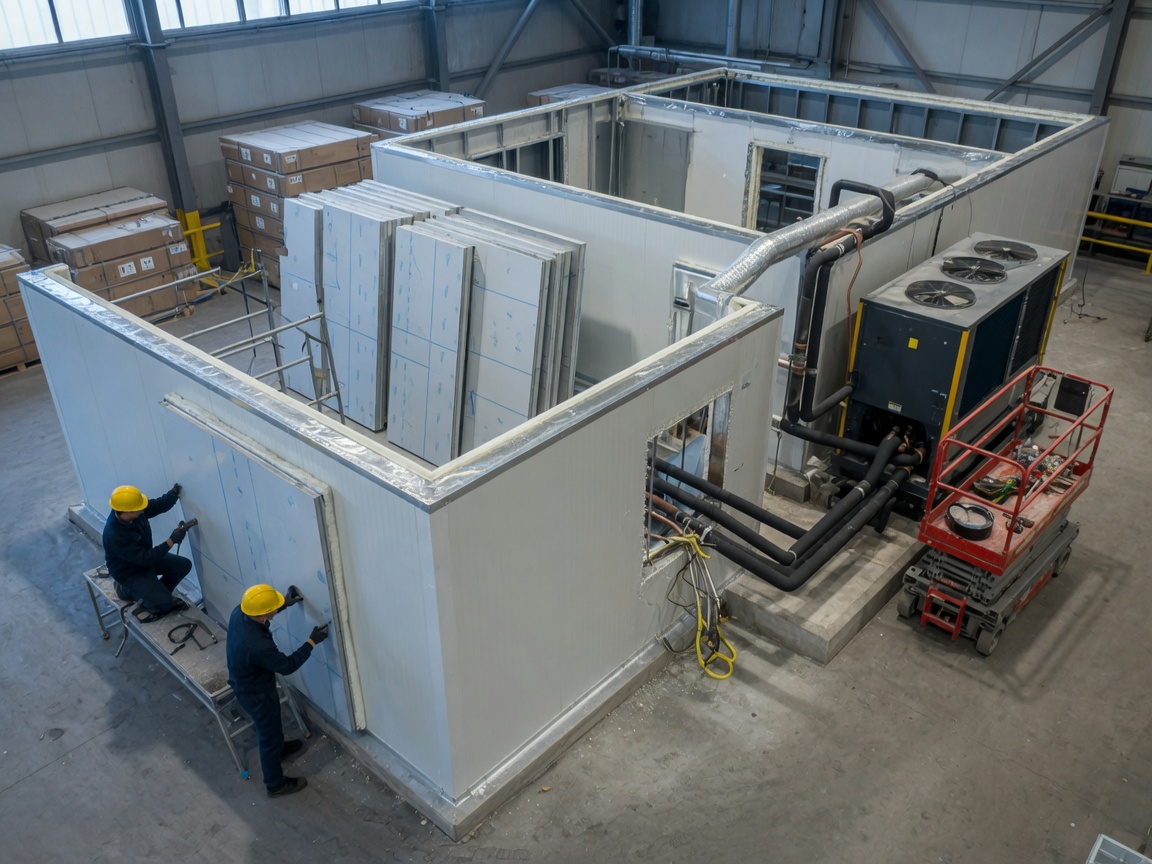
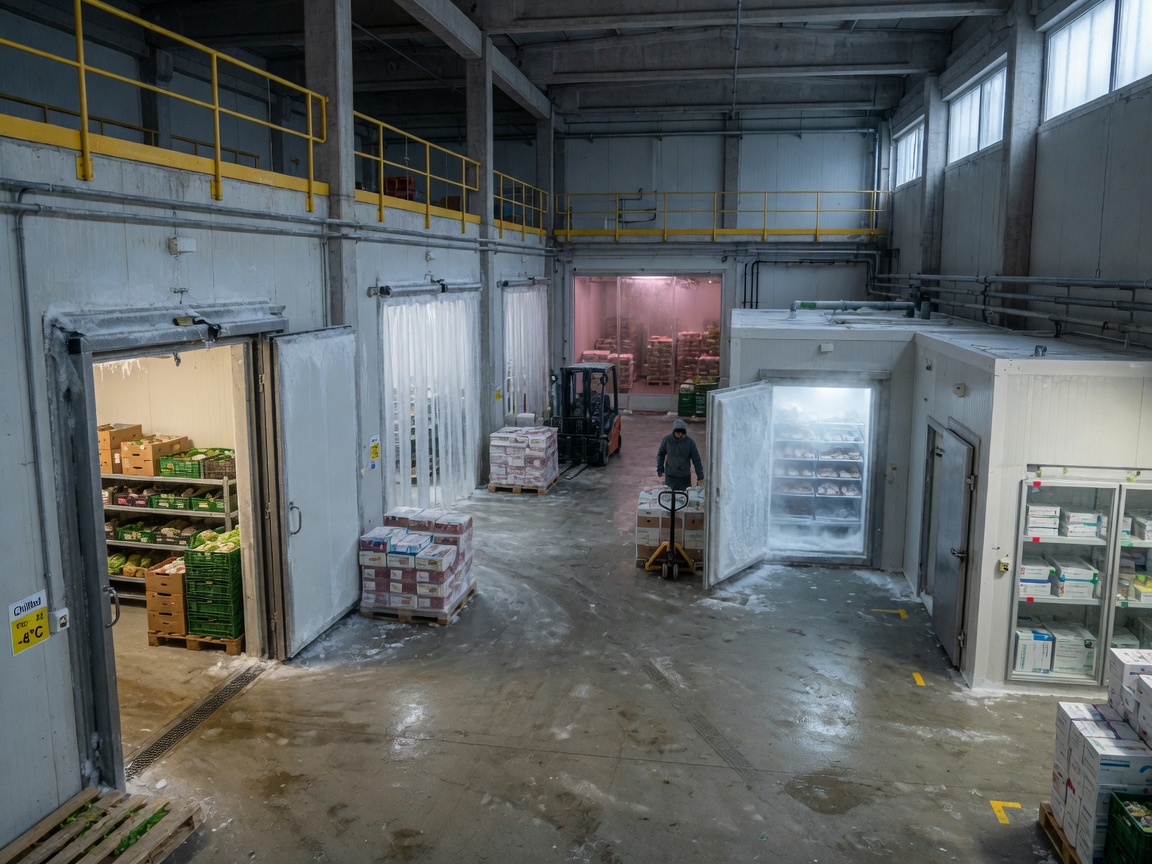
A walk-in meat freezer is the most versatile large-capacity freezer option for U.S. operations. Modular insulated panel construction allows custom sizing from 6×8 feet for a small freezer for butcher shop applications up to 10,000+ square feet for a full meat cold storage unit at a distribution center. Standard mid-sized restaurant configurations run 8×10 feet. These units function equally well as a meat locker for aging operations or as a bulk meat storage freezer for high-turnover distribution — the same physical structure serves multiple use profiles depending on the refrigeration unit spec attached to it.
Blast freezer for meat, spiral, tunnel, and plate types
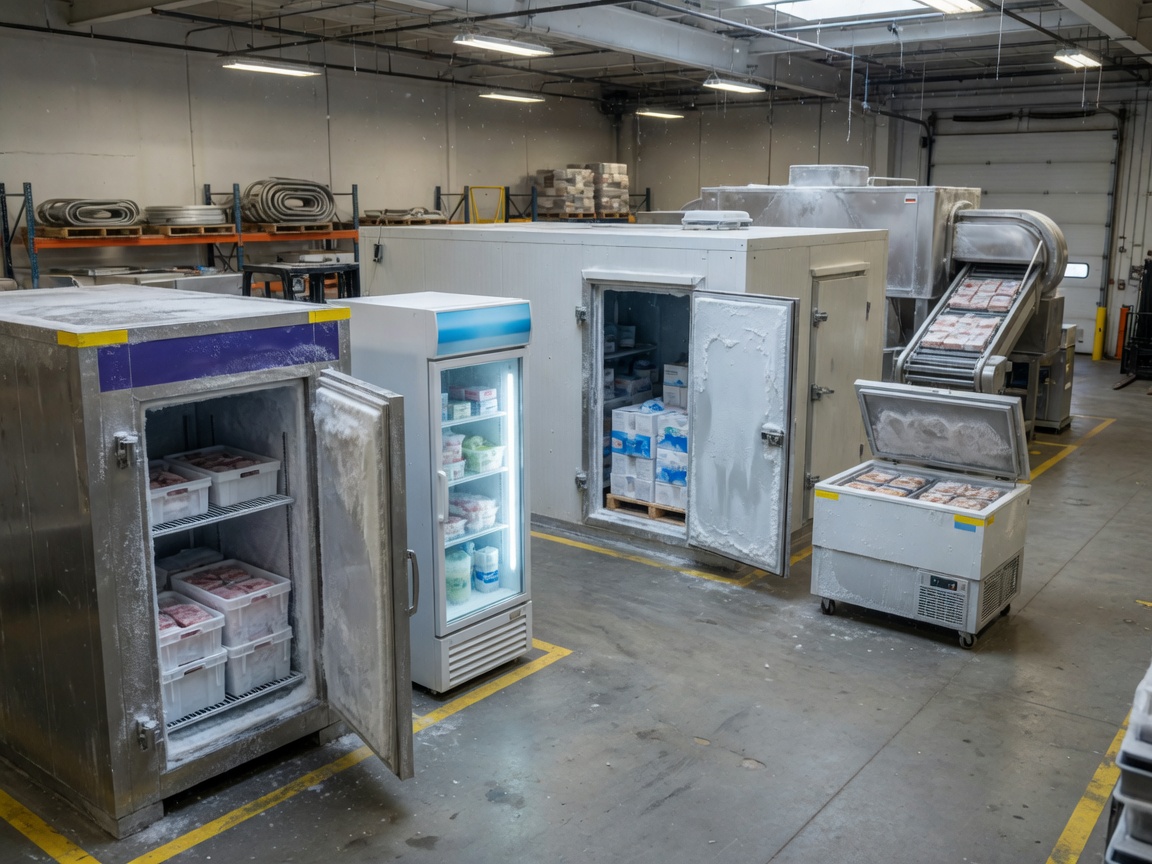
A blast freezer for meat drives high-velocity cold air across product surfaces to achieve rapid core temperature reduction — critical for food safety and texture quality reasons covered in the next section. Spiral freezers handle 500–15,000 lbs/hr and are purpose-built for continuous high-volume production lines processing burgers, nuggets, and portioned cuts. Tunnel/belt freezers offer linear throughput well suited to uniform flat products. Plate freezers — also called contact freezers — press product between refrigerated metal plates, achieving very low energy-per-pound costs (0.04–0.07 kWh/lb) and compact footprints, making them ideal for fish blocks and ground meat slabs. Cryogenic freezers using liquid nitrogen or CO₂ achieve the fastest freeze rates of any technology but carry ongoing consumable supply costs that must be factored into TCO.

| Type | Throughput | Temp range | Energy (kWh/lb) | Price range (USD) | Best fit |
|---|---|---|---|---|---|
| Walk-in blast freezer | 500–20,000 lb/day | 0°F to -40°F | 0.08–0.14 | $8,000–$120,000 | Butcher shops, processors, distribution |
| Spiral freezer | 500–15,000 lb/hr | -10°F to -40°F | 0.07–0.12 | $80,000–$600,000 | High-volume continuous production lines |
| Tunnel / belt freezer | 200–8,000 lb/hr | -10°F to -35°F | 0.08–0.13 | $40,000–$300,000 | Flat portioned cuts, patties, fish fillets |
| Plate / contact freezer | 100–5,000 lb/hr | -4°F to -40°F | 0.04–0.07 | $15,000–$200,000 | Ground meat blocks, uniform slabs |
| Cryogenic (LN₂/CO₂) | 20–3,000 lb/hr | -100°F to -40°F | N/A (consumable cost) | $12,000–$180,000 | High-value proteins, delicate textures |
| Chest freezer for meat | Static storage | 0°F to -10°F | 0.03–0.05 | $500–$4,000 | Small butcher shops, entry-level retail |
Blast freezing vs. conventional freezing: meat quality and profitability
This is the technical distinction that most buying guides skip entirely — and it directly affects your bottom line. Blast freezing using IQF (Individual Quick Freeze) technology freezes product so rapidly that water molecules form micro-crystalline structures rather than large ice crystals. Large ice crystals, produced by slow conventional freezing, physically rupture muscle fiber cell walls. When the product thaws, that ruptured cellular structure releases moisture — called drip loss or purge loss — at rates of 5% to 12% of product weight.
IQF technology: the financial impact on processors
Why does this matter commercially? Consider a mid-sized processor moving 10,000 lbs of frozen beef per day. At a 7% drip loss from slow freezing versus a 1.5% drip loss from IQF blast freezing, the difference is 550 lbs of sellable product — every single day. At $4.50/lb wholesale beef value, that is $2,475 in daily revenue leakage. Over a 250-day operating year, the number reaches $618,750. That figure reframes the capital cost of a $150,000 spiral blast freezer entirely. Actual testing on beef chuck rolls in 2026 USDA-cited processing facilities confirms IQF drip loss rates of 1.2%–2.1%, versus 6%–11% for conventional chest freezer or slow-walk-in methods.
Texture, moisture retention, and consumer perception
Beyond weight loss, IQF-frozen meat consistently scores higher on post-thaw texture evaluations. Intact muscle fiber structure means firmer bite, better moisture retention during cooking, and improved appearance at the retail case — all measurable factors in consumer repurchase behavior. Of course, there are situations where IQF investment is not justified: very small-volume operators or those freezing products for long-term aging rather than rapid sale cycles may find a properly managed meat aging freezer in a conventional walk-in meets their needs without the capital outlay of full IQF equipment.
"The rate of freezing is the single most important variable in determining frozen meat quality at point of sale. Operations that treat freezing speed as a secondary specification consistently underperform on yield and customer returns." — USDA Agricultural Marketing Service, Meat Grading and Certification Branch technical guidelines (referenced in 2026 cold chain compliance reviews)
HACCP, USDA, and FDA compliance requirements
Compliance is not optional. It is also more layered than most equipment vendors acknowledge during the sales process. U.S. meat cold storage operations must satisfy requirements from multiple overlapping regulatory frameworks simultaneously.
FDA Food Code and USDA FSIS temperature mandates
The FDA Food Code requires all frozen food to be maintained at 0°F (-18°C) or below. USDA FSIS regulations under 9 CFR Part 381 (for poultry) and 9 CFR Part 318 (for red meat) mandate continuous temperature monitoring and documentation at USDA-inspected establishments. This is not a spot-check requirement — it is continuous logging. Any industrial refrigeration unit installed in a USDA-inspected facility must interface with a temperature data logging system capable of producing audit-ready records. Equipment that lacks this capability will fail inspection. For comprehensive guidance on food safety and cold storage guidelines, the FDA's HACCP principles documentation outlines the critical control point framework that governs temperature management in U.S. meat facilities.
HACCP critical control points and equipment specifications
Under HACCP protocol, freezer temperature is a Critical Control Point (CCP) with defined critical limits, monitoring procedures, corrective actions, and verification requirements. Practically, this means your freezer must maintain set-point temperature under maximum operational load — not just at idle. A unit that holds -10°F in an empty state but drifts to +5°F during peak loading fails its CCP. Procurement teams should request documented pull-down performance data from vendors under full load conditions, not just the nameplate temperature specification. NSF/ANSI Standard 7 certification confirms that the interior materials and construction meet food zone contact and cleanability standards required in USDA and FDA-regulated environments. Additionally, facilities processing ready-to-eat products must comply with FSMA Preventive Controls rules, which include environmental monitoring and equipment sanitation requirements that affect freezer interior design selection — smooth-weld stainless interiors are not cosmetic preferences, they are audit-driven specifications.
Walk-in meat freezer installation and build-out cost guide
Walk-in units dominate U.S. commercial meat storage procurement, yet installation costs are consistently underestimated. Purchase price covers the panel kit and refrigeration system. It does not cover electrical work, floor reinforcement, drain installation, permit fees, or contractor labor — which collectively can equal or exceed the equipment cost itself.
Square-footage-based cost estimates for U.S. buyers
Based on real U.S. contractor quotes from 2025–2026, here are realistic total installed cost ranges by unit size. A standard 8×10 ft walk-in (80 sq ft), appropriate for a mid-volume freezer for butcher shop use, runs $12,000–$28,000 all-in, including the refrigeration unit, electrical panel upgrade to 3-phase, drain line, and installation labor. A medium 10×20 ft unit (200 sq ft) suitable for a restaurant group or small food processor runs $28,000–$65,000 installed. Large commercial cold storage configurations at 400–1,000 sq ft range from $65,000 to $180,000 depending on insulation spec (R-32 vs. R-40), refrigerant choice, and local permitting complexity. Industrial freezer storage rooms exceeding 2,000 sq ft enter custom design territory; budget $180,000 to $500,000+ for a fully spec'd, permit-approved installation.
Contractor selection tips for U.S. walk-in installations
Select only contractors holding both EPA 608 certification (required for refrigerant handling) and active state mechanical contractor licensing. Request at least two completed walk-in references in food processing or butcher shop environments — residential refrigeration experience does not translate to commercial food zone requirements. Verify that the contractor is familiar with your local health department's plan review process; many U.S. jurisdictions require pre-installation plan submission for any walk-in freezer in a food establishment. Skipping this step routinely leads to costly change orders after rough-in work is complete.
Total cost of ownership: 5-year TCO analysis
Purchase price is the least meaningful number in any serious equipment evaluation. What actually determines financial performance is five-year TCO — the sum of acquisition cost, installation, energy consumption, refrigerant service, preventive maintenance, and unplanned repair costs across the operational life of the unit.
Energy consumption benchmarks by freezer type
A standard 10×12 ft walk-in blast freezer operating in the U.S. Midwest consumes approximately 40–65 kWh per day under typical loading conditions. At the 2026 U.S. commercial electricity average of $0.12/kWh, that represents $1,752–$2,847 in annual energy cost per unit. A spiral freezer running continuous production draws 150–400 kWh/day — $6,570–$17,520 annually. These figures shift materially based on ambient temperature: a unit in Phoenix, AZ working against 110°F summer ambient temperatures will consume 20–35% more energy than the same unit in Minneapolis. Commercial freezer energy standards from ENERGY STAR provide certified benchmarks; units carrying the ENERGY STAR label typically reduce consumption 10–20% versus non-certified equivalents.
5-year maintenance and refrigerant cost estimates
Refrigerant refills are a frequently overlooked TCO line item. Systems using R-404A or R-448A typically require 2–5 lb top-off per year at $15–$30/lb refrigerant cost plus $150–$300 service call labor. Over five years, budget $1,500–$4,000 for refrigerant maintenance on a mid-sized walk-in. Units transitioning to natural refrigerants (NH₃ or CO₂) have higher initial installation costs but near-zero ongoing refrigerant expense. Preventive maintenance contracts from U.S. service networks typically run $800–$2,500/year for commercial walk-in units, covering coil cleaning, gasket inspection, and compressor service. Factor in one unplanned repair event of $1,500–$4,000 as a statistical probability within any five-year window. Total five-year TCO for a properly maintained 10×12 walk-in blast freezer in the U.S.: $45,000–$95,000 all-in, depending on energy costs, refrigerant type, and local service rates.
Brand comparison: Manitowoc, Nor-Lake, Arctic Industries, and Bally
No competing guide in the U.S. market currently provides a side-by-side comparison of these four brands with current lead times, warranty terms, and service network data. Based on 2026 dealer network information and procurement intelligence gathered from U.S. food processing sourcing contacts, here is the honest comparison.
Side-by-side brand specifications and availability
| Brand | Product focus | Typical lead time (U.S.) | Warranty (compressor) | U.S. service network | Price position |
|---|---|---|---|---|---|
| Manitowoc | Walk-in systems, food processing freezer | 6–14 weeks | 5 years | National (350+ dealers) | Premium |
| Nor-Lake | Walk-in meat locker, cold storage panels | 4–10 weeks | 3 years | National (200+ dealers) | Mid-range |
| Arctic Industries | Heavy-duty freezer, custom walk-in builds | 5–12 weeks | 3 years (parts) | Southeast/national expansion | Mid-range |
| Bally Refrigerated Boxes | Industrial cold room, large-scale meat preservation equipment | 8–18 weeks | 5 years | National (factory-direct + reps) | Premium |
How to select based on your procurement priorities
Manitowoc and Bally are the preferred specifications for USDA-inspected processing facilities where warranty depth and national service coverage justify the premium. Nor-Lake delivers strong value for mid-volume butcher shop and restaurant-group applications where lead time flexibility and cost management are the primary drivers. Arctic Industries is worth evaluating for large custom walk-in projects in the Southeast, where their factory proximity reduces freight damage risk and shortens response times for service calls. Always verify current dealer-stocked inventory versus factory-order lead times before committing to a timeline — 2026 supply chain conditions have compressed some lead times but extended others depending on refrigerant availability and compressor sourcing.
2026 buying trends: IoT monitoring and natural refrigerants
Two trends are reshaping what U.S. buyers should specify in 2026. Ignoring either one risks purchasing equipment that is operationally or regulatorily obsolete within three to five years.
IoT integration and smart temperature monitoring
Remote temperature monitoring, cloud-based data logging, and predictive maintenance alerts have moved from premium add-ons to standard specification requirements among large U.S. food processors and grocery distribution chains. The practical driver is HACCP documentation: automated continuous logging eliminates the manual temperature log compliance gap that remains a leading cause of FDA warning letters in food facilities. Systems like Monnit, Sensaphone, and integrated OEM solutions now provide real-time alerts, audit-ready export formats, and energy consumption dashboards accessible from any mobile device. When evaluating an industrial refrigeration unit in 2026, confirm whether the unit's controller outputs to open-protocol data streams (Modbus, BACnet, or API) or is locked to a proprietary monitoring subscription. For additional context on how industrial refrigeration for food storage has evolved in cold chain applications, the engineering principles transfer directly to stationary processing environments.
Natural refrigerants: NH₃ and CO₂ systems
The phasedown of high-GWP HFC refrigerants under the AIM Act — the U.S. equivalent of the EU F-Gas regulation — is accelerating natural refrigerant adoption in 2026. Ammonia (NH₃) and transcritical CO₂ systems now represent the preferred specification for new-construction industrial meat freezer installations above 10,000 sq ft. Ammonia offers superior thermodynamic efficiency and zero GWP, but requires OSHA Process Safety Management (PSM) compliance above 10,000 lb charge thresholds. CO₂ transcritical systems carry lower regulatory burden and are increasingly cost-competitive in cold-climate U.S. locations. For smaller operations, low-GWP HFO blends (R-448A, R-449A) represent a pragmatic transition bridge without the infrastructure demands of natural refrigerant systems. Procurement managers specifying new equipment in 2026 should request a refrigerant roadmap from vendors — any supplier who cannot articulate their 2030 refrigerant strategy is a procurement risk.
Frequently asked questions
Q: What temperature should an industrial meat freezer maintain?
A: The FDA Food Code mandates 0°F (-18°C) or below for all frozen food storage. USDA FSIS guidance for inspected meat facilities requires this temperature to be maintained under operational load, not just at idle. For blast freezing operations, pull-down to -10°F within a defined time window is the HACCP critical limit. Always verify performance with a calibrated independent thermometer, not solely the unit's built-in display.
Q: How much does a walk-in meat freezer cost to install in the U.S.?
A: Total installed cost ranges from $12,000–$28,000 for a standard 8×10 ft unit to $65,000–$180,000 for a 400–1,000 sq ft commercial cold storage installation. These figures include equipment, electrical upgrade, drain installation, and contractor labor. Permit fees and floor reinforcement add $1,000–$8,000 depending on jurisdiction.
Q: Is a walk-in freezer or a chest freezer better for a butcher shop?
A: For any butcher shop storing more than 300–400 lbs of frozen product regularly, a walk-in meat freezer delivers better inventory access, more consistent temperature under loading, and easier HACCP documentation. A chest freezer for meat is adequate only for very small-volume operations or supplemental overflow storage where access frequency is low.
Q: Does an industrial meat freezer need NSF certification?
A: Yes, for any unit installed in a U.S. food establishment subject to health department inspection. NSF/ANSI Standard 7 certification confirms interior materials, welds, and construction meet food zone contact and cleanability standards. USDA-inspected facilities additionally require equipment approval through USDA FSIS Accepted Equipment lists.
Q: What is IQF freezing and why does it matter for meat processors?
A: IQF (Individual Quick Freeze) technology freezes product rapidly enough to form micro ice crystals rather than large ice crystals, preventing cell wall rupture. This reduces drip loss at thaw from 6–11% (slow freezing) to 1.2–2.1%, preserving sellable weight and improving post-thaw texture. For high-volume processors, the yield recovery from IQF blast freezing can generate hundreds of thousands of dollars in annual revenue retention.
Common questions about industrial meat freezers
Q: What is the difference between an industrial meat freezer and a commercial freezer?
A: An industrial meat freezer is engineered for continuous heavy-duty operation — 18+ hour daily duty cycles, 3-phase power, reinforced R-32 to R-40 insulation, and HACCP-compliant temperature logging. A standard commercial freezer is designed for intermittent use in a restaurant or retail environment and lacks the compressor sizing, insulation depth, and compliance interfaces required in a USDA-inspected processing facility.
Q: How long do industrial meat freezers last?
A: With proper preventive maintenance — annual coil cleaning, quarterly gasket inspection, and timely refrigerant service — a well-specified industrial refrigeration unit from a major brand should deliver 15–20 years of service life. Compressors are typically warranted for 3–5 years; insulated panels often carry 10-year manufacturer warranties on thermal performance.
Q: What refrigerant should I specify for a new industrial meat freezer in 2026?
A: For new installations, specify low-GWP HFO blends (R-448A or R-449A) as a minimum, or natural refrigerants (NH₃ or CO₂) for large-scale systems. Avoid specifying R-404A in any new equipment — it is subject to ongoing AIM Act phasedown restrictions and will carry increasing cost and supply risk through 2030.
Q: Can I use a food processing freezer for meat aging?
A: Dry aging requires precise temperature control (34°F–38°F), humidity management (75%–85% RH), and consistent airflow — conditions that differ significantly from blast freezing specifications. A dedicated meat aging freezer with independent humidity control and variable-speed fan management is the correct equipment for aging applications. Standard blast freezers operating at sub-zero temperatures are not suitable for aging protocols.
Final recommendations
Selecting the right industrial meat freezer in 2026 requires matching freezer type to operational throughput, specifying NSF/ANSI 7 and HACCP-compliant temperature logging as non-negotiable requirements, and calculating five-year TCO rather than anchoring on purchase price alone. The blast freezing versus conventional freezing decision carries direct P&L impact for any operation moving meaningful volume — the yield math is unambiguous. Walk-in build-out costs are predictable when scoped correctly; the mistake is treating installation as an afterthought rather than a line item in the original budget. On brand selection, Manitowoc and Bally are the defensible premium choices for inspected processing facilities. Nor-Lake and Arctic Industries deliver strong value-to-spec ratios for mid-volume applications. Whatever brand you select, verify current authorized dealer service network coverage in your specific geography before signing a purchase order — equipment warranty is only as good as the technician who can respond to an after-hours compressor failure in your city.
Keywords:
Inquiry
If you are interested in our products, please leave your email to receive a free product quote, thank you!
More information

Tel:
Sales E-mail: