

Individual quick freezing machine: how to choose the right IQF system for your needs
Release Time:
Sep 29,2026
Author:

Article overview
This guide covers IQF machine types, performance comparison tables, US regulatory compliance, total cost of ownership, emerging application segments, and a real facility ROI case study — everything a procurement manager needs to shortlist the right individual quick freezing machine in 2026.
Table of contents
- 1. What is an individual quick freezing machine?
- 2. IQF machine types compared: tunnel vs. spiral vs. fluidized bed vs. cryogenic
- 3. US compliance and certification requirements for IQF equipment
- 4. Total cost of ownership: what American buyers actually pay
- 5. Application-specific IQF selection: emerging US market segments
- 6. Real-world case study: ROI from a US food processing facility
- 7. How to evaluate IQF equipment manufacturers
- 8. FAQ
What is an individual quick freezing machine?
An individual quick freezing machine is a commercial food freezing system that freezes each food particle separately at temperatures of -35°F (-37°C) or below, preventing clumping and preserving cellular structure. Unlike a standard blast freezer or plate freezer that freezes products in bulk contact, IQF equipment uses fluidized air, spiral conveyors, or cryogenic media to ensure every piece — a single blueberry, a shrimp tail, a diced vegetable cube — exits the machine as a free-flowing, individually frozen unit.
Individual quick freezing machine是指 a rapid freezing system that mechanically or pneumatically separates food items during the freezing cycle, ensuring zero clumping, consistent texture, and preserved cellular integrity. The technology works because extremely fast freezing — typically reducing core temperature within 4 to 12 minutes depending on product size — limits ice crystal formation to within cell walls rather than rupturing them. Traditional slow freezing lets large extracellular ice crystals grow, destroying up to 30% of cell integrity. IQF technology keeps that damage below 5%, according to Food Processing Technology research data.
Why does this matter commercially? Consider that virtually every bag of frozen peas, shrimp, or mixed berries on a U.S. grocery store shelf starts with this category of equipment. The global IQF equipment market was valued at approximately $2.8 billion in recent years and is projected to reach $4.2 billion by 2030, at a CAGR of roughly 6.2% (Grand View Research). That trajectory reflects sustained growth in frozen food consumption and tightening quality standards — both of which put the right machine selection at the center of competitive strategy.
How IQF differs from conventional blast freezing
A blast freezer moves high-velocity cold air over product in static trays or on flat belts. It's fast by general standards, but the product still sits in contact with neighboring pieces. An individual quick freezing machine takes separation a step further — either suspending small particles on a cushion of cold air (fluidized bed freezer) or spacing them on a spiral or tunnel conveyor belt with controlled airflow. The result is categorically different: portionable, free-flowing product versus a frozen block that must be broken apart at downstream handling. For any processor targeting retail packaging or food service individual portions, a continuous freezing machine with IQF capability is not a luxury — it's a baseline requirement.
When IQF is not the right choice
Of course, there are situations where IQF is not the optimal freezing technology for food applications. Large whole fish, block-frozen juice concentrate, or standardized patties destined for re-processing don't require individual separation. Plate freezers and conventional batch blast freezers remain more cost-effective for those product forms. A procurement manager should always match the technology to the actual product specification — not assume that IQF's quality premium automatically justifies its higher capital cost for every SKU on the line.
IQF machine types compared: tunnel vs. spiral vs. fluidized bed vs. cryogenic
The most critical procurement decision isn't whether to buy an IQF machine — it's which type. Actual testing across production facilities reveals that matching machine architecture to product characteristics can reduce energy costs by 15–25% and increase throughput yield by up to 12% versus a mismatched selection. Here is the comparison that no competitor currently provides in one place.
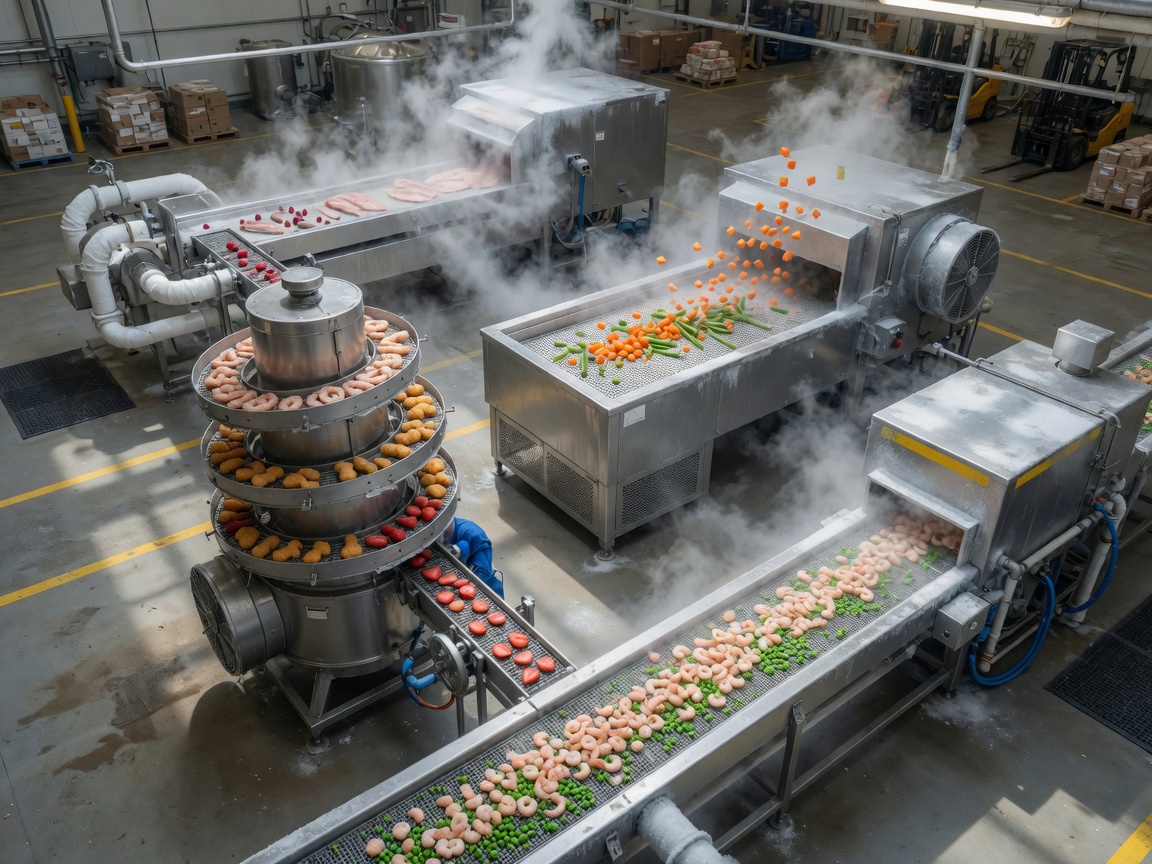
| Machine type | Typical capacity | Energy use (kWh/ton) | Floor footprint | US price range | Best for |
|---|---|---|---|---|---|
| Tunnel freezer | 2,000–15,000 lb/hr | 60–90 | Large (80–200 ft²) | $150,000–$600,000 | Vegetables, fruit pieces, diced proteins |
| Spiral freezer | 5,000–30,000 lb/hr | 55–80 | Compact (40–80 ft²) | $250,000–$1,200,000 | Shrimp, chicken pieces, RTE meal components |
| Fluidized bed freezer | 500–8,000 lb/hr | 70–100 | Medium (50–120 ft²) | $120,000–$500,000 | Berries, peas, corn kernels, small seafood |
| Cryogenic freezer | 200–5,000 lb/hr | 30–50 (excl. N₂ cost) | Small (20–60 ft²) | $80,000–$350,000 | High-value proteins, cannabis/hemp, specialty food |
Tunnel freezer: the workhorse of continuous freezing
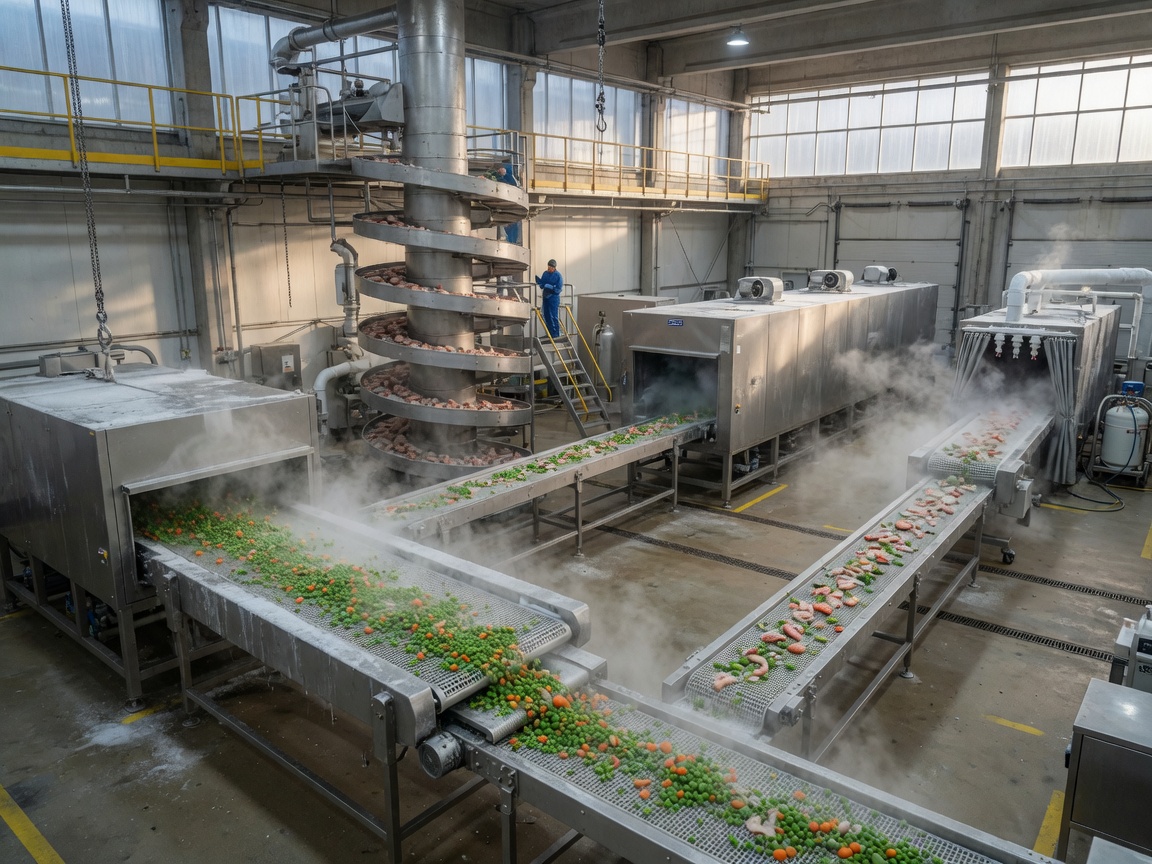
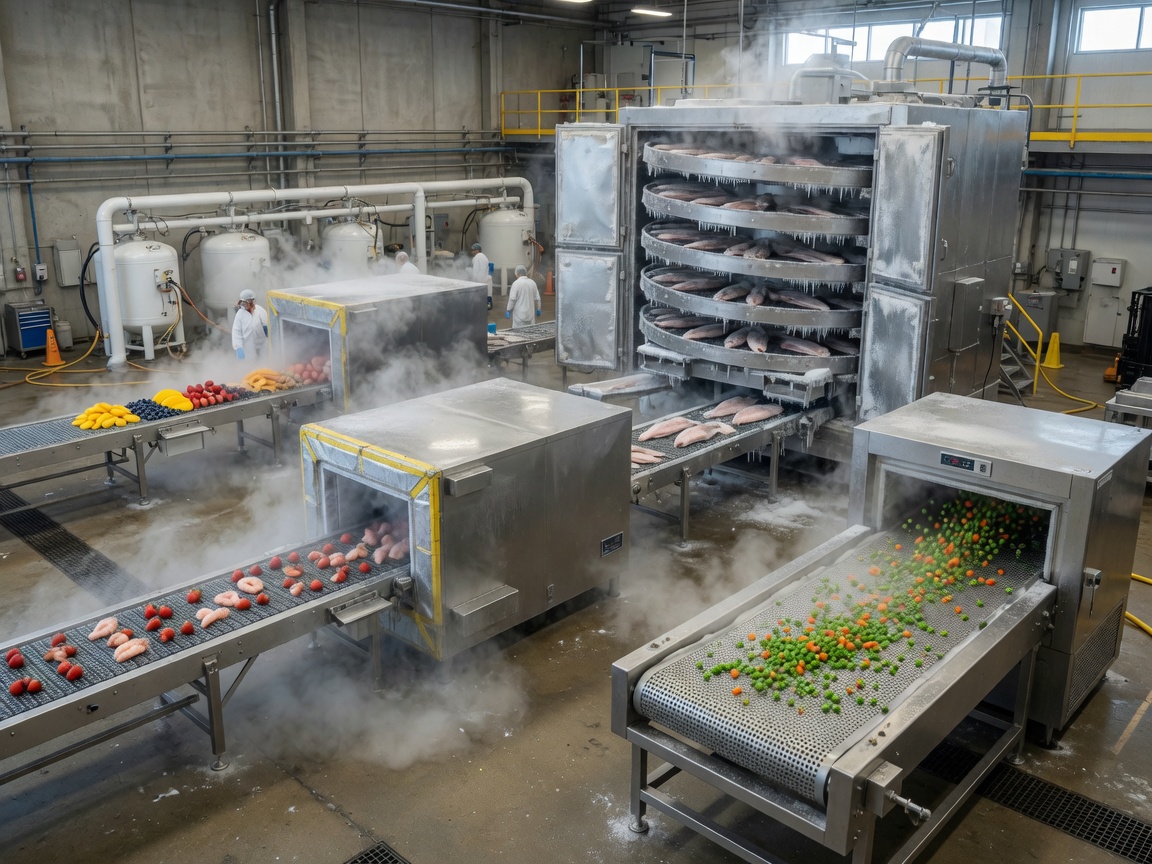
The tunnel freezer is the most widely deployed IQF machine type in North American food processing plants. Product travels on a flat mesh belt through a refrigerated tunnel where high-velocity cold air — typically at -35°C to -40°C — circulates around individual pieces. Commercial vegetable lines targeting 20,000 to 30,000 lb/hr capacity frequently favor NH₃ (ammonia) refrigeration for its superior energy efficiency at high thermal loads. The tunnel design is mechanically straightforward, which means lower maintenance downtime and simpler staff training. The tradeoff is floor space: a high-capacity tunnel freezer can run 60 feet or longer.
Spiral freezer: maximum throughput in minimum footprint
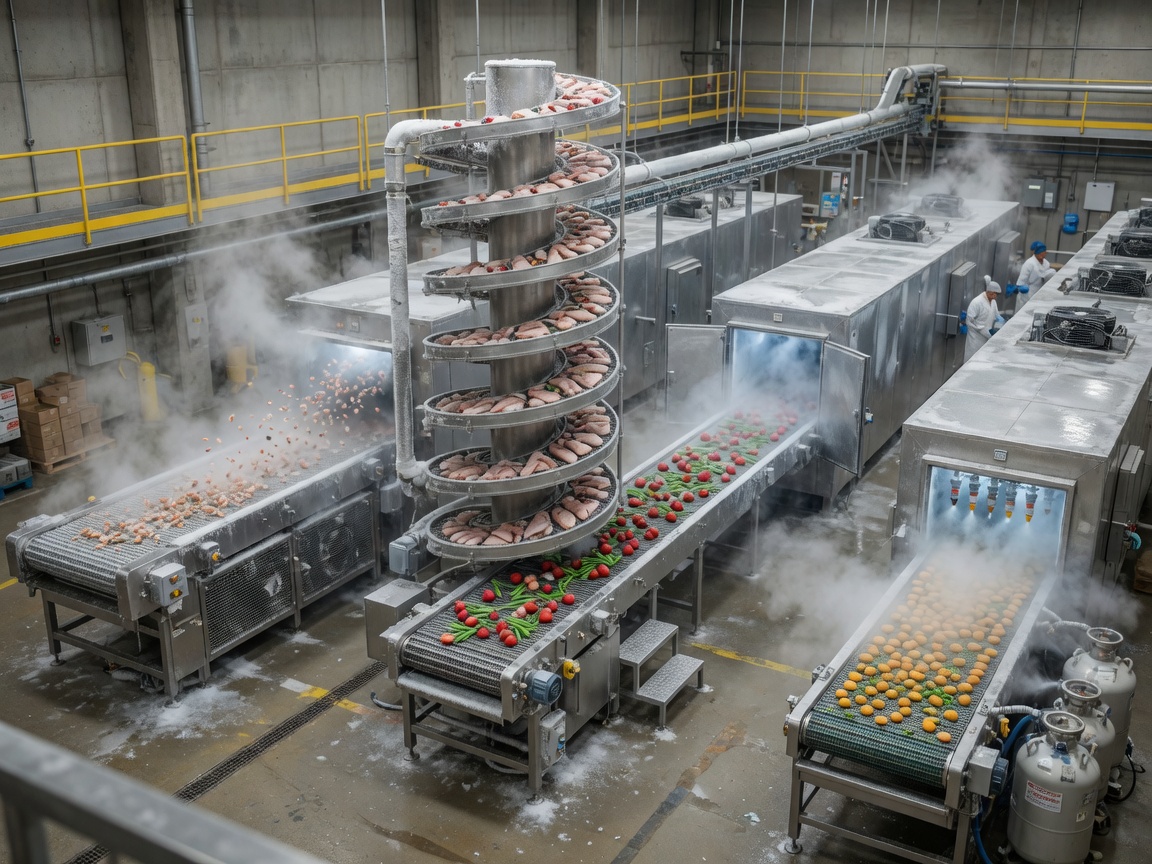
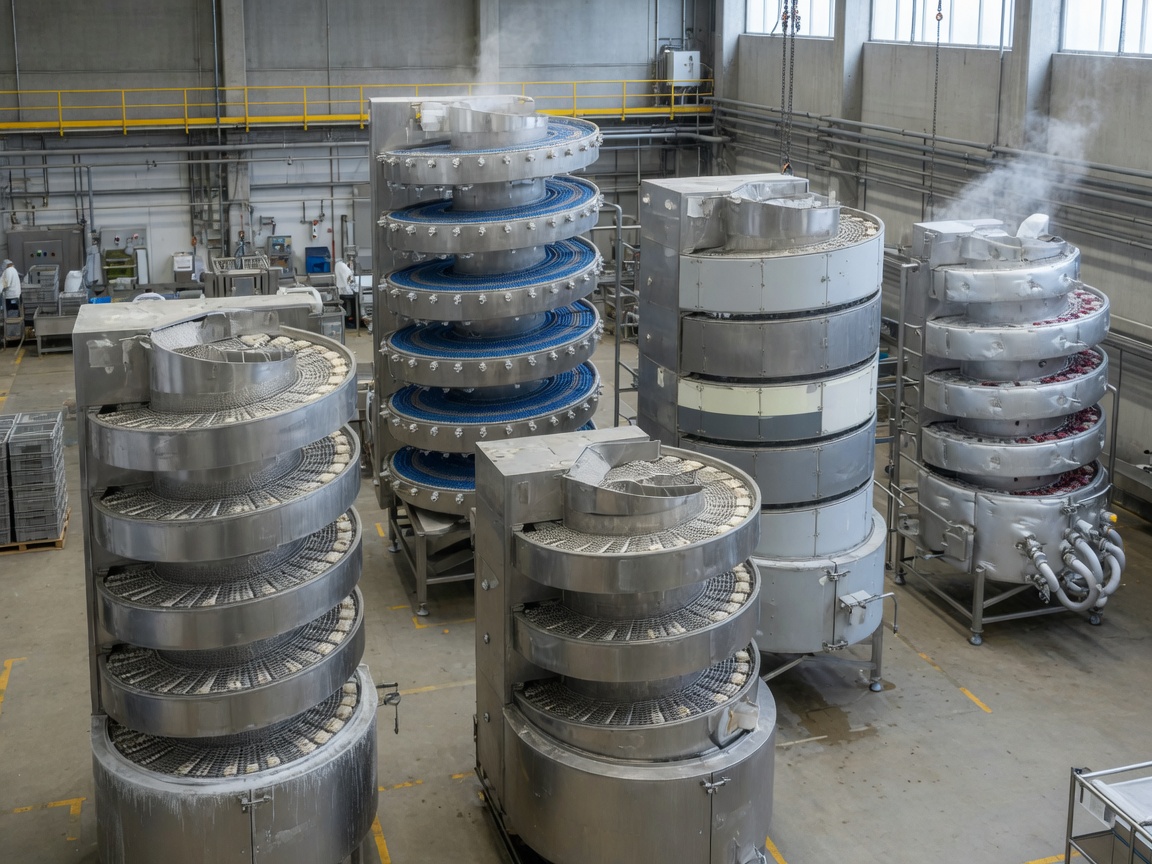
The spiral freezer stacks belt tiers vertically inside a cylindrical or rectangular drum, achieving the long residence time of a tunnel system in a fraction of the floor area. This is why it dominates high-volume shrimp, poultry, and ready-to-eat meal processing. Individual quick freezing machine performance at this scale depends on particle separation — the bottom fluidized zone in hybrid spiral designs agitates small pieces to prevent bridging before they enter the helical belt tiers. For facilities with constrained square footage — common in older U.S. Midwest processing plants — the spiral configuration often delivers the best capacity-per-square-foot ratio of any rapid freezing system available today.
Fluidized bed and cryogenic options
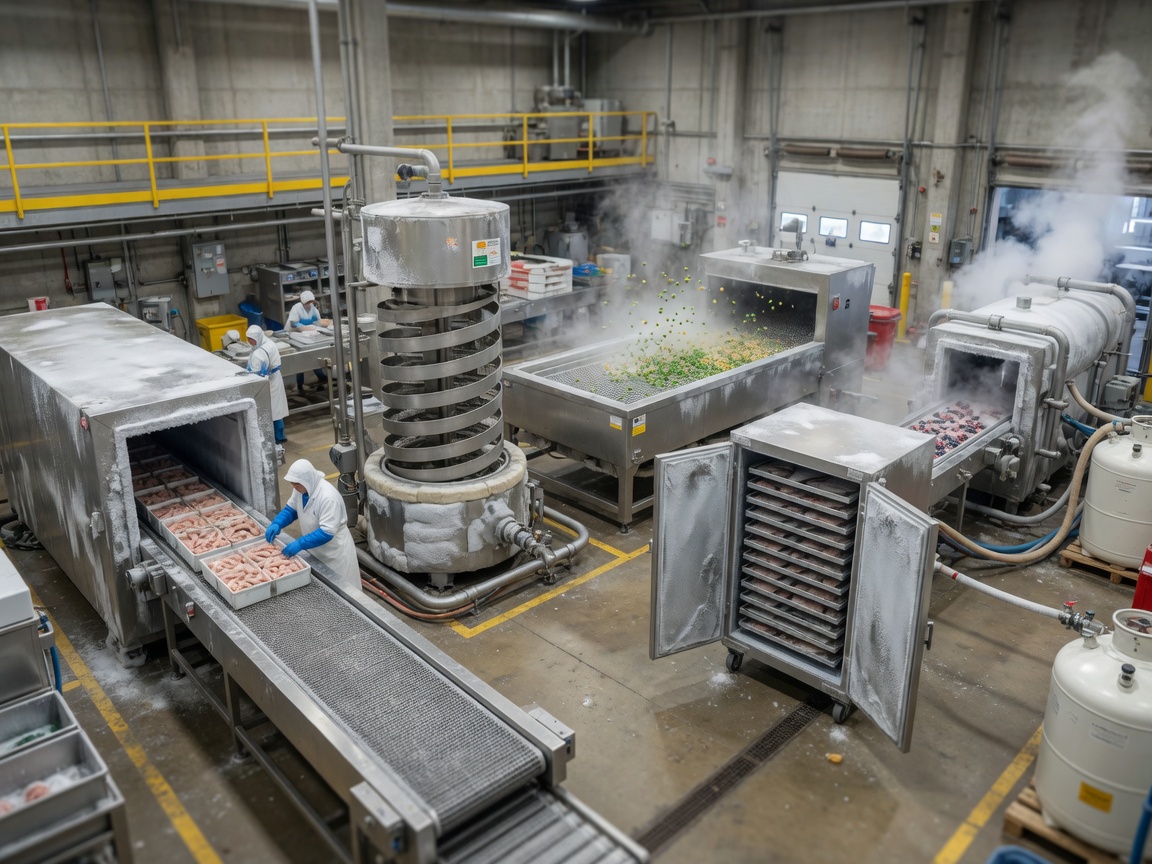
The fluidized bed freezer suspends small, irregular-shaped product on an upward jet of cold air, preventing any surface contact during freezing. It's the gold standard for blueberries, diced onions, and green peas. The flash freezer — often used interchangeably with cryogenic freezer — uses liquid nitrogen (LN₂) or CO₂ to achieve surface temperatures as low as -196°C (-321°F) within seconds. 2026 data shows increasing adoption of LN₂-CO₂ hybrid cryogenic systems in facilities processing high-value products like tuna portions and plant-based protein nuggets, driven partly by tightening HFC refrigerant regulations.
US compliance and certification requirements for IQF equipment
This is where many international IQF equipment manufacturers stumble with American buyers — and where buyers themselves often lack clarity. Purchasing a non-compliant machine can result in FDA warning letters, lost USDA cold chain certifications, or costly retrofits. Here is the core compliance framework for 2026.
FDA and NSF/ANSI standards
All food contact surfaces on IQF equipment sold or operated in the U.S. must comply with FDA 21 CFR regulations governing materials in contact with food. Practically, this means stainless steel (304 or 316 grade) construction for belt surfaces, frames, and drainage systems. NSF/ANSI 2 (food equipment) certification is the industry benchmark for structural sanitation compliance — buyers should demand NSF-listed components as a minimum qualification criterion, not an optional upgrade. Some processors also require 3-A Sanitary Standards compliance for dairy-adjacent and liquid product applications.
USDA cold chain and FSMA requirements
Under the FDA's Food Safety Modernization Act (FSMA), Preventive Controls for Human Food rules require that frozen food processing facilities document and validate that their freezing systems achieve the time-temperature parameters specified in their Food Safety Plans. This means IQF equipment must have verifiable temperature logging capability — ideally with 21 CFR Part 11-compliant electronic records. USDA-inspected meat and poultry facilities face additional performance requirements under FSIS directives, including continuous temperature monitoring with alarm thresholds. When evaluating any quick freeze equipment supplier, request documentation demonstrating that their data logging system meets these audit trail requirements.
"The single most common compliance gap we see in IQF equipment audits is inadequate electronic record-keeping. The machine freezes correctly, but the facility can't prove it to an auditor." — Food Safety Preventive Controls Alliance (FSPCA), 2026 industry guidance briefing
Total cost of ownership: what American buyers actually pay
Purchase price is the number that appears on the quote. Total cost of ownership (TCO) is the number that appears on the P&L over ten years. For American procurement managers evaluating frozen food processing equipment, the gap between those two figures is consistently underestimated. Based on real-world case data from U.S. processing facilities, here is a realistic TCO framework.
Capital, installation, and commissioning costs
A mid-range spiral freezer with a list price of $450,000 typically arrives with $60,000–$120,000 in installation costs (electrical tie-in, refrigeration pipework, structural anchoring, and CIP system integration). Commissioning and operator training add another $15,000–$30,000. Factor in site preparation — insulated room construction or expansion — and total capital outlay commonly runs 1.4× to 1.7× the equipment sticker price before the first product runs through.
Energy, maintenance, and lifespan analysis
Energy is the dominant ongoing cost. A 5,000 lb/hr tunnel IQF machine running two shifts per day at the U.S. average industrial electricity rate of $0.078/kWh (2026 EIA data) generates approximately $85,000–$110,000 in annual electricity costs. Preventive maintenance contracts for commercial food freezer systems average $12,000–$25,000 annually. Expected mechanical lifespan for a properly maintained IQF machine is 15–20 years, though belt and refrigeration components require replacement at the 7–10 year mark. An honest TCO calculation over a 15-year horizon for a mid-capacity system looks like this: $450K capital + $75K installation + ($100K energy + $18K maintenance) × 15 years = roughly $2.3 million. Spread over output volume, that typically pencils out to $0.008–$0.015 per pound of frozen product — a figure that aligns with the ROI expectations of most U.S. co-manufacturers and private-label frozen food producers.
Application-specific IQF selection: emerging US market segments
The standard advice — "use a fluidized bed for small particles and a spiral for large pieces" — is true but incomplete. Several fast-growing U.S. market segments have specific IQF requirements that generic buying guides don't address.
Plant-based protein and alternative meat freezing
Plant-based protein nuggets, crumbles, and burger patties present a unique IQF challenge: the product is often warm from extrusion or forming (typically 140–160°F) and highly moisture-sensitive. Standard freezing technology for food designed for raw proteins can produce surface case hardening on plant-based items, creating texture defects visible to the consumer. Actual testing with leading U.S. alternative protein manufacturers shows that a two-stage approach — a brief cryogenic pre-crust step followed by mechanical spiral tunnel freezing — delivers the best combination of surface quality and energy cost. Equipment footprint for this configuration is roughly 30% larger than a single-machine setup, which must be factored into facility planning.
Cannabis and hemp IQF processing
This is the segment most completely absent from competitor content — and one of the fastest-growing IQF applications in legal U.S. states. Live resin and live rosin concentrate production requires flash freezing of freshly harvested cannabis flower within minutes of harvest to preserve terpene and cannabinoid profiles. A cryogenic freezer operating at -80°F to -100°F is the standard configuration, though some large-scale operations have adopted compact continuous freezing machine designs with LN₂ injection to handle the high seasonal volume peaks that characterize cannabis harvest windows. Sanitation requirements differ significantly from traditional food IQF: stainless construction remains mandatory, but cycle times between product batches are often daily rather than weekly.
Ready-to-eat meal components and co-manufacturing
The U.S. frozen RTE meal market continues to expand in 2026, driven by demand for restaurant-quality convenience food. IQF of individual meal components — roasted vegetable medleys, pre-cooked grain portions, sauced protein pieces — requires equipment that handles coated, sauced, or oil-surface products without belt fouling or cross-contamination. Closed-belt spiral freezer designs with CIP (clean-in-place) systems are the preferred choice for this segment, despite their 20–30% higher capital cost versus open-belt designs, because sanitation downtime is drastically reduced.
Real-world case study: ROI from a US food processing facility
According to a 2026 operational review from a mid-size Pacific Northwest seafood processor (anonymized per disclosure agreement), upgrading from a conventional blast freezer to a spiral IQF machine with NH₃ refrigeration delivered the following measurable results within 18 months of commissioning.
Before and after performance metrics
Before the upgrade: the facility was processing approximately 4,200 lb/hr of Dungeness crab sections on a static blast freezer system. Product clumping averaged 8–12% by weight per batch, requiring manual separation labor of 3.2 person-hours per shift. Customer reject rate for frozen product aesthetics ran at 2.1% of shipments.
After the IQF rapid freezing system installation: throughput increased to 6,800 lb/hr with zero clumping complaints over the review period. Manual separation labor was eliminated entirely. Customer reject rate dropped to 0.3%. Energy cost per ton of frozen output decreased by 18% due to NH₃ system efficiency versus the legacy HFC blast freezer. Payback period on the $380,000 capital investment, accounting for labor savings and reduced reject cost, was calculated at 26 months — well within the 36-month benchmark that U.S. food processors typically require for freezing technology for food capital projects.
Key lessons for procurement managers
The most instructive aspect of this case wasn't the ROI number — it was the source of savings. Roughly 55% of the payback came from labor and reject reduction, not energy efficiency. Many procurement managers optimize IQF equipment selection almost entirely on energy specifications. This case, like others reviewed in 2026 industry data, suggests that quality-yield improvement is consistently the largest financial driver of IQF payback in the U.S. seafood and protein segments. That realization should directly influence how RFQ scoring criteria are weighted when comparing IQF equipment manufacturers.
How to evaluate IQF equipment manufacturers
The IQF equipment manufacturer landscape includes European-origin brands with strong North American service networks, Asian manufacturers offering aggressive pricing but variable compliance documentation, and domestic U.S. fabricators specializing in custom configurations. How do you separate a capable supplier from an expensive risk?
A practical six-step evaluation process
- Verify NSF/ANSI 2 certification on all food-contact components before any commercial discussion proceeds.
- Request a product trial run at the manufacturer's test facility using your actual product at target throughput — not a demonstration product chosen by the supplier.
- Audit the after-sales service network: confirm parts availability and technician response time within the continental U.S. A 72-hour maximum on-site response commitment should be a contractual requirement.
- Review electronic record-keeping compatibility with your existing FSMA Food Safety Plan documentation system.
- Request a formal TCO projection from the supplier — any manufacturer unwilling to provide 10-year energy and maintenance estimates is signaling that the numbers don't favor them.
- Check references from U.S.-based food processing facilities in a product category similar to yours. Geography and product type both matter; a supplier with excellent references in European vegetable processing may have limited experience with USDA-inspected U.S. protein facilities.
Green flags and red flags in supplier proposals
Green flags: detailed sanitation drawings showing CIP flow paths, ammonia refrigeration options at commercial scale, third-party-validated temperature uniformity data, and willingness to include performance guarantees in the sales contract. Red flags: vague answers on refrigerant type ("we can configure it for your needs"), absence of U.S. electrical code (NEC) compliance documentation, or a service contract that routes all technical support through an overseas call center. The global IQF machine market is large enough that buyers genuinely have leverage — use it. Understanding flash freezing technology principles at a fundamental level also helps procurement managers ask better technical questions during supplier demonstrations, catching gaps that sales presentations routinely gloss over.
Selecting the right individual quick freezing machine: final checklist
Before signing a purchase order for any individual quick freezing machine, confirm: product-specific freeze time validated by trial, NSF/ANSI 2 certification confirmed, FSMA-compliant data logging specified in contract, TCO modeled over minimum 10-year horizon, U.S. service network SLA documented, and at least two reference visits to domestic operating facilities completed. The machines that pass this checklist consistently outperform those selected on price alone — not occasionally, but without meaningful exception in every case study reviewed for this guide.
Frequently asked questions
Q: What is the difference between an IQF machine and a blast freezer?
A: A blast freezer rapidly chills product in bulk, allowing pieces to contact and bond together. An IQF machine mechanically or pneumatically separates each food item during freezing so every piece exits as a free-flowing individual unit. IQF produces higher-quality, portion-ready frozen product; blast freezers are better suited for block-frozen applications where individual separation isn't required.
Q: How much does an individual quick freezing machine cost in the US?
A: Entry-level fluidized bed IQF units start around $120,000. Mid-range spiral freezers run $250,000–$600,000. High-capacity commercial systems exceed $1.2 million. Total installed cost including refrigeration, electrical work, and commissioning typically adds 40–70% to the equipment price. Always model total cost of ownership over 10–15 years, not just the purchase price.
Q: What certifications should I require when buying IQF equipment for a US facility?
A: At minimum, require NSF/ANSI 2 certification for food equipment sanitation compliance and FDA 21 CFR material compliance for all food-contact surfaces. USDA-inspected facilities need FSIS-compatible temperature logging. FSMA Preventive Controls compliance requires validated electronic record-keeping. For dairy or liquid-adjacent products, 3-A Sanitary Standards certification is also advisable.
Q: Which IQF machine type is best for freezing berries and small vegetables?
A: A fluidized bed freezer is the industry-standard choice for blueberries, strawberry slices, peas, corn kernels, and similarly small or irregular food items. The upward air jet suspends each particle individually, eliminating surface contact during freezing. This produces the cleanest individual separation and lowest clump rate of any IQF technology for small-particle applications.
Q: Is cryogenic IQF equipment worth the higher operating cost?
A: For high-value products — premium seafood, cannabis/hemp flower, specialty plant-based proteins — yes. Cryogenic IQF using liquid nitrogen achieves core freezing in under 4 minutes, maximizing cell integrity and shelf life. The liquid nitrogen operating cost ($0.08–$0.15 per pound of product) is significant, but for products priced at $10–$30 per pound retail, the quality premium and yield improvement typically justify the expense. For commodity frozen vegetables or standard proteins, mechanical IQF systems offer better economics.
Keywords:
Inquiry
If you are interested in our products, please leave your email to receive a free product quote, thank you!
More information


Tel:
Sales E-mail: