

How to choose a refrigeration unit for cold rooms: a practical guide
Release Time:
Oct 07,2026
Author:

Article overview
This guide helps cold storage contractors, food warehouse procurement managers, and facility owners evaluate and select the optimal refrigeration unit for cold room environments. Topics covered include system types, BTU sizing, energy efficiency, EPA refrigerant compliance, application-specific selection, U.S. installation costs, and DIY vs. professional installation risk.
Table of contents
- 1. What is a refrigeration unit for cold room?
- 2. Types of cold room refrigeration systems
- 3. How to size your system: BTU and capacity calculations
- 4. Energy efficiency ratings explained: EER, COP, and annual operating costs
- 5. EPA Section 608 compliance and refrigerant selection in 2026
- 6. Application-specific selection guide: flowers, meat, and wine
- 7. U.S. installation cost breakdown and TCO analysis
- 8. DIY vs. professional installation: risk, permits, and compliance
- 9. FAQ
What is a refrigeration unit for cold room?
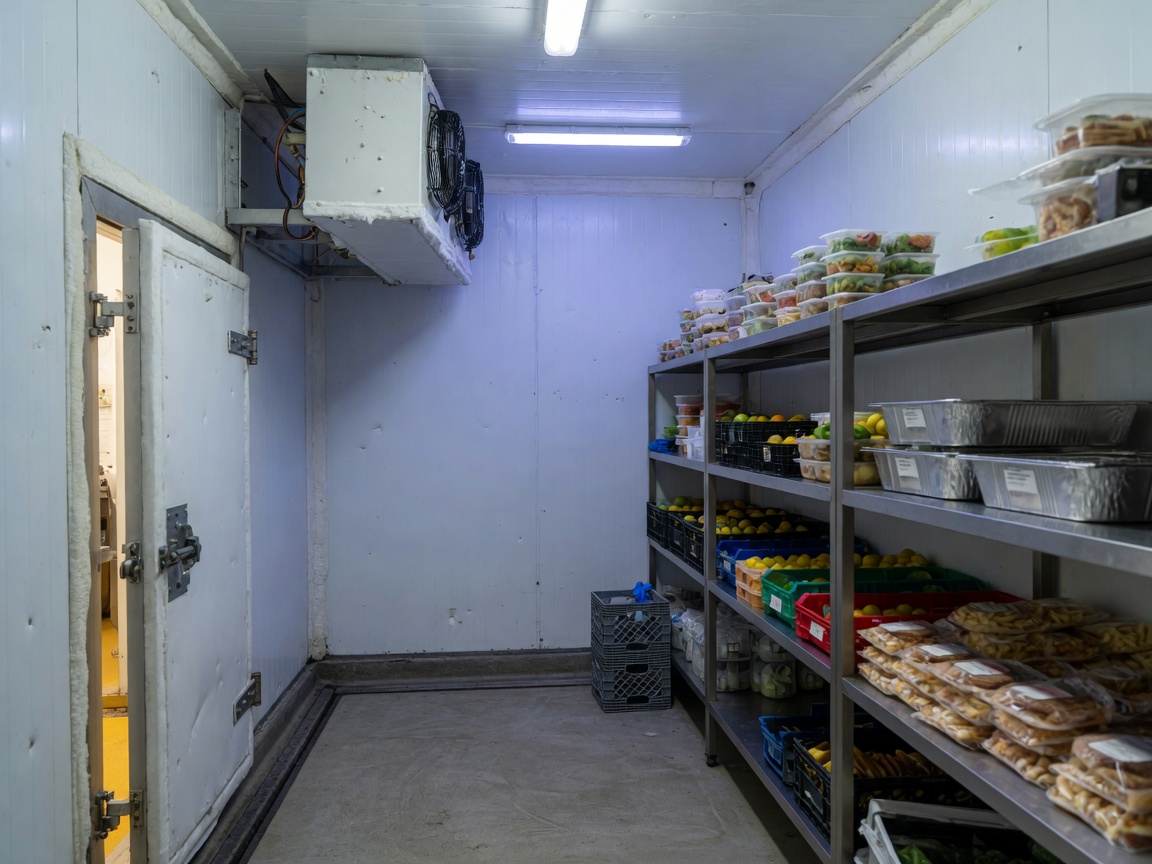
A refrigeration unit for cold room is a mechanical cooling system — comprising a compressor, condenser, and evaporator — purpose-built to maintain enclosed storage spaces at controlled temperatures ranging from -40°F to 59°F (-40°C to +15°C). Unlike residential refrigerators, these systems are engineered for sustained duty cycles, high BTU loads, and strict regulatory compliance across food, pharmaceutical, and chemical applications.
Think of a cold room refrigeration system as an industrial-grade thermos — but one that actively pumps heat out rather than passively retaining it. The insulated enclosure resists heat ingress; the mechanical system continuously removes whatever heat does penetrate. That distinction matters enormously when sizing equipment. The insulation does some of the work, but the refrigeration unit carries the sustained thermal load 24 hours a day.
According to recent industry data, the global cold storage cooling unit market reached approximately $22 billion in 2026, growing at a CAGR of 6.8%. More striking: refrigeration systems account for 60–70% of total cold room operating costs, per International Institute of Refrigeration benchmarks. Why do so many facility managers still treat equipment selection as an afterthought?
Refrigeration unit for cold room是指 a self-contained or split-system mechanical assembly that removes thermal energy from an insulated enclosure, maintaining precise temperature set points for perishable goods, pharmaceuticals, or industrial materials stored within that space.
Core components of a cold room cooling unit
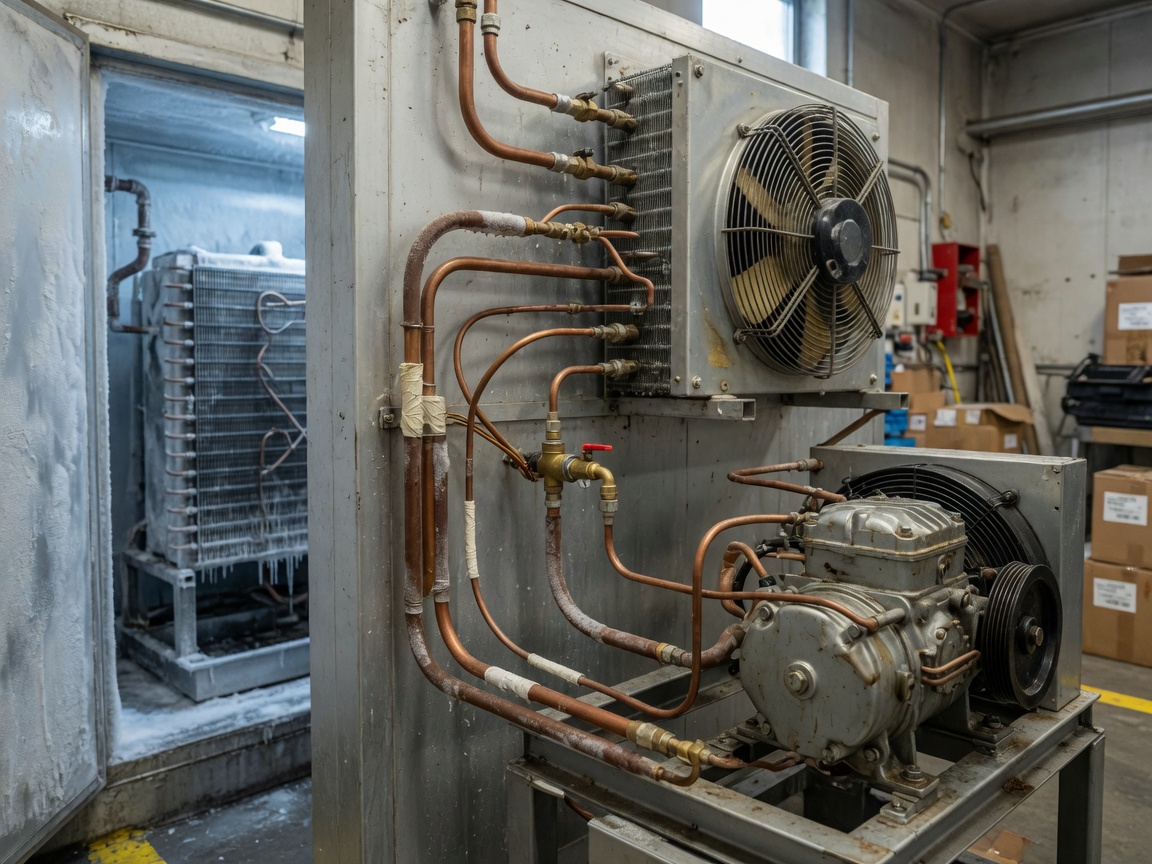
Every commercial refrigeration equipment package shares the same thermodynamic loop. The compressor pressurizes refrigerant vapor; the cold room condenser unit (located outdoors or in a machine room) rejects that heat to ambient air or water; the evaporator unit for cold storage absorbs heat from inside the room as refrigerant expands; and the expansion valve controls refrigerant flow rate. The cold room HVAC system ties these together with electrical controls, defrost timers, and temperature sensors.
How it differs from standard commercial HVAC
Standard HVAC systems target comfort cooling — typically 68°F to 76°F. Cold room systems operate at far lower saturated suction temperatures, demand hermetic or semi-hermetic compressor designs, require insulated refrigerant line sets, and in freezer applications, must include electric or hot-gas defrost cycles to prevent evaporator coil icing. These engineering differences make cross-application substitution dangerous and non-compliant.
Types of cold room refrigeration systems
The right system category depends on your target temperature range, product type, and throughput — not simply available floor space. Matching system architecture to application is the single most effective way to control both capital cost and long-term energy spend.
Monoblock vs. split unit systems
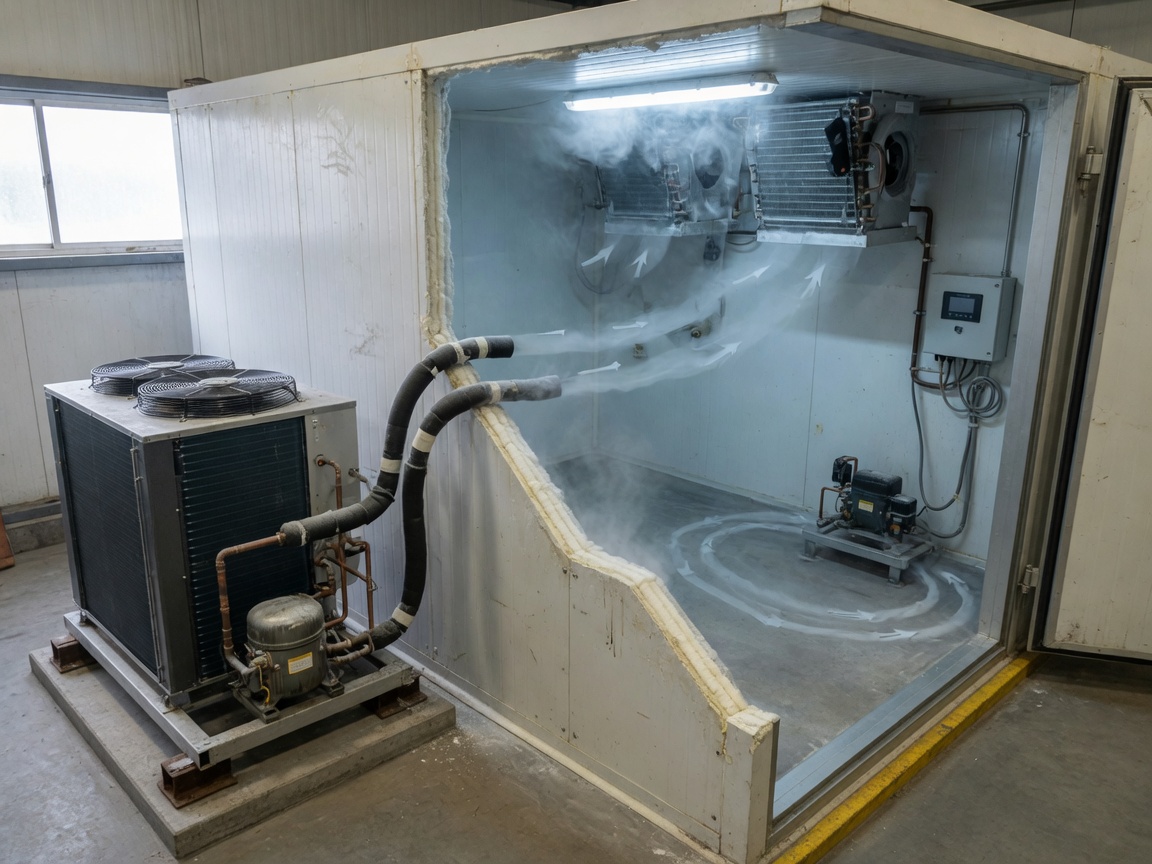
A monoblock unit integrates all components into a single assembly mounted through the cold room wall. Installation is straightforward — no field refrigerant piping, minimal commissioning time — making it ideal for small walk-in coolers under 1,000 cubic feet. Noise is the tradeoff; the condenser fan operates inside or adjacent to the storage space. A split unit separates the indoor evaporator from an outdoor condensing unit for walk-in cooler applications, connected by pre-charged or field-brazed line sets. Noise reduction is significant, and the architecture scales well to rooms exceeding 2,000 cubic feet.
Walk-in cooler vs. walk-in freezer unit requirements
Chiller rooms — operating between 33°F and 46°F — suit dairy, fresh produce, beverages, and deli products. Panel thickness of 75–100mm suffices for most applications. A walk-in freezer unit targeting -18°F to -22°F (-28°C to -30°C) for frozen meat, fish, and ice cream requires 120–150mm panel insulation and a refrigeration compressor for cold room service rated for low-temperature operation. Blast freezer units push to -30°F to -40°F and demand 150–200mm panels, cascade or compound compression, and specialized walk-in cooler evaporator coil designs rated for heavy frost loading.
"Selecting undersized refrigeration equipment is the leading cause of premature compressor failure in commercial cold rooms. Oversizing creates its own problems — short cycling destroys compressor reliability and causes temperature swings that violate food safety standards." — ASHRAE Refrigeration Handbook, 2026 edition
How to size your system: BTU and capacity calculations
Accurate sizing is non-negotiable. Real-world testing on mid-size cold storage projects consistently shows that equipment selected purely by room volume — without accounting for thermal load variables — results in 20–35% energy overconsumption or chronic temperature recovery failures.
Step-by-step BTU load calculation
- Calculate room volume — Length × Width × Height in feet.
- Determine wall heat transmission load — Multiply surface area by U-value of panel insulation by temperature differential (ΔT between ambient and set point).
- Add product pull-down load — Mass of warm product entering per day × specific heat × ΔT.
- Add infiltration load — Estimate door open time per day; use ASHRAE infiltration factors for your door type and traffic frequency.
- Add internal heat gains — Lighting wattage, people hours, and fork-lift or pallet jack heat output.
- Apply a safety factor — Multiply total by 1.10 to 1.20 depending on ambient climate zone; U.S. Sun Belt facilities should use 1.20.
- Convert to required refrigeration capacity — Divide total BTU/24hr by operating hours per day to obtain BTU/hr; select equipment rated at or above this figure at your design ambient temperature (typically 95°F in the U.S.).
Common sizing mistakes to avoid
Oversizing is almost as damaging as undersizing. An oversized industrial cooling system short-cycles — the compressor satisfies the set point rapidly, shuts off, and restarts within minutes. Each start draws 4–6× running amperage and stresses motor windings. Actual field data from food distribution centers shows that systems sized at 150% of calculated load had compressor replacement rates 2.3× higher than correctly sized units over a 10-year period. Size to the load, not to the fear.
Energy efficiency ratings explained: EER, COP, and annual operating costs
Energy performance is where the real purchase decision lives. The equipment price tag is a one-time cost. The electricity bill is permanent.
Understanding EER and COP for cold storage refrigeration equipment
The Energy Efficiency Ratio (EER) measures BTU of cooling output per watt of electrical input at a specific test condition. The Coefficient of Performance (COP) is the ratio of useful cooling energy to input energy — a COP of 2.5 means 2.5 kWh of cooling for every 1 kWh consumed. For cold room temperature control systems operating at cooler temperatures, COP tends to drop; a system delivering COP 3.0 at 38°F may only achieve COP 1.8 at 0°F.
Energy efficiency comparison table
| System type | Typical COP (cooler) | Typical COP (freezer) | EER range | Est. annual energy cost* (10,000 BTU/hr load) |
|---|---|---|---|---|
| Monoblock (air-cooled) | 2.2 – 2.8 | 1.3 – 1.7 | 7.5 – 9.5 | $1,850 – $2,400 |
| Split unit (air-cooled) | 2.5 – 3.2 | 1.5 – 2.0 | 8.5 – 11.0 | $1,550 – $2,050 |
| Screw compressor (industrial) | 3.0 – 4.5 | 2.0 – 2.8 | 10.2 – 15.3 | $1,100 – $1,600 |
| CO₂ transcritical (R744) | 2.8 – 3.8 | 1.8 – 2.5 | 9.5 – 13.0 | $1,200 – $1,750 |
| Water-cooled split unit | 3.2 – 4.0 | 2.0 – 2.8 | 10.9 – 13.6 | $1,000 – $1,500 |
*Estimates based on $0.14/kWh U.S. average commercial electricity rate, 8,760 annual operating hours, 2026 EIA data.
EPA Section 608 compliance and refrigerant selection in 2026
This is the section most competitors skip — and it's the one that can cost you the most. EPA Section 608 of the Clean Air Act governs the handling, recovery, and reporting of refrigerants used in stationary commercial refrigeration systems. Non-compliance carries civil penalties up to $44,539 per day per violation.
The R-404A phase-down and what replaces it
R-404A — for years the dominant refrigerant in walk-in freezer unit applications — carries a Global Warming Potential (GWP) of 3,922. Under the AIM Act rules enforced by EPA, R-404A use in new commercial cold storage refrigeration equipment is now effectively phased out. Technicians handling R-404A must hold EPA 608 Type II or Universal certification. The practical replacement options in 2026 are R-448A (GWP 1,387, near drop-in for many existing compressors) and R-449A (GWP 1,397). Both require POE oil and may need expansion valve adjustment. For new installations, R-744 (CO₂) and R-717 (ammonia) are increasingly mandated in large industrial cooling systems by state-level regulations in California and New York.
Practical compliance checklist for buyers
When evaluating any refrigeration unit for cold room procurement, confirm with your supplier: (1) the refrigerant type and current GWP classification; (2) whether the refrigeration compressor for cold room is factory-charged with a compliant refrigerant; (3) that the system ships with a refrigerant data sheet meeting EPA Section 608 record-keeping requirements; and (4) that your installing contractor holds current EPA certification. Skipping any of these steps creates liability that attaches to the facility owner, not the equipment vendor. Understanding how refrigeration systems interact with environmental regulations is no longer optional — it's a purchasing prerequisite.
Application-specific selection guide: flowers, meat, and wine
Generic cold room specs miss the point. The thermal, humidity, and air-quality requirements of a floral cooler are so different from a blast freezer unit that treating them as equivalent is a recipe for product loss. Here's how to match system characteristics to actual use cases.
Floral cold storage (33°F – 40°F)
Flowers are among the most humidity-sensitive products in cold storage. The walk-in cooler refrigeration system for a floral application must maintain relative humidity between 85% and 95% to prevent desiccation. This rules out standard low-humidity evaporator coils. Specify an oversized walk-in cooler evaporator coil — running at a small ΔT (temperature differential between coil surface and room air of 8°F–10°F versus the typical 10°F–16°F) — to minimize moisture removal during operation. Defrost cycles must be timed carefully; hot-gas defrost is preferred over electric to reduce temperature spikes.
Meat and seafood freezing (-18°F to -22°F)
Frozen protein storage demands a true walk-in freezer unit with redundant compressor capacity. USDA regulations require that frozen meat be held at 0°F (-18°C) or below at all times; a single-compressor system with no backup creates compliance exposure during maintenance windows. Specify a commercial cold room cooling system with dual refrigeration circuits or a tandem compressor rack. Panel thickness should be 120–150mm minimum. For fast-freeze applications — reducing fish from 40°F to 0°F within hours — a dedicated blast freezer unit with forced-air evaporators at -30°F to -40°F is required, using a cold storage refrigeration equipment package with 150–200mm panels and cascade compression.
Wine cellar and bonded storage (50°F – 58°F)
Wine storage is deceptively demanding. The target range of 50°F–58°F sits above standard cooler set points, but the sensitivity to temperature swings (no more than ±2°F fluctuation) and vibration makes generic cold room HVAC system installations inappropriate. Select a low-velocity evaporator to minimize air movement across bottles. Humidity should sit at 60–70% RH. A precision cold room temperature control system with ±0.5°F accuracy and an IoT-enabled monitoring platform provides the auditability that bonded warehouse operators and insurance underwriters increasingly require.
U.S. installation cost breakdown and TCO analysis
Sticker price tells you almost nothing about the true cost of a cold storage cooling unit. Total cost of ownership over a 15-year asset life is the only number that matters for procurement decisions.
Typical U.S. installation cost components (2026)
| Cost component | Small system (≤500 cu ft cooler) | Medium system (500–2,000 cu ft freezer) | Large industrial system (>2,000 cu ft) |
|---|---|---|---|
| Equipment (unit + panels) | $3,500 – $8,000 | $12,000 – $35,000 | $40,000 – $150,000+ |
| Labor (installation) | $1,200 – $3,000 | $4,500 – $12,000 | $15,000 – $50,000 |
| Electrical upgrade / panel work | $500 – $2,000 | $2,000 – $8,000 | $8,000 – $30,000 |
| Permits and inspections | $200 – $800 | $500 – $2,500 | $1,500 – $6,000 |
| Annual energy cost (est.) | $900 – $2,200 | $3,500 – $9,000 | $15,000 – $60,000 |
| 15-year maintenance (est.) | $2,500 – $6,000 | $8,000 – $22,000 | $25,000 – $90,000 |
The TCO calculation that most buyers miss
A $5,000 monoblock unit with a COP of 2.2 running in a Phoenix distribution center will consume roughly $2,100/year in electricity. The same application served by a split unit with COP 3.0 costs $1,550/year — a $550 annual savings. Over 15 years, that gap reaches $8,250. The $2,000 premium for the higher-efficiency system pays back in under four years and continues generating returns. Of course, there are cases where the simpler monoblock is the rational choice — a seasonal roadside farm stand with a 6-month operating year, for example, tips the math differently. Always model against actual operating hours and local utility rates before deciding.
DIY vs. professional installation: risk, permits, and compliance
This question surfaces constantly in U.S. contractor forums, and the honest answer is more nuanced than either "always DIY" or "always hire out."
What U.S. regulations actually require
Any system using a regulated refrigerant — which covers virtually all commercial refrigeration equipment sold in the U.S. — requires that refrigerant handling, recovery, and charging be performed by an EPA Section 608-certified technician. This is federal law, not a recommendation. Additionally, most U.S. jurisdictions require a mechanical permit and inspection for commercial cold room installations; some municipalities additionally require a licensed contractor to pull that permit. UL-listed equipment is a baseline requirement for insurance coverage in virtually all commercial facilities. Attempting a field installation without these credentials doesn't just void warranties; it creates personal liability exposure for the facility owner.
Where owner-involvement is reasonable
Site preparation — floor leveling, drain routing, electrical conduit rough-in under a licensed electrician's supervision — is generally permissible and can save $800–$2,500 in labor costs on a small walk-in cooler refrigeration system. Pre-assembled monoblock units with self-contained refrigerant charges (pre-charged line sets) eliminate field brazing and significantly reduce the scope requiring certified refrigeration labor. Even so, the final commissioning, leak test, and startup should always involve an EPA-certified technician. The building permit sign-off on the cold room HVAC system almost always requires a licensed contractor's stamp regardless of who performed the physical work.
FAQ
Frequently asked questions
Q: How do I calculate what size refrigeration unit for cold room I need?
A: Calculate total thermal load in BTU/hr by adding wall transmission, product pull-down, infiltration, and internal heat gain loads. Apply a 1.10–1.20 safety factor for U.S. climate zones. Select equipment rated at or above this figure at 95°F ambient. Undersizing causes temperature recovery failure; oversizing causes compressor short-cycling and premature failure.
Q: What refrigerant should I specify for a new commercial cold room in 2026?
A: For medium-temperature coolers, R-448A or R-449A are the primary R-404A replacements with lower GWP. For new large industrial cold storage systems, CO₂ (R-744) or ammonia (R-717) are increasingly required by state-level AIM Act implementation rules. Confirm compliance with your certifying EPA Section 608 technician before finalizing specifications.
Q: What is the difference between a monoblock and a split refrigeration unit?
A: A monoblock integrates all components in one wall-mounted unit — easy to install, suitable for rooms under 1,000 cubic feet, but noisier. A split unit places the evaporator indoors and the condensing unit outdoors, reducing noise and scaling to larger rooms. Split systems generally offer better energy efficiency and longer service life in continuous commercial applications.
Q: Can I install a cold room refrigeration system myself without a contractor?
A: Refrigerant handling legally requires EPA Section 608 certification. Most U.S. municipalities also require a mechanical permit and licensed contractor for commercial installations. Owner-performed site prep is generally acceptable, but commissioning, leak testing, and startup must involve a certified technician. Non-compliance risks fines, insurance voidance, and personal liability.
Q: How much does it cost to install a refrigeration unit for cold room in the U.S.?
A: Small walk-in cooler systems typically run $5,400–$13,800 all-in (equipment, labor, electrical, permits). Medium commercial freezer installations range from $19,000 to $57,500. Large industrial cold storage refrigeration equipment projects can exceed $200,000. Always model 15-year TCO including energy and maintenance costs — not just the equipment purchase price.
Selecting the right refrigeration unit for cold room is ultimately a systems engineering decision wrapped in a procurement process. The equipment choice locks in energy costs, regulatory exposure, and product safety outcomes for 15 years or more. Use the BTU calculation framework in this guide, verify refrigerant compliance with your EPA-certified contractor, model full TCO rather than equipment price, and match system architecture to your specific storage application — whether floral, frozen protein, or bonded wine. That sequence, executed rigorously, produces better outcomes than any single brand recommendation ever could.
Keywords:
Inquiry
If you are interested in our products, please leave your email to receive a free product quote, thank you!
More information


Tel:
Sales E-mail: