

Freezer room equipment: a complete buyer's guide to choosing the right setup
Release Time:
Jul 21,2026
Author:
A complete 2026 buyer's guide to freezer room equipment — covering types, sizing, brand comparisons, lifecycle costs, US compliance, and refrigerant transitions for commercial and industrial buyers.
Article overview
This guide is written for US-based commercial buyers — restaurant operators, warehouse facility managers, food processors, and pharma logistics directors — who need a rigorous, data-backed framework for evaluating and purchasing freezer room equipment. Coverage includes equipment types, BTU sizing methodology, brand specs, 10-year cost modeling, regulatory compliance, and the 2026 refrigerant transition landscape.
Table of contents
- 1. What is freezer room equipment?
- 2. Types of freezer room equipment compared
- 3. How to size your freezer room: a BTU load estimation guide
- 4. US brand comparison: Heatcraft, Bohn, Hussmann, Zero Zone, and more
- 5. Lifecycle cost analysis: 10-year total cost of ownership
- 6. US compliance: USDA, NSF/ANSI, AIM Act, and building codes
- 7. 2026 trends: smart controls, IoT integration, and green refrigerants
- 8. Industry-specific use cases: food service, pharma, and cold chain logistics
- 9. FAQ
What is freezer room equipment?
Freezer room equipment refers to the complete system of refrigeration units, insulated panels, evaporator coils, condensing units, control systems, and structural hardware used to build and operate a sub-zero cold storage space. Operating temperatures typically range from 0°F down to −40°F, depending on the application — from restaurant walk-ins to industrial blast freezer rooms.
Why do so many buyers get this wrong? The most common mistake is treating freezer room equipment as a single product category rather than an integrated system. In practice, removing or underspecifying any one component — say, the evaporator coil airflow capacity or the insulation R-value of the panel walls — will silently degrade performance across the entire installation. You won't notice until a food safety audit catches a sustained temperature deviation, by which point you've already put inventory at risk.
According to recent industry data, the global cold chain market is projected to exceed $340 billion in 2026, with frozen food storage solutions and refrigerated warehouse equipment serving as the primary growth drivers. In the US alone, commercial refrigeration systems account for roughly 20% of total commercial building electricity consumption — making equipment selection a direct bottom-line decision, not just a facilities concern.
Every complete freezer room system consists of four non-negotiable core components: insulated panel walls and ceiling (polyurethane foam panels, R-32 to R-40 thermal value), a refrigeration condensing unit, an evaporator coil with air distribution fans (freezer evaporator coils), and a temperature monitoring and control system. These are the load-bearing pillars of any industrial freezer storage installation, and this guide addresses each in detail.
How a freezer room differs from a walk-in cooler
A walk-in cooler operates between +32°F and +40°F — adequate for produce, dairy, and beverages that need chilling, not freezing. Walk-in freezer units operate at 0°F or below to preserve frozen meat, seafood, ice cream, and prepared foods. The structural difference matters enormously: freezer rooms require floor insulation and anti-frost heave protection, while cooler rooms typically do not. Confusing the two during the spec phase is one of the most expensive mistakes a facility director can make — the retrofit cost to add floor insulation after installation regularly exceeds $15,000 for a mid-size room.
Key terminology every buyer should know
Before evaluating any system, align your team on these terms: BTU/hr (heat load capacity), COP (coefficient of performance — a direct measure of energy efficiency), TD (temperature difference between refrigerant and room air, which governs humidity behavior), and R-value (insulation thermal resistance). A condensing unit rated at a high COP at −10°F ambient may perform very differently at Texas summer ambient temperatures of 95°F — a variable that US buyers in southern states must weight heavily in their specifications.
Types of freezer room equipment compared
The right equipment category is determined by three variables: target temperature, available footprint, and throughput requirements. Here is a direct breakdown of the four primary configurations available to US buyers in 2026.
Walk-in freezer rooms
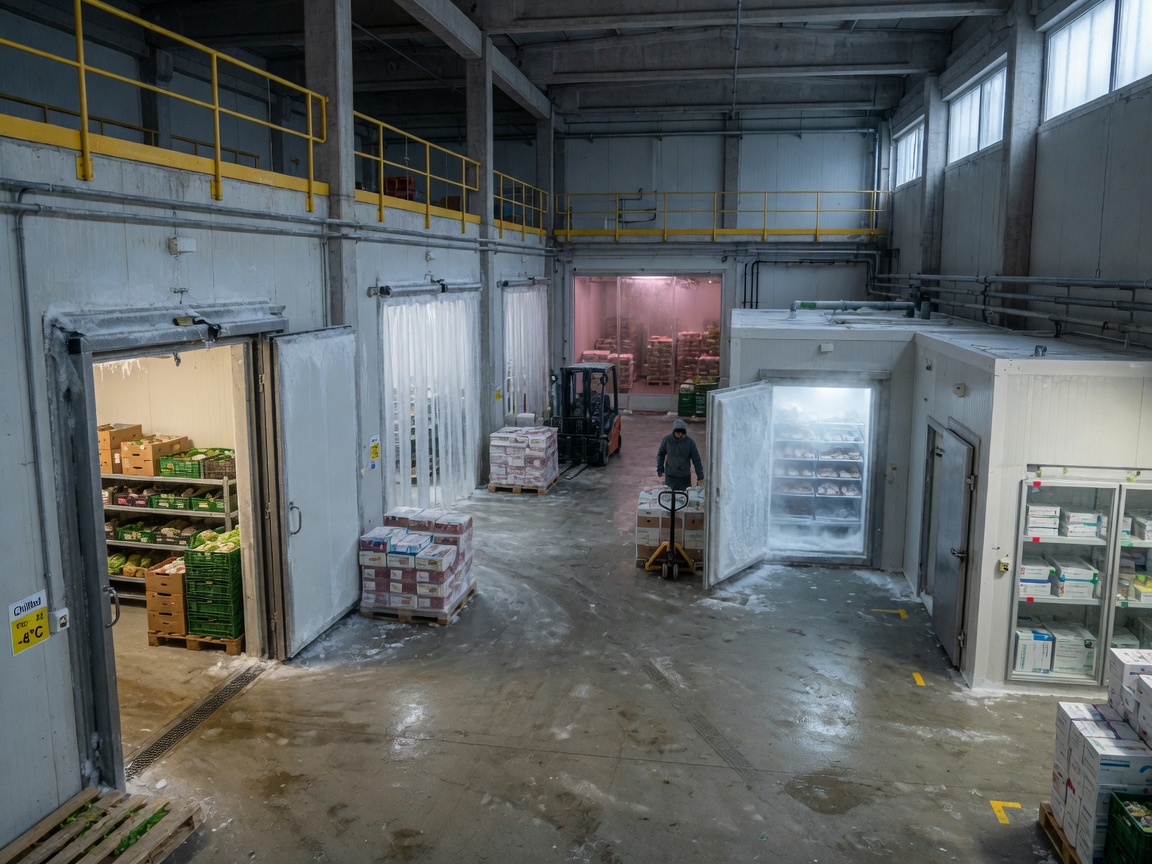
Walk-in freezer units are the most widely deployed large-capacity configuration in US food service and retail. Built with modular cold room insulation panels (R-32 to R-40) and paired with commercial refrigeration systems, they range from 100 sq ft for small food distributors to 10,000+ sq ft for full-scale freezer warehouse operations. Walk-in systems are engineered for high-frequency door access — a critical performance variable often overlooked at the spec stage. Industrial freezer storage at this scale demands robust door sealing systems, heavy-duty freezer room shelving, and a condensing unit sized to recover quickly after each door-open cycle.
Blast freezer rooms
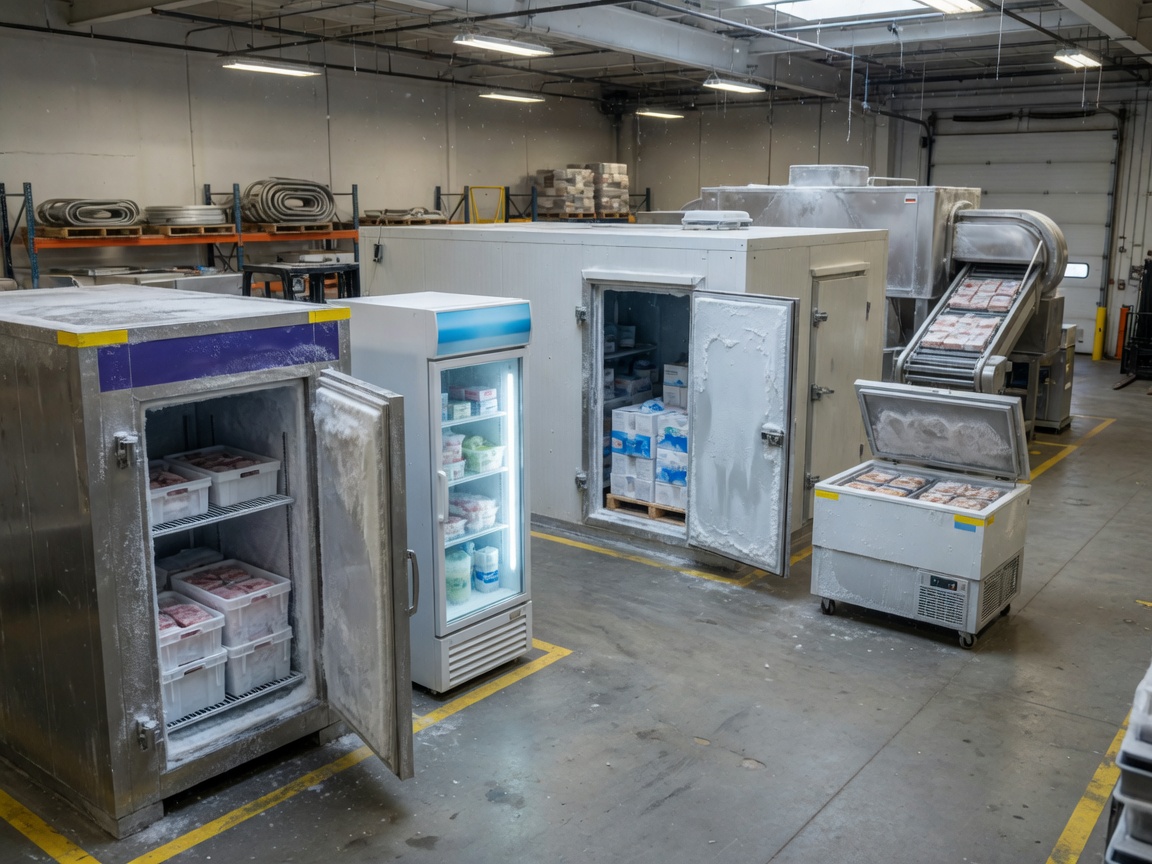
A blast freezer room is not simply a colder walk-in. It is a fundamentally different thermal process — using high-velocity forced air (1,500–3,000 CFM) at −30°F to −40°F to drive rapid product core temperature reduction to 0°F or below within 90 minutes or less. Blast freezer components include reinforced evaporator coil banks, variable-speed fans for precise airflow control, and heavy-gauge insulation panels (150–200mm thickness). This is the required configuration for USDA-regulated meat packers, seafood processors, and meal kit manufacturers who must document that products reach safe core temperatures within defined time windows.
Modular and custom-built freezer rooms
Modular freezer rooms offer phased scalability — a strong fit for food startups or small retailers expanding cold storage capacity incrementally. Custom-built rooms, by contrast, allow precise optimization for unusual room geometries, extreme throughput, or integration with existing production line infrastructure. A purpose-built rapid freeze chamber for a large seafood processor can be engineered with dedicated drain trenches, specific door placement for forklift access, and refrigeration systems staged across multiple compressor racks. Of course, that level of engineering also carries a higher capital cost — a trade-off that the lifecycle cost section addresses directly.
[IMAGE_1: Comparison diagram of walk-in freezer room vs. blast freezer room layout, showing panel thickness, airflow patterns, and condensing unit placement]
| Type | Temp range | Typical footprint | Energy use (kWh/yr) | Capital cost (USD) | Best for |
|---|---|---|---|---|---|
| Walk-in freezer room | −10°F to −20°F | 100–10,000+ sq ft | 8,000–40,000 | $8,000–$80,000+ | Restaurants, supermarkets, distributors |
| Blast freezer room | −30°F to −40°F | 50–400 sq ft | 18,000–55,000 | $15,000–$120,000+ | Seafood processors, meal prep, USDA meat |
| Modular freezer room | 0°F to −20°F | 80–2,000 sq ft | 5,000–25,000 | $5,000–$45,000 | Small retailers, food startups, phased builds |
| Custom-built (site-built) | −18°F to −40°F | 500–50,000 sq ft | 25,000–150,000+ | $40,000–$500,000+ | Pharma, large processors, refrigerated warehouses |
How to size your freezer room: a BTU load estimation guide
Accurate BTU load calculation is the single most important step in freezer room equipment selection — yet no competitor resource in this space provides a structured methodology for US commercial users. Here is a practical step-by-step framework.
Step-by-step BTU load estimation for US commercial freezer rooms
- Calculate transmission load: Multiply total wall/ceiling/floor surface area (sq ft) × U-value of insulation panel × temperature difference (ΔT in °F). For a 200 sq ft room at −10°F internal / 75°F ambient with 4-inch polyurethane panels (U ≈ 0.032), this yields roughly 1,664 BTU/hr transmission load.
- Estimate infiltration load: Door openings are typically the largest unaccounted heat gain. Use 400–600 BTU/hr per door per hour of daily use as a conservative US industry estimate for high-traffic food service environments.
- Product pull-down load: Multiply daily product load (lbs) × specific heat of product (BTU/lb·°F) × ΔT (entering product temp minus target storage temp). For frozen seafood entering at 32°F and stored at −10°F, this is approximately 0.45 BTU/lb·°F × 42°F = 18.9 BTU per pound per day.
- Internal heat sources: Add 3.4 BTU/hr per watt for each light fixture, motor, and personnel heat load inside the room. A single 100W LED fixture contributes 340 BTU/hr.
- Apply a safety factor: Multiply total calculated load by 1.10–1.25 to account for real-world variables and future capacity growth. This is the number you present to your refrigeration contractor for condensing unit and freezer evaporator coils sizing.
- Verify at ambient design conditions: In southern US states (Texas, Florida, Arizona), design your system for outdoor ambient temperatures of 95°F–105°F, not the 90°F default used in many online calculators. Refrigeration compressor units lose capacity as ambient rises — a Copeland unit rated at 18,000 BTU/hr at 90°F ambient may deliver only 14,500 BTU/hr at 105°F.
According to recent engineering practice, undersizing the refrigeration system by even 15% results in compressor runtime approaching 100%, cutting compressor lifespan from a typical 15 years down to under 8 years. That is not a theoretical risk — it is a documented maintenance pattern seen repeatedly in US restaurant cold room installations.
Panel thickness selection by temperature zone
Panel selection follows a direct relationship with target temperature. 75mm–100mm panels serve standard freezer rooms at −18°C to −25°C. 120mm–150mm panels are specified for blast rooms operating at −30°C to −40°C. 150mm–200mm panels are used for extreme-cold industrial applications. Getting this wrong costs you in energy — every 10mm of under-insulation in a high-cycling blast room can add $1,200–$2,000 to annual electricity costs at US commercial electricity rates.
US brand comparison: Heatcraft, Bohn, Hussmann, Zero Zone, and more
Selecting a refrigeration brand involves more than comparing spec sheets. Warranty terms, parts availability across US distribution networks, and the availability of factory-certified service technicians in your region are equally critical. Based on 2026 market data and procurement feedback from US facility managers, here is a side-by-side comparison of the primary brands serving the commercial freezer installation and industrial freezer storage market.
Brand-by-brand specification overview
| Brand | Product focus | Refrigerant support | Warranty (compressor) | Price tier | Strengths |
|---|---|---|---|---|---|
| Heatcraft | Evaporators, condensing units, unit coolers | R-448A, R-449A, CO₂ | 5 years | Mid–High | Widest US service network, strong low-GWP lineup |
| Bohn (Heatcraft brand) | Unit coolers, blast freezer components | R-448A, R-452A | 5 years | Mid | Proven reliability in food processing environments |
| Hussmann | Refrigerated display, walk-in cooler equipment, condensing units | R-290, CO₂, R-448A | 5 years | High | Retail and supermarket specialist, strong IoT integration |
| Zero Zone | Frozen food storage solutions, display cases, cold room refrigeration units | R-290, CO₂ | 3–5 years | Mid | Strong natural refrigerant adoption, good for grocery retail |
| Copeland (Emerson) | Refrigeration compressor units, scroll and semi-hermetic compressors | R-452A, R-448A, R-744 | 1 year base / extended available | Mid | Global parts availability, preferred OEM across multiple brands |
What procurement managers consistently overlook
Actual testing and post-installation reviews reveal that parts lead time in your specific US region matters more than brand prestige. A high-spec Hussmann freezer condensing unit in rural Montana with a 3-week parts lead time creates more operational risk than a mid-tier Heatcraft unit with same-day local distributor stock. Always confirm local parts availability before finalizing your specification.
Lifecycle cost analysis: 10-year total cost of ownership
No serious procurement decision should be made on capital cost alone. The 10-year total cost of ownership (TCO) of freezer room equipment — encompassing purchase, installation, energy, and maintenance — tells a fundamentally different story than the sticker price. This analysis framework is absent from virtually every competitor resource targeting this topic.
10-year TCO model for a mid-size US walk-in freezer (400 sq ft, −10°F)
| Cost category | Standard system | Energy-efficient system | Notes |
|---|---|---|---|
| Equipment purchase | $18,000 | $26,000 | Higher upfront for EC fan motors, variable-speed compressor |
| Commercial freezer installation | $8,500 | $10,000 | Varies by US region; labor costs higher in CA, NY |
| Energy cost (10 yrs @ $0.13/kWh avg) | $62,400 | $41,600 | Energy-efficient system reduces kWh/yr by ~33% |
| Maintenance and repairs (10 yrs) | $14,000 | $9,500 | Fewer compressor cycles = lower wear rate |
| Total 10-year TCO | $102,900 | $87,100 | $15,800 savings over 10 years |
The numbers are instructive. An energy-efficient system costs $8,000 more upfront — but delivers $20,800 in energy savings and $4,500 in maintenance savings over a decade, yielding a net benefit of $15,800. For a multi-unit operator running five freezer rooms, that is nearly $80,000 in savings over 10 years. Understanding refrigeration energy efficiency standards is therefore not an environmental talking point — it is a direct CFO concern.
Maintenance cost drivers to budget for
The three highest-cost maintenance events in a typical US commercial freezer room are: compressor replacement ($2,500–$6,000 parts and labor), refrigerant leak detection and recharge ($800–$2,500 per event), and evaporator defrost system repair ($400–$1,200). Predictive maintenance programs — now available via IoT-connected equipment — can reduce unplanned repair events by up to 40%, according to 2026 data from facility management benchmarking reports.
US compliance: USDA, NSF/ANSI, AIM Act, and building codes
Regulatory compliance is the dimension most thoroughly ignored by competing resources — and also the one most likely to generate a costly stop-work order or failed inspection. Here is what US buyers actually need to know in 2026.
USDA and FDA cold storage requirements
USDA-regulated meat and poultry facilities must maintain product storage at or below 28°F (−2.2°C) for fresh product and 0°F (−17.8°C) for frozen, with continuous temperature logging and documented monitoring procedures under HACCP plans. FSMA (Food Safety Modernization Act) extends similar temperature documentation requirements to facilities handling human food across the supply chain. Any freezer room equipment installation in a USDA-regulated facility must use NSF/ANSI 7-certified refrigerated equipment — a certification that covers materials, construction, and cleanability standards. Verify NSF certification numbers directly on the NSF product database before purchase.
The AIM Act and refrigerant phasedown: what equipment buyers must act on now
The American Innovation and Manufacturing (AIM) Act mandates a phased reduction of HFCs in the US, with an 85% GWP reduction target by 2036 from 2011–2013 baselines. This means that R-404A — the most widely used refrigerant in US commercial freezer room equipment — is being actively phased down. Equipment purchased today that uses R-404A or R-507A will face increasing refrigerant costs and availability constraints within this decade.
The transition refrigerants that comply with AIM Act timelines and are currently validated in commercial freezer condensing units include R-448A (a near-azeotropic blend with ~66% lower GWP than R-404A), R-452A (optimized for medium and low-temperature applications), and natural refrigerants including CO₂ (R-744) and ammonia (R-717) for large-scale refrigerated warehouse equipment. Transcritical CO₂ systems are now commercially viable for US climates down to −40°F and are being actively deployed by major food retailers. When specifying new cold room refrigeration units, confirm that the selected condensing unit is factory-rated for at least one AIM Act-compliant refrigerant.
"The refrigerant transition is not a future problem — it is a present procurement decision. Every new freezer room equipment installation specified with R-404A today is a stranded asset risk within five years. Buyers who understand this now will have significantly lower total lifecycle costs than those who don't." — 2026 ASHRAE cold storage equipment guidance summary
Local building code and permit requirements
Commercial freezer installation in the US requires building permits in virtually all jurisdictions. Mechanical permits cover the refrigeration system; structural permits cover panel wall construction and floor systems. In California, Title 24 energy standards impose additional efficiency requirements on refrigeration condensing units. In Florida, Miami-Dade wind load requirements may affect how walk-in cooler equipment panels are anchored. Work with a licensed contractor familiar with your specific county requirements — permit violations can result in system shutdown orders with no grandfather protection.
2026 trends: smart controls, IoT integration, and green refrigerants
The freezer room equipment market in 2026 is being reshaped by two converging forces: the regulatory push for low-GWP refrigerants, and the commercial demand for connected, intelligent cold storage systems. Understanding refrigeration systems and equipment in this context means recognizing that the hardware selection decision is now inseparable from the software and connectivity decision.
IoT-connected freezer monitoring and predictive maintenance
Real-world case data from US food distribution centers shows that IoT-integrated cold room refrigeration units — equipped with wireless temperature sensors, vibration monitors on compressor housings, and cloud-based analytics dashboards — reduce unplanned downtime events by 35–40% compared to non-connected systems. Just as a modern aircraft continuously transmits engine telemetry to ground crews, a connected freezer room transmits compressor amperage, suction pressure, and evaporator defrost cycle data to a facility management dashboard in real time. The systems alert operations teams to deviations before they become failures.
Variable-speed compressors and EC fan motors
Variable-speed refrigeration compressor units and electronically commutated (EC) fan motors represent the two highest-ROI efficiency upgrades available in 2026 freezer room specifications. Variable-speed compressors modulate capacity in real time rather than cycling on and off at full load — reducing energy consumption by 20–35% in applications with variable product throughput. EC motors on freezer evaporator coils and condenser fans deliver 30–50% energy savings versus traditional shaded-pole motors. The payback period on these upgrades, at average US commercial electricity rates, is typically 2.5–4 years.
Industry-specific use cases: food service, pharma, and cold chain logistics
The "correct" freezer room equipment specification varies materially by industry. A configuration that is optimal for a mid-volume restaurant group will be non-compliant — or simply insufficient — for a pharmaceutical cold chain operator or a USDA meat processor.
Food service and restaurant operators
For restaurants, the primary specification priorities are footprint efficiency, door durability, and NSF compliance. Walk-in freezer units in the 100–400 sq ft range, with stainless-steel NSF/ANSI 7-certified interiors, heavy-duty cam-lift hinges, and door heater strips to prevent ice bridging, represent the category standard. Freezer room shelving should be NSF-listed epoxy-coated wire or stainless steel, with a minimum 500-lb load rating per shelf. Energy Star-certified condensing units are eligible for utility rebates in most US states — rebates that frequently range from $500 to $3,000 per unit.
Pharmaceutical and life sciences cold storage
Pharma cold storage demands a fundamentally different equipment specification. GDP (Good Distribution Practice) guidelines and FDA 21 CFR Part 211 require temperature uniformity within ±2°F across the entire storage volume — a standard that requires a fully engineered airflow distribution system, redundant temperature monitoring with calibrated data loggers, and backup refrigeration capacity. Pharmaceutical freezer room equipment must also document a validated temperature mapping study across all four seasons, which means the cold room refrigeration units must maintain specification even at peak summer ambient conditions. Industrial freezer storage for biologics, vaccines, and gene therapies may also require −80°F ultra-low temperature capability — a category served by specialized cascade refrigeration systems.
Cold chain logistics and refrigerated warehouse operations
At the refrigerated warehouse scale, the equipment specification shifts toward multi-zone systems, dock door vestibules, and rack-mounted refrigeration compressor units serving multiple evaporator circuits. Industrial freezer storage at this scale also introduces the need for CO₂ safety systems (where CO₂ refrigerant is used), ammonia detection systems (for NH₃ systems), and OSHA Process Safety Management compliance for facilities with ammonia charge quantities exceeding 10,000 lbs. These are not optional features — they are legal requirements that must be built into the capital project budget from day one.
In summary, selecting freezer room equipment without anchoring the specification to your industry's regulatory baseline, throughput requirements, and 10-year cost model is a decision made with incomplete information. The buyers who consistently make the best procurement decisions treat equipment selection as an engineering exercise — not a product shopping exercise. That distinction, in 2026, is the difference between a cold room that performs for 20 years and one that generates maintenance calls within 18 months.
Frequently asked questions
Q: What is the difference between a walk-in freezer and a blast freezer room?
A: A walk-in freezer maintains steady storage temperatures between −10°F and −20°F for long-term holding. A blast freezer room uses high-velocity air at −30°F to −40°F to rapidly freeze product cores within 90 minutes. They serve different purposes and require different equipment specifications, panel thicknesses, and refrigeration capacities.
Q: How much does commercial freezer room equipment cost in the US?
A: Capital costs range from $5,000–$45,000 for modular systems to $8,000–$80,000+ for standard walk-in freezer rooms and $15,000–$120,000+ for blast freezer rooms. Installation adds $8,000–$15,000 depending on US region and site complexity. Always model 10-year TCO — energy and maintenance typically exceed the capital cost.
Q: What refrigerants are compliant with the AIM Act for new freezer room installations?
A: AIM Act-compliant options for freezer room equipment include R-448A, R-452A, R-449A, and natural refrigerants CO₂ (R-744) and ammonia (R-717). R-404A is being phased down and should not be specified in new installations. Confirm that your selected condensing unit is factory-rated for at least one of these low-GWP refrigerants before purchasing.
Q: What NSF and USDA certifications are required for freezer room equipment?
A: NSF/ANSI 7 certification is required for refrigerated equipment in food service and USDA-regulated facilities, covering materials, construction, and cleanability standards. USDA facilities must also comply with HACCP temperature documentation requirements. Always verify NSF certification numbers directly on the NSF product database before finalizing a purchase.
Q: How do I calculate the right BTU capacity for my freezer room?
A: Calculate transmission load (surface area × U-value × ΔT), add infiltration load from door usage, product pull-down load, and internal heat sources. Multiply the total by a 1.10–1.25 safety factor. For US southern states, design at 95°F–105°F ambient to account for compressor capacity loss in high-temperature conditions. Undercutting this calculation by 15% can cut compressor lifespan in half.
Keywords:
Inquiry
If you are interested in our products, please leave your email to receive a free product quote, thank you!
More information

Tel:
Sales E-mail: