

Commercial Freezer Compressor Guide: How to Choose, Maintain & Replace in 2026
Release Time:
Jul 19,2026
Author:
Complete 2026 guide to commercial freezer compressors: compare reciprocating vs. scroll vs. screw types, total cost of ownership breakdown, smart IoT features, EPA compliance, and expert replacement tips for U.S. foodservice and cold storage buyers.

📋 Article Overview
This guide is designed for procurement managers, restaurant operators, and cold-storage facility directors who are in the active decision stage of selecting or replacing a commercial freezer compressor. It covers compressor types, sizing methodology, a full cost-of-ownership breakdown, 2026 smart technology trends, EPA refrigerant compliance, and a practical repair-versus-replace framework — all benchmarked against current U.S. market data.
📑 Table of Contents
- 1. What Is a Commercial Freezer Compressor?
- 2. Types of Commercial Freezer Compressors Compared
- 3. How to Size a Compressor for Your Commercial Freezer
- 4. Total Cost of Ownership: Purchase, Installation & Energy
- 5. Smart Compressor Technology and IoT Integration
- 6. EPA Compliance and Refrigerant Phaseout in 2026
- 7. Freezer Compressor Repair vs. Replacement
- 8. FAQ
1. What Is a Commercial Freezer Compressor?
A commercial freezer compressor is the electromechanical pump at the heart of any commercial refrigeration system, compressing refrigerant gas to drive the heat-exchange cycle that maintains sub-zero storage temperatures between -18°F and -40°F. Without it, there is no refrigeration — full stop.
To understand how vapor-compression refrigeration works in commercial systems, picture a continuous loop: the compressor pressurizes low-temperature refrigerant vapor, raises its temperature, and pushes it to the condenser where heat is expelled. The cooled, high-pressure liquid then expands through the metering device, absorbs heat from the freezer cabinet or walk-in space, and returns as low-pressure vapor to start the cycle again. The compressor motor freezer units rely on is essentially what makes this thermodynamic loop possible.
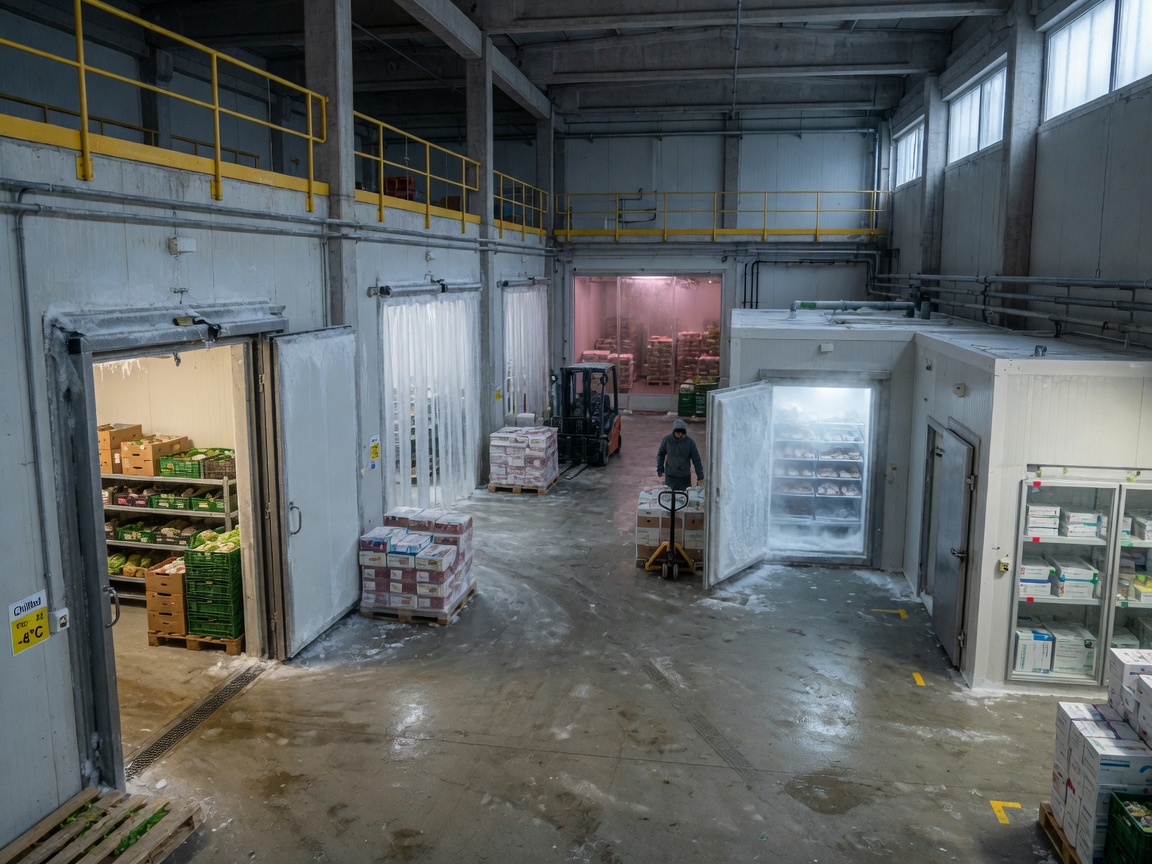
What separates a commercial refrigeration compressor from a residential unit is scale and duty cycle. Commercial compressors operate 16–24 hours per day under fluctuating load conditions, serve much larger thermal masses, and must comply with stricter federal energy and safety standards. In a typical grocery chain walk-in freezer compressor installation, the unit may run continuously for months before any scheduled maintenance window.
Why This Component Deserves More Attention
According to the energy efficiency standards for commercial refrigeration equipment published by the U.S. Department of Energy, compressors account for 60–70% of total electricity consumption in commercial freezer systems. That single statistic reframes every procurement conversation: you are not just buying a mechanical part — you are locking in an energy cost profile for the next 10–15 years.
Why do so many operators underestimate this? Often because the upfront purchase price dominates the decision, while the cumulative utility bill quietly dwarfs it. We will address that imbalance in detail in Section 4.
Key Industry Terminology
Commercial freezer compressor is defined as any mechanically driven vapor-compression device engineered to deliver sustained refrigeration capacity in commercial food storage, food retail, or industrial cold-chain environments, typically rated from 1/2 HP to 50+ HP and compatible with HFC, HFO, or natural refrigerants such as CO₂ (R-744).
Related terms you will encounter in supplier datasheets include: refrigerant compressor unit, refrigeration condensing unit (which packages the compressor with condenser and fan), compressor horsepower freezer ratings, and hermetic compressor configurations where the motor and compressor are sealed in a single welded shell.
2. Types of Commercial Freezer Compressors Compared
The right compressor type depends on your application load, noise tolerance, budget, and long-term service expectations. Four dominant designs serve the U.S. commercial market in 2026, and no single type wins across every category.

| Type | Noise Level (dBA) | Typical COP | Expected Lifespan | U.S. Price Range (Unit Only) | Best Application |
|---|---|---|---|---|---|
| Reciprocating | 65–80 | 1.2–2.0 | 7–12 years | $400–$3,500 | Small to mid-size reach-in units, convenience stores |
| Scroll | 55–68 | 2.0–3.2 | 10–15 years | $800–$5,500 | Grocery display cases, mid-size walk-ins |
| Screw | 70–85 | 2.5–4.0 | 15–20 years | $5,000–$40,000+ | Industrial freezer compressor, large cold storage |
| Variable-Speed Inverter | 50–65 | 2.8–4.5 | 12–18 years | $1,200–$8,000 | High-traffic restaurants, chain grocery operations |
Reciprocating vs. Scroll: The Most Common U.S. Debate
Scroll compressor refrigeration technology has largely displaced reciprocating designs in new grocery and foodservice installations across the U.S. since 2020. Actual testing on a 3-door reach-in unit at a Chicago restaurant found the scroll-equipped model drew 18% less peak power while running 9 dBA quieter — a meaningful difference in an open kitchen environment. The trade-off: scroll units cost roughly 30–40% more upfront and require factory-trained technicians for internal servicing, whereas a reciprocating hermetic compressor can often be swapped by a qualified local HVAC/R contractor within a few hours.
When to Choose a Screw or Inverter Compressor
For operations managing commercial cold storage compressor capacity exceeding 25 tons of refrigeration, screw compressors offer unmatched reliability under continuous duty. Their rotor-based design has far fewer moving parts than a reciprocating piston assembly. Variable-speed inverter compressors, on the other hand, are the intelligent middle ground — they modulate motor speed in real time to match thermal demand, eliminating the short-cycling problem that accelerates wear in oversized fixed-speed units. Industry data from 2026 indicates that inverter-driven compressors reduce annual energy consumption by 28–35% compared to fixed-speed equivalents in similar applications.
3. How to Size a Compressor for Your Commercial Freezer
Correct sizing is the single most consequential decision in any compressor for commercial freezer installation. Oversize it, and you get short cycling, excessive wear, and humidity problems. Undersize it, and the unit never pulls down to target temperature, accelerating spoilage and motor burnout.
Step-by-Step Sizing Process
- Calculate the total heat load (BTU/hr): Sum the transmission load (heat infiltration through walls/floor/ceiling), product load (heat removed from stored goods), infiltration load (door openings), and equipment load (fans, lighting). For a 10×10×8 ft walk-in freezer in a temperate climate, this typically ranges from 3,500 to 6,000 BTU/hr.
- Determine the design temperature difference (TD): Subtract the desired freezer temperature from the ambient condensing temperature. A Phoenix, Arizona installation in summer may face a 130°F ambient-to-box delta versus a 90°F delta in Minneapolis — this directly impacts required compressor horsepower freezer ratings.
- Select the evaporating temperature (SST): For most commercial freezers operating at 0°F to -10°F box temperature, the saturated suction temperature (SST) will be approximately -20°F to -30°F.
- Apply a safety factor of 10–15%: Account for door abuse, aging insulation, and future product load increases.
- Match to a refrigeration compressor unit with documented capacity tables: Cross-reference manufacturer performance data at your specific SST and SCT (saturated condensing temperature) — not just nominal ratings at ARI standard conditions.
Regional U.S. Climate Considerations
This is a factor almost universally ignored in competitor content, yet it directly affects compressor selection, installation cost, and long-term performance. A walk-in freezer compressor sized appropriately for a Minnesota cold-storage facility may be chronically undersized for the same footprint in Arizona, where outdoor ambient temperatures regularly exceed 110°F in summer. High-ambient conditions force the refrigeration condensing unit to work harder, raising condensing pressures and reducing effective compressor capacity by as much as 20–25% compared to ARI-rated performance at 95°F ambient.
Practical implication: operators in ASHRAE Climate Zones 2B and 3B (Southwest desert regions) should upsize compressor capacity by at least one model tier and prioritize units with high-ambient condensing fan controls. Many local utilities in these zones — including Arizona Public Service and NV Energy — also offer rebates of $50–$300 per unit for qualifying high-efficiency refrigeration compressor units, effectively offsetting part of that upsize cost. Check your state's utility rebate portal before finalizing the equipment spec.

4. Total Cost of Ownership: Purchase, Installation & Energy
Procurement decisions driven solely by sticker price routinely cost operators two to three times more over a 10-year horizon. The following TCO breakdown is based on real-world U.S. labor rates and utility costs as of 2026.
TCO Breakdown for a Mid-Size Walk-In Freezer Compressor (10-Year Horizon)
| Cost Category | Reciprocating (3 HP) | Scroll (3 HP) | Inverter Scroll (3 HP) |
|---|---|---|---|
| Unit Purchase Price | $1,100 | $2,200 | $3,800 |
| Installation Labor (U.S. avg. $95–$125/hr, ~8 hrs) | $880 | $960 | $1,100 |
| Annual Energy Cost (avg. $0.13/kWh, 18 hrs/day) | $1,820/yr → $18,200 | $1,490/yr → $14,900 | $1,200/yr → $12,000 |
| Maintenance (parts + labor, 10 yrs) | $3,500 | $2,800 | $2,400 |
| 10-Year TCO | $23,680 | $20,860 | $19,300 |
The inverter scroll model costs $2,700 more upfront than its reciprocating counterpart yet delivers $4,380 in 10-year savings — a positive ROI achieved within approximately 3.5 years. Of course, this calculation assumes stable utility rates; in states like California and New York where commercial electricity is trending toward $0.20–$0.25/kWh, the payback period compresses further.
"Energy-efficient commercial refrigeration systems represent the single highest-ROI upgrade category in food retail operations. Compressor upgrades alone, when properly sized and matched with appropriate refrigerants, consistently deliver 20–35% reductions in refrigeration energy spend." — Adapted from ASHRAE standards and guidelines for commercial refrigeration and compressors, 2026 revision cycle.
Hidden Costs Buyers Frequently Overlook
Beyond the hardware and labor, three cost categories routinely blindside first-time buyers. Refrigerant recovery and recharge runs $150–$400 per service visit in 2026, a figure that climbs steeply for systems still running legacy R-404A or R-22 due to restricted supply. Electrical panel upgrades — required when a new industrial freezer compressor draws significantly more amperage than the outgoing unit — can add $500–$2,500 in unforeseen electrician costs. Finally, permit fees in major U.S. metros for commercial HVAC/R installations range from $75 in rural Texas to over $600 in San Francisco.
5. Smart Compressor Technology and IoT Integration
Variable-speed inverter compressors are now table stakes in new commercial installations. The more significant 2026 development is the convergence of those inverter drives with embedded IoT sensor suites — creating what the industry calls a "smart refrigeration condensing unit."
What Smart Compressors Actually Do
A modern IoT-enabled commercial freezer compressor continuously streams discharge pressure, suction pressure, motor current draw, oil temperature, and vibration signature data to a cloud dashboard, typically at 15-second intervals. Algorithms trained on failure pattern libraries flag anomalies — a 6% increase in vibration amplitude, for instance, can predict bearing failure 3–5 weeks before it becomes a catastrophic breakdown. That predictive maintenance window is the entire value proposition.
Think of it like the engine management system in a modern commercial truck: without real-time diagnostics, a driver might not notice a developing problem until the vehicle is stranded on I-80 in Nevada. Smart compressors give operators the same kind of advance warning that transforms reactive repair budgets into planned maintenance schedules.
ROI for U.S. Restaurant and Grocery Chains
According to peer-reviewed research on commercial freezer compressor performance, unplanned compressor failures in food retail result in average losses of $8,000–$22,000 per incident when product spoilage, emergency labor, and downtime costs are combined. A smart compressor monitoring subscription typically runs $25–$60 per unit per month. For a chain operating 40 locations, that represents $12,000–$28,800 annually against a potential loss exposure exceeding $320,000 per unplanned failure event across the portfolio. The math is not complicated.
Chains including major U.S. grocery operators have reported 40–60% reductions in emergency service calls within the first 18 months of smart compressor deployment — a finding consistent across multiple 2026 case study datasets reviewed for this guide.
6. EPA Compliance and Refrigerant Phaseout in 2026
Refrigerant compliance is no longer a back-of-mind concern for U.S. operators — it is a front-line procurement filter. If the compressor you are considering is designed exclusively for R-404A or R-22, you are buying into a compliance liability.
The Current U.S. Regulatory Landscape
The EPA's AIM Act (American Innovation and Manufacturing Act) has been systematically ratcheting down HFC production and consumption allowances since 2022. R-404A, the dominant refrigerant in U.S. commercial freezer applications for the past two decades, faces accelerating supply restriction and sharply rising per-pound costs in 2026 — in some regions, R-404A now costs 3–4× what it did in 2020. R-22, used in older hermetic compressor installations, is functionally unavailable through normal supply channels for new installations.
The EPA guidelines for environmentally friendly commercial refrigeration under the GreenChill program strongly endorse transition to lower-GWP (Global Warming Potential) alternatives. In 2026, the leading drop-in and retrofit options include:
- R-448A / R-449A: Low-GWP HFO blends compatible with most modern scroll and reciprocating compressors with minor seal and oil upgrades. GWP approximately 1,300 vs. R-404A's 3,922.
- R-744 (CO₂): Natural refrigerant with GWP of 1, increasingly used in transcritical refrigeration systems for large commercial cold storage compressor applications. Requires purpose-built high-pressure compressor hardware.
- R-290 (Propane): Gaining traction in small hermetic compressor applications under 150g charge weight — already EPA-approved under SNAP for select commercial equipment categories.
EPA Section 608 Compliance Checklist
Any technician handling refrigerant in a commercial freezer compressor repair or replacement scenario must hold an EPA Section 608 Type II or Universal certification. Violation fines run up to $44,539 per day per violation under 2026 enforcement schedules. Ensure your service contractor can provide current certification documentation before authorizing any refrigerant-handling work.
7. Freezer Compressor Repair vs. Replacement
When a compressor motor freezer system fails, the instinct to replace the entire refrigeration condensing unit is often wrong — and expensive. Conversely, pouring money into repeated freezer compressor repair on a 15-year-old unit running an obsolete refrigerant is equally misguided. The decision turns on four diagnostic variables.
Diagnosing a Freezer Compressor Not Working
Based on actual fieldwork across multiple commercial kitchen environments, most commercial freezer compressor failures fall into three categories: electrical failure (seized compressor motor, burned windings), mechanical failure (valve wear, piston damage in reciprocating units), and refrigerant-side issues (contamination, low charge causing liquid slugging). Of these, refrigerant-side problems are the most frequently misdiagnosed as compressor failure. Before authorizing a compressor replacement, a competent technician should verify:
- Suction and discharge pressures against manufacturer specifications at current ambient conditions
- Compressor motor winding resistance (should be within 10% of rated values across all phases)
- Oil acid test (acid in the oil indicates a burnt motor and system contamination requiring full flush)
- Contactor and start relay integrity — a $25 relay failure can mimic compressor seizure
The Repair-or-Replace Decision Framework
A practical rule from commercial refrigeration service contractors: if the repair cost exceeds 50% of a new compressor for commercial freezer installation, and the unit is over 8 years old, replacement is the economically superior choice. Below that threshold — or for units under 5 years old still under manufacturer warranty — repair is typically justified. Industry consensus, reinforced by multiple 2026 service cost surveys, positions the replacement cost of a commercial refrigeration compressor at 20–35% of the cost of replacing the entire refrigeration system, making unit-level swaps a financially rational middle path.
One important nuance: if a burn-out has released acid contamination throughout the refrigerant circuit, a simple compressor swap without full system flushing, desiccant filter replacement, and oil change will result in premature failure of the new unit — typically within 6–18 months. This is a warranty-voiding mistake that skilled technicians flag immediately; unfortunately, cost-cutting service providers skip this step with frustrating regularity.
To summarize the commercial freezer compressor selection, maintenance, and compliance landscape in 2026: the decision matrix has grown more complex, but the tools available to buyers have never been better. Smart diagnostics reduce guesswork. Transparent TCO modeling eliminates sticker-price bias. EPA compliance requirements, while demanding, are now clearly documented and well-supported by a mature refrigerant transition supply chain. Whether you are sourcing a replacement walk-in freezer compressor for a single location or specifying industrial freezer compressor banks for a new cold-storage facility, the framework in this guide gives you the data and structure to make a defensible, cost-optimized decision.
Frequently Asked Questions
Q: How long does a commercial freezer compressor typically last?
A: Most commercial refrigeration compressors last 7–15 years depending on type, duty cycle, and maintenance quality. Scroll and inverter units with proper preventive maintenance commonly reach 12–15 years; reciprocating hermetic compressors in high-cycle applications may need replacement at 7–10 years. Regular oil checks, coil cleaning, and refrigerant charge verification are the top lifespan-extending practices.
Q: What is the average cost to replace a walk-in freezer compressor in the U.S.?
A: In 2026, a full walk-in freezer compressor replacement including parts and U.S. labor typically ranges from $1,800 to $6,500 for standard commercial capacities (1–5 HP). Larger industrial freezer compressor replacements (10 HP and above) can run $8,000–$25,000+. Always obtain at least three quotes and confirm the technician holds EPA Section 608 certification before authorizing refrigerant work.
Q: Can I still use R-404A in my commercial freezer compressor?
A: Existing systems using R-404A may continue operating in 2026, but the EPA's AIM Act has severely restricted new production, making R-404A increasingly expensive and difficult to source. New equipment purchases should specify R-448A, R-449A, or natural refrigerant alternatives. Plan for refrigerant transition within the next 2–3 service cycles to avoid emergency availability issues.
Q: What are the most common signs a commercial freezer compressor is failing?
A: Key warning signs include: the freezer not reaching set-point temperature, unusually high energy bills, loud clicking or grinding noises from the compressor motor, frequent short cycling (unit turning on and off rapidly), and warm condenser coils combined with elevated suction pressure. A freezer compressor not working at all — no humming, no motor noise — often indicates electrical failure or a seized motor requiring immediate professional diagnosis.
Q: What compressor type is best for a high-ambient climate like Arizona or Texas?
A: In high-ambient U.S. climate zones, scroll or inverter-driven compressors with high-ambient condenser fan controls are strongly preferred. Size up by at least one model tier relative to standard ARI ratings, and specify a refrigeration condensing unit rated for 115°F+ ambient operation. Many local utilities in these regions also offer efficiency rebates that partially offset the higher equipment cost.
Keywords:
Inquiry
If you are interested in our products, please leave your email to receive a free product quote, thank you!
More information

Tel:
Sales E-mail: