

Cold room refrigeration system: complete guide to types, costs & installation
Release Time:
Oct 07,2026
Author:

Article overview
This guide is written for facility managers and food storage operators who are actively comparing cold room refrigeration solutions and suppliers. It covers system types, sizing methods, lifecycle costs, US compliance rules, and the latest refrigerant transition requirements — everything you need to make a confident procurement decision in 2026.
Table of contents
- 1. What is a cold room refrigeration system?
- 2. Types of cold room refrigeration systems
- 3. How to size your system: BTU calculation and load factors
- 4. Full lifecycle cost breakdown
- 5. Build vs. lease: ROI model for small and mid-size businesses
- 6. US regulatory compliance: FDA, USDA, NSF, and EPA requirements
- 7. Refrigerant transition roadmap for 2026 and beyond
- 8. Frequently asked questions
What is a cold room refrigeration system?
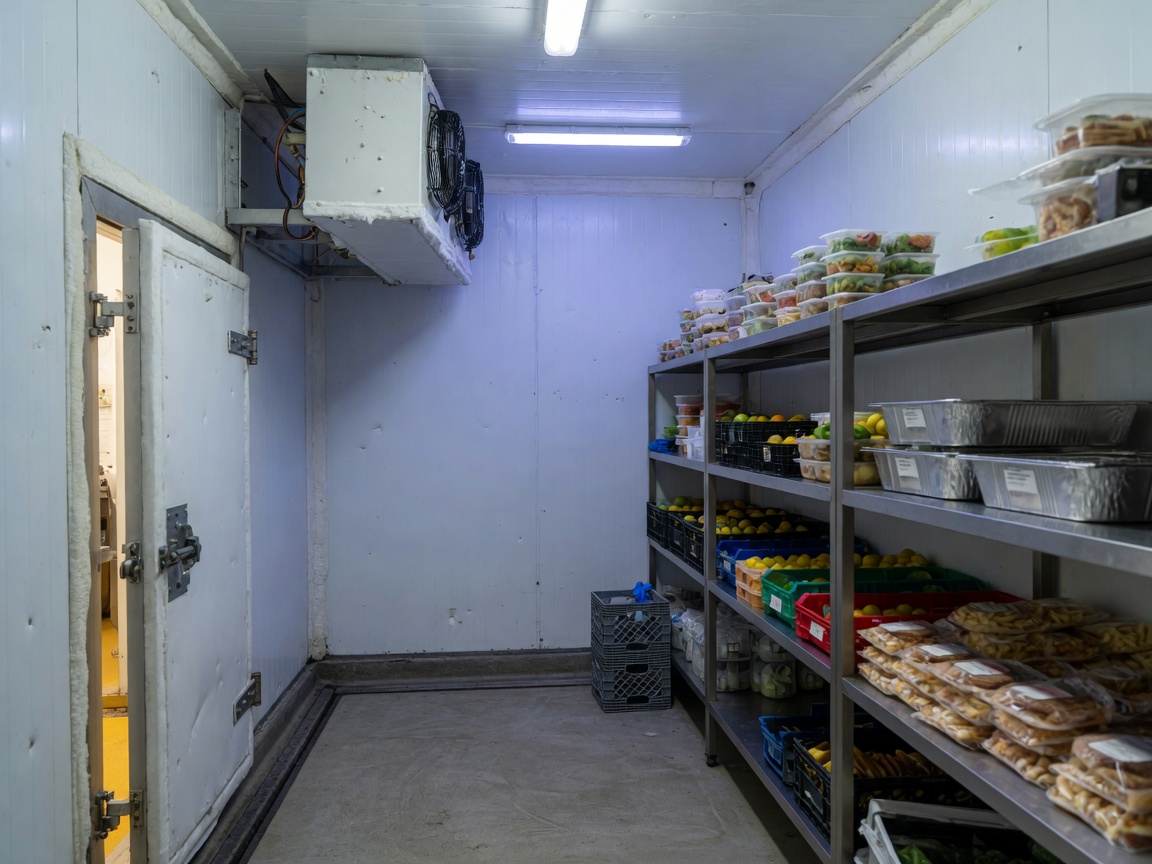
A cold room refrigeration system is a mechanical assembly — comprising a compressor, condenser, expansion valve, and evaporator — that continuously removes heat from an insulated enclosure to maintain a defined low-temperature environment for commercial or industrial storage. Unlike a residential refrigerator, this class of equipment is engineered for sustained duty cycles, high BTU loads, and strict regulatory compliance across food, pharmaceutical, and chemical applications.
Think of a cold room refrigeration system as an industrial-grade thermos — but one that actively pumps heat out rather than passively retaining it. The insulated enclosure resists heat ingress; the refrigeration unit continuously removes whatever heat does enter. It is a deceptively simple concept executed with considerable engineering precision.
For a deeper understanding of the underlying thermodynamic principles, the refrigeration systems overview on Wikipedia provides a solid foundation. What separates a cold room system from simpler cooling equipment is its ability to handle variable heat loads — from product pull-down after a delivery to door-open cycles during a busy shift — without allowing temperature to drift outside specification.
Core components and how they work together
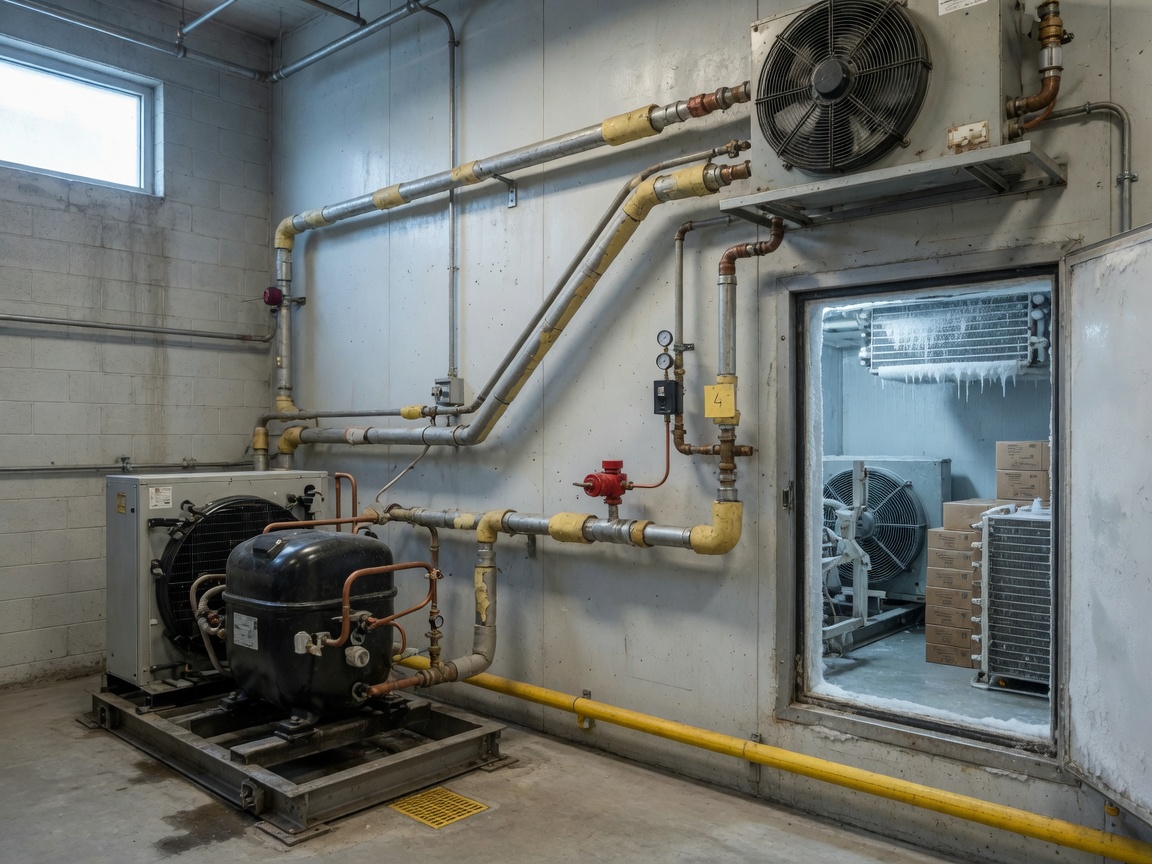
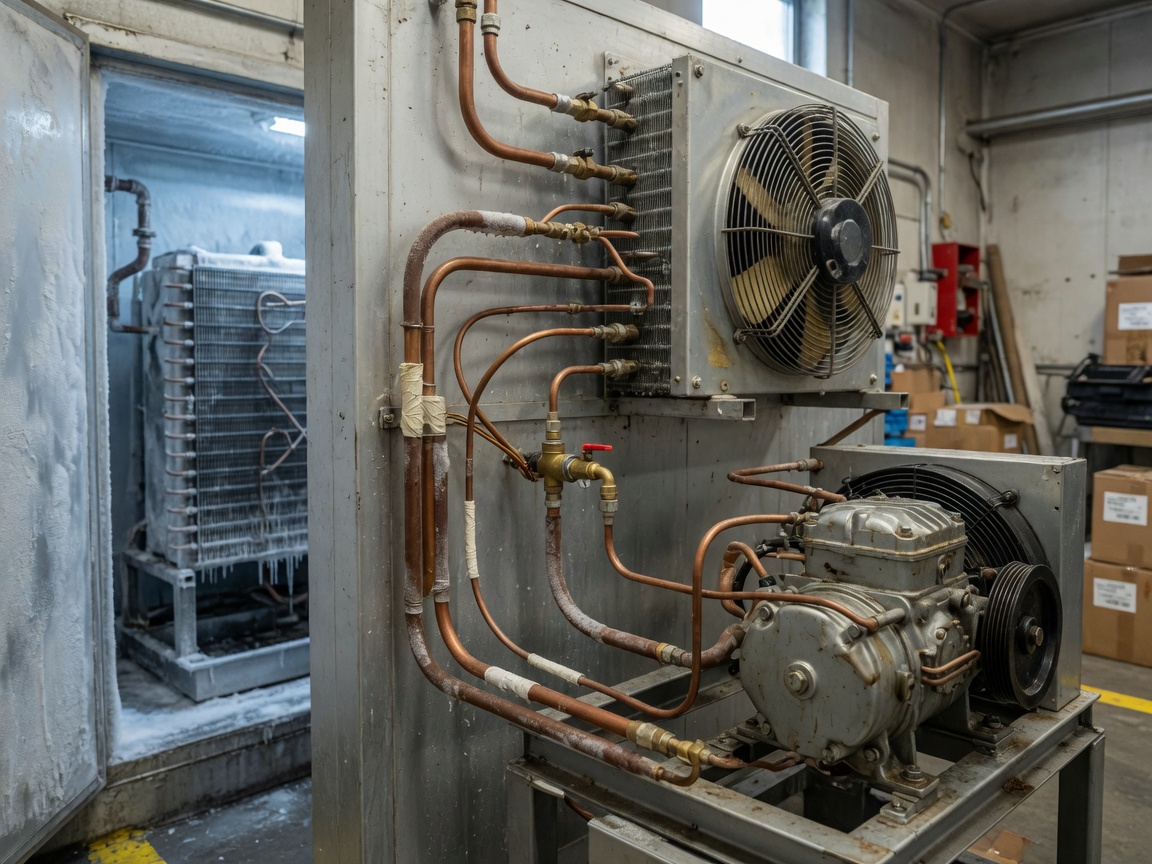
The refrigeration cycle follows four stages. The compressor pressurizes refrigerant vapor, raising its temperature. The condenser unit — mounted outdoors or in a remote machine room — dissipates that heat to ambient air or water. The expansion valve then drops refrigerant pressure sharply, causing rapid cooling. Finally, the cold room evaporator unit absorbs heat from inside the room, completing the loop. Each component failure cascades quickly: a fouled condenser coil, for example, can raise compressor head pressure by 15–20%, cutting efficiency and shortening compressor life.
Where cold room systems are used in the US market
Commercial applications dominate — grocery distribution centers, restaurant walk-in coolers, brewery cold rooms, and pharmaceutical storage facilities collectively represent the largest installed base. Industrial freezer room equipment is common in seafood processing, frozen food manufacturing, and cold storage warehousing. According to recent 2026 data, the global cold chain logistics market is valued at over $340 billion, with the US accounting for a significant share driven by food safety regulation and e-commerce grocery expansion.
Types of cold room refrigeration systems
The right system type is determined by your target temperature range, product type, and throughput — not by available floor space alone. Choosing the wrong category is one of the most expensive mistakes in commercial refrigeration installation.
Chiller rooms and walk-in coolers (33°F – 46°F)
A walk-in cooler refrigeration unit operating between 33°F and 46°F is the workhorse of food retail and food service. Dairy, fresh produce, beverages, and deli products all fall within this temperature range. These systems typically use a direct-expansion (DX) refrigerant circuit with a self-contained or remote condensing unit. Small configurations — under 200 sq ft — often use packaged units mounted through the wall. Larger installations favor split systems with a remote cold room condenser unit placed on the roof or in a mechanical room, reducing in-room noise and heat load.
Freezer rooms and blast freezers (-18°F to -10°F and below)
Industrial freezer room equipment must overcome significantly higher heat-load differentials than chiller systems, demanding more robust compressor staging and thicker insulation panels (typically 4–6 inches of polyurethane). Blast freezer refrigeration is a specialized subcategory: it pulls product core temperatures down rapidly — often from 40°F to -10°F within 90 minutes — using high-velocity airflow across oversized evaporator coils. Actual testing in food processing facilities confirms that improperly sized blast freezers are the single most common source of product quality complaints in frozen food operations.
Refrigerated warehouse and multi-zone systems
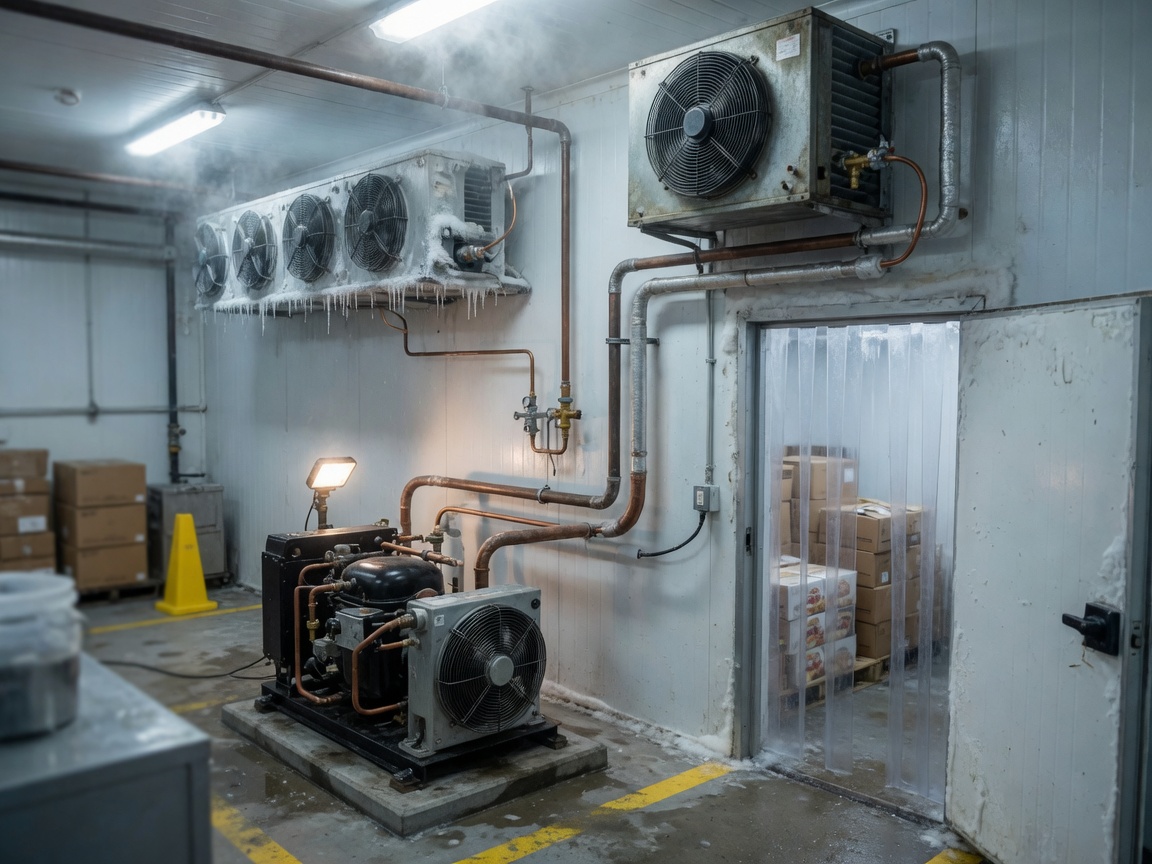
A refrigerated warehouse cooling system serving 10,000+ sq ft typically uses a centralized chiller room HVAC system with parallel compressor racks and a distributed evaporator network. Multi-zone configurations — combining chiller rooms, freezer rooms, and blast freezers within a single facility — are common in large distribution centers. The cold storage compressor unit in these settings is usually housed in a dedicated machine room, isolating heat rejection from the conditioned space and simplifying maintenance access.
Pharmaceutical and specialty cold rooms
Pharmaceutical cold rooms must comply with GDP/GMP standards and often require 35°F–46°F with ±0.5°F uniformity, redundant refrigeration circuits, and validated temperature mapping. These are a distinct market from commercial food storage systems, though the underlying refrigeration components overlap significantly. Medical-grade units also require uninterruptible power supply (UPS) backup and 21 CFR Part 11-compliant data logging.
| System type | Temperature range | Typical application | Avg. installed cost (US) | Common refrigerant |
|---|---|---|---|---|
| Walk-in cooler | 33°F – 46°F | Food retail, restaurant | $8,000 – $30,000 | R-448A, R-404A |
| Walk-in freezer | -10°F – 0°F | Frozen food storage | $15,000 – $55,000 | R-448A, R-507A |
| Blast freezer | -40°F – -10°F | Food processing, seafood | $25,000 – $80,000 | R-448A, CO₂ (R-744) |
| Refrigerated warehouse | -20°F – 40°F (multi-zone) | Distribution, 3PL | $100,000 – $500,000+ | NH₃ (R-717), CO₂ |
| Pharmaceutical cold room | 35°F – 46°F (±0.5°F) | Biotech, pharma | $40,000 – $150,000 | R-410A, R-32 |
How to size your system: BTU calculation and load factors
Correct sizing is the single most important technical decision in any cold room refrigeration system project. Oversized systems short-cycle, causing accelerated compressor wear and poor humidity control. Undersized systems run continuously and never achieve setpoint — a point that is surprisingly often overlooked even by experienced contractors.
The five heat load components you must calculate
- Transmission load: Heat conducted through walls, floor, and ceiling. Driven by insulation R-value, surface area, and indoor/outdoor temperature differential (ΔT).
- Product load: Heat removed when pulling product down to storage temperature. Use specific heat values: fresh beef ≈ 0.84 BTU/lb·°F above freezing.
- Infiltration load: Warm air entering through door openings. A busy grocery walk-in with 30 door-open events per hour can add 15–25% to total load.
- Equipment load: Heat from lighting, fan motors inside the room. LED lighting reduces this load by up to 60% vs. fluorescent fixtures.
- Occupancy load: Each person inside a cold room generates approximately 900 BTU/hr. Relevant in processing and picking operations.
How US climate zones affect system selection
Why do so many facilities in the South underperform their northern counterparts on refrigeration efficiency? The answer lies in ambient conditions. In Houston or Miami, summer ambient temperatures regularly reach 95°F–105°F with 80%+ relative humidity. This forces condensing temperatures up, sharply reducing compressor capacity and coefficient of performance (COP). A refrigeration unit for cold storage specified for Phoenix (dry heat) will be meaningfully undersized in New Orleans. Southern US facilities should add a 10–15% capacity buffer and strongly consider evaporative pre-coolers or adiabatic cooling on condensers to manage peak-day load. Northern facilities in Minnesota or Wisconsin face a different challenge: sub-zero ambient temperatures in winter can cause head pressure control issues, requiring pressure-regulating valves on outdoor condenser units to prevent refrigerant flood-back.
Full lifecycle cost breakdown
Most procurement decisions are made on equipment purchase price alone. This is a mistake that costs operators tens of thousands of dollars over the life of the system. A complete economic evaluation of a commercial cold storage system must account for three cost buckets across a 10-year horizon.
Equipment acquisition cost
Cold room cooling system installation costs vary widely. A small 8×10 ft walk-in cooler with a self-contained unit runs $8,000–$15,000 installed. A 20×30 ft walk-in freezer with a remote split system runs $25,000–$55,000. Large refrigerated warehouse systems with centralized compressor racks can reach $300,000–$500,000 or more. These figures include panels, refrigeration equipment, electrical rough-in, and commissioning — but not floor drains, structural modifications, or permitting fees, which add 10–20% in most US jurisdictions.
Annual energy cost
Refrigeration accounts for 40%–60% of a cold storage facility's total energy bill, according to 2026 data from the US Department of Energy. A 200 sq ft walk-in cooler running in a Midwest warehouse will consume roughly 8,000–12,000 kWh per year. At the US commercial average of $0.12/kWh, that is $960–$1,440 annually — before demand charges. A 5,000 sq ft freezer warehouse can easily exceed $60,000/year in electricity costs. Energy-efficient systems with EC fan motors, variable-speed compressors, and LED lighting can cut this figure by 25–35%. For current benchmarks, the commercial refrigeration efficiency resources from the US Department of Energy provide a reliable reference point.
Maintenance and repair cost
Budget 2%–4% of equipment value per year for planned maintenance on a well-specified commercial refrigeration installation. This covers coil cleaning, refrigerant charge verification, electrical connection retightening, and door gasket replacement. Unplanned repairs — compressor failures, refrigerant leaks, defrost control failures — average $1,500–$8,000 per incident. Facilities with remote monitoring and predictive maintenance platforms (now standard on IoT-enabled systems in 2026) report 30–40% reductions in unplanned downtime. Of course, older systems without smart controls will see higher emergency repair rates, particularly after the five-year mark.
"The total cost of ownership for commercial refrigeration over a 10-year period typically runs 2.5–3× the initial equipment purchase price when energy and maintenance are properly accounted for. Operators who evaluate only capital cost are systematically underestimating their exposure." — Industrial Refrigeration Consortium, 2025 benchmarking report
Build vs. lease: ROI model for small and mid-size businesses
For small and mid-size food businesses, the build-vs-lease decision is one of the most consequential and least-discussed questions in cold storage planning. Leasing a prefabricated modular cold room avoids large upfront capital outlay but carries a long-term premium that can erode margins significantly.
Build scenario: 200 sq ft walk-in freezer
Upfront cost: approximately $35,000 (installed). Annual energy: $6,000. Annual maintenance: $1,200. Year-1 total outlay: $42,200. Over 10 years, cumulative cost: approximately $77,000 (energy and maintenance only after Year 1). The asset sits on your balance sheet and retains residual value. If the unit lasts 15 years — realistic for a well-maintained system — the effective annual cost drops to under $7,000.
Lease scenario: equivalent modular cold room
Typical US lease rates for a 200 sq ft modular freezer room run $1,800–$2,800/month, all-inclusive (maintenance, but not energy). At $2,200/month average, the 10-year outlay is $264,000 — more than 3× the build scenario's total cost. The lease makes sense when capital is constrained, when the facility is temporary, or when operational flexibility (scale-up/scale-down) outweighs the cost premium. For businesses with stable volume projections and owned or long-leased premises, building is almost always the superior ROI choice beyond a 3-year horizon.
US regulatory compliance: FDA, USDA, NSF, and EPA requirements
Regulatory compliance is non-negotiable in US commercial refrigeration. Enforcement actions from FDA, USDA, and state agencies result in facility shutdowns, product recalls, and civil liability — risks that dwarf the cost of compliant equipment.
FDA 21 CFR 117 and food safety modernization requirements
Under FDA 21 CFR Part 117 (FSMA Preventive Controls for Human Food), facilities storing refrigerated ready-to-eat products must implement and document temperature controls as a preventive control. This means continuous temperature monitoring with calibrated sensors, defined corrective action procedures when temperature excursions occur, and records retained for a minimum of two years. Cold room evaporator units and freezer room temperature control systems must be capable of maintaining setpoint within ±2°F under maximum anticipated load conditions — not just under ideal conditions.
USDA cold chain requirements and NSF certification
USDA-regulated facilities (meat, poultry, egg products) must maintain product at or below 40°F (chilled) or 0°F (frozen) throughout storage, with FSIS verification access. All food-contact surfaces and equipment in refrigerated spaces must meet NSF/ANSI Standard 7 for commercial refrigerators and freezers, or NSF/ANSI Standard 2 for food equipment generally. NSF certification is increasingly treated as a baseline requirement by retail grocery buyers and foodservice distributors — not merely a regulatory checkbox. Walk-in freezer refrigeration components including evaporator coil housings, drain pans, and fan guards must all be fabricated from NSF-approved materials.
EPA Section 608 and refrigerant regulations
EPA Section 608 regulations govern the handling, recovery, and disposal of refrigerants in commercial refrigeration installation and service. As of 2026, technicians servicing systems with more than 50 lbs of refrigerant charge must hold EPA 608 certification. Venting of any refrigerant is a federal violation. Facilities using legacy R-22 equipment face escalating compliance costs as the refrigerant becomes increasingly scarce and expensive — a driver pushing many operators toward early system replacement.
Refrigerant transition roadmap for 2026 and beyond
The refrigerant landscape is shifting faster in 2026 than at any point in the past two decades. R-22 is gone from production. R-404A and R-507A — the dominant HFCs in walk-in freezer refrigeration components and blast freezer refrigeration systems — face phasedown schedules under the AIM Act. Understanding the transition options is essential for any new cold room refrigeration system specification.
HFC drop-in replacements: R-448A and R-449A
R-448A (Solstice N40) and R-449A (Opteon XP40) are the primary near-term replacements for R-404A in medium and low-temperature food storage cooling equipment. Both deliver GWP reductions of approximately 65% vs. R-404A while operating in existing system hardware with minor adjustments (oil change, TXV retuning). Real-world testing in US grocery distribution facilities confirms COP improvements of 5–8% in medium-temperature applications. These are bridge solutions — not the endgame — but they are the pragmatic choice for system retrofits over the next five to seven years.
Natural refrigerants: CO₂, ammonia, and their role in 2026
CO₂ transcritical systems (R-744) have crossed the commercial viability threshold in the US market. Major grocery chains including Whole Foods and Kroger have deployed CO₂ rack systems in new store builds across multiple climate zones. In colder northern markets, CO₂ transcritical systems now achieve COP parity with HFC systems. In hot southern markets, parallel compression and gas cooler optimization are required to maintain efficiency — adding $15,000–$40,000 to system cost but enabling full AIM Act compliance. Ammonia (R-717) remains the dominant refrigerant in large-scale industrial freezer room equipment and refrigerated warehouse cooling systems above 100,000 sq ft due to its zero GWP and exceptional thermodynamic efficiency. For mid-size applications (5,000–30,000 sq ft), low-charge ammonia systems with secondary CO₂ distribution loops — so-called NH₃/CO₂ cascade systems — are gaining traction as the preferred future-proof architecture for new cold storage compressor unit installations.
What to specify for new systems today
For new cold room cooling system installations in 2026, the specification guidance is clear: avoid R-404A and R-507A on any new equipment; specify R-448A or R-449A for near-term HFC systems; and evaluate CO₂ transcritical or NH₃/CO₂ cascade for any system above 50 tons of refrigeration. Future-proofing your system against the next round of AIM Act phasedowns is not just environmental responsibility — it is sound financial planning. Stranded-asset risk on high-GWP refrigerant systems is real and quantifiable.
Choosing the right partner for your cold room refrigeration system
A cold room refrigeration system is a long-term asset. The supplier relationship matters as much as the equipment specification. When evaluating vendors, prioritize documented installation references in your climate zone, in-house EPA 608-certified technicians, documented NSF compliance for food-contact components, and a clear refrigerant transition strategy aligned with AIM Act timelines. Request a 10-year lifecycle cost projection — any supplier unwilling to provide one deserves scrutiny. The commercial refrigeration landscape in 2026 rewards buyers who ask technical questions and penalizes those who optimize solely on sticker price.
Frequently asked questions
Q: How long does a cold room refrigeration system typically last?
A: A well-maintained commercial cold room refrigeration system has a service life of 12–20 years for the structural panels and 10–15 years for the refrigeration equipment. Compressors typically carry 5-year warranties and may require replacement at the 10–12-year mark. Regular preventive maintenance is the single largest determinant of system longevity.
Q: What size cold room refrigeration unit do I need for a 500 sq ft walk-in cooler?
A: A 500 sq ft walk-in cooler at 35°F with standard 4-inch insulated panels and moderate door traffic typically requires 3–5 tons of refrigeration (36,000–60,000 BTU/hr). Exact sizing depends on product load, occupancy, lighting, and local ambient temperatures. Always perform a full heat load calculation before specifying equipment.
Q: Is R-22 still legal to use in existing cold room systems in the US?
A: Yes — using recovered or reclaimed R-22 in existing equipment is still legal in the US as of 2026. However, R-22 production and import have been banned since 2020, making the refrigerant scarce and expensive (often $30–$60/lb). Any significant repair or refrigerant loss event on an R-22 system is now a strong economic trigger for full system replacement.
Q: What is the difference between a split system and a self-contained cold room refrigeration system?
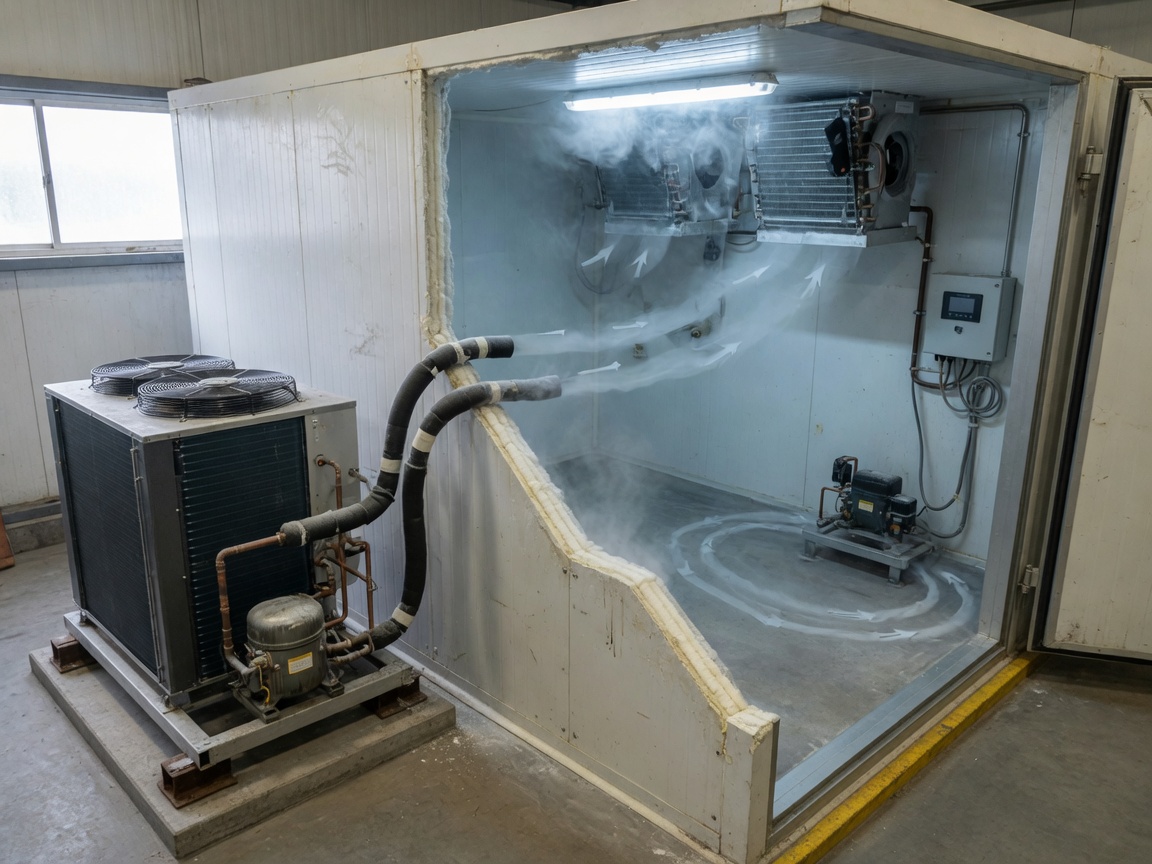
A: A self-contained unit houses the compressor, condenser, and evaporator in a single assembly mounted through the wall — simpler to install but louder and less efficient. A split system separates the condensing unit (outdoors or in a machine room) from the indoor evaporator, offering quieter operation, better heat rejection, and higher efficiency, at greater installation cost and complexity.
Q: Do I need NSF certification for a cold room used only for non-food storage?
A: NSF certification is specifically required for food-contact and food storage applications under FDA and USDA regulations. For non-food cold storage — pharmaceutical, chemical, or floral — NSF is not mandated, though pharmaceutical applications carry their own GDP/GMP equipment qualification requirements. Always confirm requirements with your local health department and relevant federal agency before specifying equipment.
Keywords:
Inquiry
If you are interested in our products, please leave your email to receive a free product quote, thank you!
More information


Tel:
Sales E-mail: