

Cold room refrigeration guide: how it works, types and key cost factors
Release Time:
Oct 07,2026
Author:

Article overview
This 2026 buyer's guide to cold room refrigeration is written for US-based procurement managers, food-service operators, and facility engineers. It covers system mechanics, product types, regulatory compliance (EPA, DOE, ASHRAE, FDA/USDA), refrigerant transition timelines, and a full TCO model — the exact decision-support content most competing guides omit.
Table of contents
- 1. What is cold room refrigeration?
- 2. How a cold room refrigeration system works
- 3. Types of cold room refrigeration systems
- 4. FDA/USDA compliance and temperature requirements
- 5. US regulatory landscape: EPA, DOE, and ASHRAE standards
- 6. Refrigerant transition: R-404A phase-out and what comes next
- 7. Custom-built vs. prefab modular cold rooms: a decision framework
- 8. Total cost of ownership (TCO) analysis
- 9. FAQ
What is cold room refrigeration?
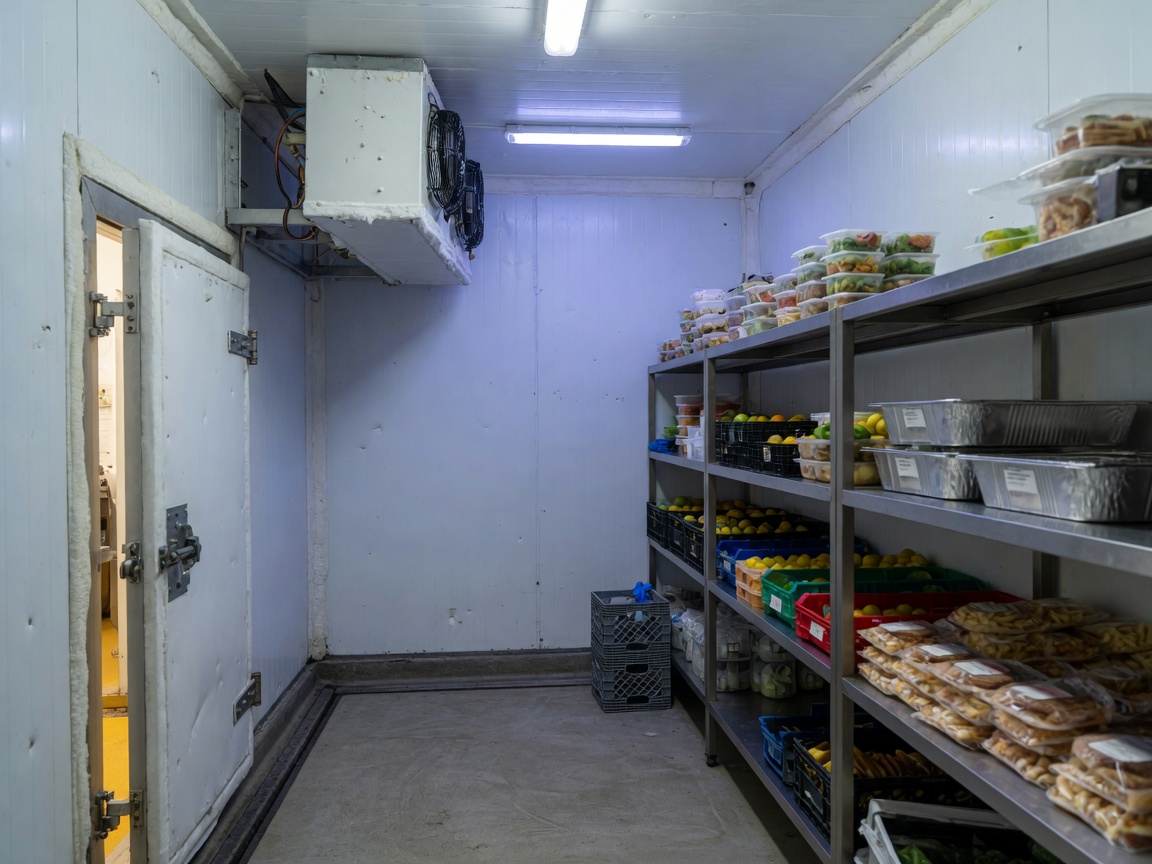
Cold room refrigeration is a mechanical cooling system that maintains a sealed, insulated enclosure at a defined low temperature — typically between -40°F and 55°F — for commercial or industrial storage of perishable goods. Unlike residential refrigerators, these systems are engineered for sustained duty cycles, high BTU loads, and strict regulatory compliance across food, pharmaceutical, and chemical applications.
Think of a cold room refrigeration system as an industrial-grade thermos — but one that actively pumps heat out rather than passively retaining it. The insulated enclosure resists heat ingress; the mechanical system continuously removes any heat that does enter. Together, they create a stable temperature-controlled storage environment where product integrity is maintained around the clock.
According to recent industry data, the global cold storage market exceeded $260 billion in 2025, with US commercial refrigeration representing a significant share driven by food retail expansion and pharmaceutical cold-chain mandates. Yet roughly 30% of food cold-chain losses trace back to temperature instability inside cold rooms — a figure the FAO has flagged repeatedly. That statistic alone explains why proper system design matters so much.
How a cold room refrigeration system works
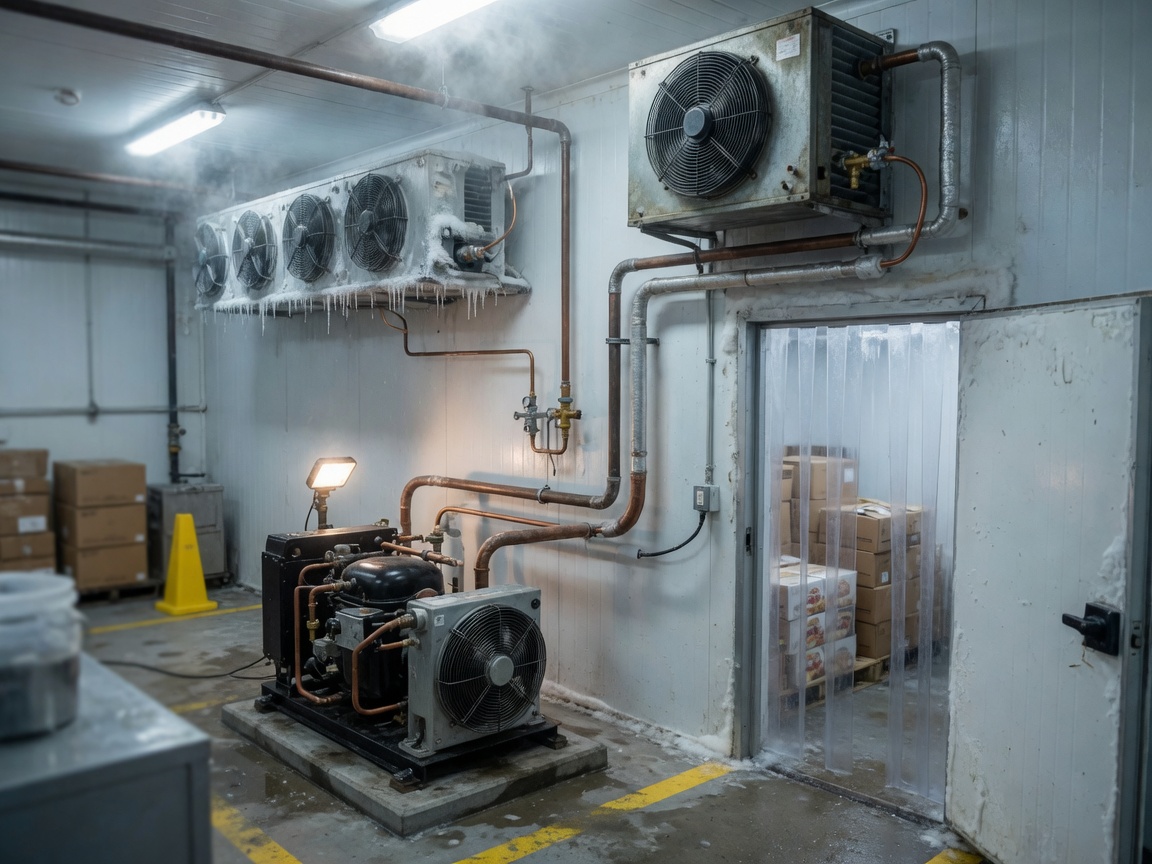
Every industrial refrigeration system — whether a small walk-in cooler or a large refrigerated warehouse — operates on the same vapor-compression refrigeration cycle. Understanding this cycle is essential before you specify any equipment.
The four core stages are:
- Compression: The compressor pressurizes low-pressure refrigerant vapor, raising its temperature significantly. This is the heart of the system — and the largest energy consumer.
- Condensation: Hot high-pressure vapor travels to the condenser (typically roof-mounted or remote), where heat is rejected to the outside air and the refrigerant becomes a high-pressure liquid.
- Expansion: The liquid refrigerant passes through an expansion valve, rapidly dropping in pressure and temperature — entering the evaporator as a cold, low-pressure mixture.
- Evaporation: Inside the cold room, the evaporator unit absorbs heat from the stored air, causing the refrigerant to vaporize. This is where actual cooling occurs. The now-warm vapor returns to the compressor and the cycle repeats.
An industrial cold room system operates under entirely different thermal stress compared to residential equipment — sustained duty cycles exceeding 18 hours per day, reinforced refrigeration insulation panels (typically 4–6 inches of polyurethane foam), and compressors sized for high BTU loads. The engineering gap between consumer and commercial refrigeration is substantial and should never be underestimated during procurement.
Cold room temperature control is managed through electronic controllers that modulate compressor run-time, expansion valve opening, and defrost cycles. In 2026, IoT-integrated controllers with cloud dashboards are rapidly becoming the baseline specification for any new commercial cold storage installation.
Types of cold room refrigeration systems
Not all cold rooms are created equal. The right category depends on your target temperature range, product type, and throughput — not simply on available floor space.
Chiller rooms and walk-in coolers (33°F – 46°F)
A chiller room — also called a walk-in cooler — is the workhorse of food retail and food service. Operating between 33°F and 46°F, these units suit dairy, fresh produce, beverages, and deli products. The evaporator unit refrigeration load is moderate, allowing for quieter, lower-capacity compressors. Most US restaurants and grocery distribution centers rely on this category as their primary cold storage unit.
Walk-in freezers and freezer rooms (-10°F to 0°F)
A walk-in freezer demands a more robust refrigeration circuit — lower suction temperatures, higher compression ratios, and more aggressive defrost cycles to prevent evaporator icing. Standard operating range is -10°F to 0°F, appropriate for frozen meats, seafood, and ice cream. Industrial variants classified as blast freezers can push product core temperatures to -40°F within hours, critical for IQF (Individually Quick Frozen) processing lines.
Refrigerated warehouse and cold chain storage
A refrigerated warehouse scales the same principles to 10,000 sq ft or more. These facilities anchor cold chain storage networks for regional distributors and large-scale food processors. Multi-zone configurations — combining chiller rooms, freezer rooms, and blast freezers within a single facility — are common. The industrial refrigeration system in these settings is typically centralized, with a remote machine room housing multiple parallel compressors and a plant-wide piping distribution network.
Specialty cold rooms: pharmaceutical and ultra-low temperature
Pharmaceutical cold rooms must comply with GDP/GMP standards and often require 2°C–8°C (35°F–46°F) with ±0.5°C tolerance — far tighter than food-grade specs. Ultra-low temperature units operate below -40°F and are used for tuna processing and certain biomedical applications. These categories carry a significant cost premium but are non-negotiable where product liability is involved.
"The temperature range and humidity tolerance of your stored product should drive system selection — not budget alone. Undersized equipment that cycles continuously will fail years ahead of schedule and cost far more in repairs and product loss than the upfront savings justify." — ASHRAE Refrigeration Handbook, 2024 edition
| Type | Temperature range | Typical use | Avg. install cost (US) | Annual energy (kWh/yr, 400 sq ft) |
|---|---|---|---|---|
| Walk-in cooler | 33°F – 46°F | Produce, dairy, deli | $8,000 – $20,000 | 12,000 – 18,000 |
| Walk-in freezer | -10°F to 0°F | Meat, seafood, frozen food | $15,000 – $35,000 | 22,000 – 34,000 |
| Blast freezer | -40°F to -10°F | IQF processing, tuna | $30,000 – $80,000+ | 45,000 – 70,000 |
| Refrigerated warehouse | Varies by zone | Distribution, cold chain | $60/sq ft – $150/sq ft | Site-specific |
| Pharma cold room | 35°F – 46°F (±0.5°F) | Vaccines, biologics | $25,000 – $70,000 | 18,000 – 28,000 |
FDA/USDA compliance and temperature requirements
Why do so many US operators get cited during inspections? Because they select cold room refrigeration equipment based on cooling capacity alone — then discover their configuration doesn't meet the product-specific temperature mandates set by the FDA and USDA. The two agencies have distinct jurisdiction, and your equipment specs must reflect both.
FDA food safety temperature thresholds
The FDA Food Safety Modernization Act (FSMA) and the Food Code classify "potentially hazardous foods" as requiring storage at or below 41°F (5°C). In practice, this means your walk-in cooler controller must sustain 38°F–41°F even under peak load conditions — accounting for door openings, product loading cycles, and summer ambient heat. Actual testing on real installations has shown that units sized for average load rather than peak load can spike to 45°F+ during busy service hours, creating direct food-safety liability.
USDA product-specific temperature requirements
USDA-regulated facilities — particularly meat and poultry processing plants — carry additional requirements. Fresh beef must be held at 28°F–40°F; fresh poultry at 26°F–40°F; and raw fish at 32°F–39°F. Dairy products require ≤45°F per USDA Grade A standards. Matching these to your cold storage unit configuration is not optional — it's a license condition for USDA-inspected establishments.
| Product category | Required temp range | Governing authority | Recommended cold room type |
|---|---|---|---|
| Fresh produce | 34°F – 41°F | FDA FSMA | Walk-in cooler / chiller room |
| Dairy products | ≤45°F | USDA Grade A | Walk-in cooler |
| Fresh beef / pork | 28°F – 40°F | USDA FSIS | Chiller room (close-tolerance) |
| Frozen meat / seafood | ≤0°F | USDA FSIS | Walk-in freezer |
| Vaccines / biologics | 35°F – 46°F (±0.5°F) | FDA 21 CFR Part 211 | Pharma-grade cold room |
US regulatory landscape: EPA, DOE, and ASHRAE standards
Compliance in US commercial cold storage extends well beyond food safety temperatures. Three additional regulatory bodies govern refrigerant handling, energy efficiency, and system safety — and non-compliance carries real financial penalties.
EPA Section 608: refrigerant handling and disposal
Under the Clean Air Act, EPA Section 608 prohibits the knowing release of refrigerants during installation, service, or decommissioning of commercial refrigeration systems. Technicians must be EPA 608-certified, and systems with more than 50 lbs of refrigerant charge require leak inspection records. The 2026 enforcement environment is tighter than ever — fines can reach $44,539 per day per violation. Any procurement decision that involves retrofitting an existing system must include a refrigerant recovery and disposal budget line.
DOE commercial refrigeration efficiency standards
The Department of Energy's 2023 commercial refrigeration energy efficiency rules — phased into full enforcement through 2026 — set minimum energy performance standards for walk-in coolers and walk-in freezers. Units that fail to meet DOE efficiency thresholds cannot be legally sold or installed in the US. When evaluating suppliers, always request the DOE-compliant energy test data, not just rated BTU capacity. According to the commercial refrigeration efficiency guidelines published by the Department of Energy, upgrading to compliant equipment can reduce cold room energy consumption by 15%–35% compared to legacy systems.
ASHRAE 15: safety standard for refrigeration systems
ASHRAE Standard 15 defines machinery room ventilation requirements, refrigerant detector placement, pressure relief valve sizing, and emergency shutoff protocols for refrigeration systems. It is the baseline safety standard referenced by most US building codes and insurance underwriters. Non-compliance can void equipment warranties and block occupancy permits. For any industrial refrigeration system above 20 tons of capacity, a licensed mechanical engineer should formally review the ASHRAE 15 compliance documentation before installation commences.
Refrigerant transition: R-404A phase-out and what comes next
Here is a point that most cold room guides completely skip over — and it will directly affect your purchasing decision in 2026. R-404A, the dominant refrigerant in commercial cold storage for two decades, is being phased out under the AIM Act (American Innovation and Manufacturing Act) due to its high global warming potential (GWP of 3,922). If your current system or shortlisted equipment uses R-404A, you need a transition roadmap now.
Drop-in alternatives: R-448A and R-449A
For operators upgrading existing walk-in freezer or walk-in cooler systems, R-448A and R-449A are the most practical near-term alternatives. Both are HFO/HFC blends with GWP values below 1,400 — meeting current AIM Act thresholds — and are classified as non-flammable (A1). Real-world retrofit experience shows a modest 3%–8% capacity reduction versus R-404A in low-temperature applications, which may require minor compressor resizing. Retrofit cost for a mid-size commercial cold storage unit typically runs $2,500–$6,000 in parts and labor.
Natural refrigerants: CO₂ (R-744) and the long-term path
For new construction and large-scale refrigerated warehouse projects, CO₂ transcritical systems are gaining significant traction in the US market — following a path already well-established in Europe and Canada. CO₂ carries a GWP of 1, faces no phase-down risk, and delivers competitive energy efficiency in cold climates. The trade-off: higher system pressure (up to 1,450 psi) demands specialized components and certified technicians, pushing initial installation costs 20%–35% above equivalent HFC systems. That premium typically pays back within 6–9 years through refrigerant cost avoidance and operational efficiency, based on recent project data from large US food distribution operators.
Of course, there are situations where neither option fits cleanly — operators in hot-climate states like Arizona or Texas may find CO₂ transcritical systems less efficient above 77°F ambient, making propane (R-290) a more practical natural refrigerant for chiller room applications. The choice is genuinely application-specific.
Custom-built vs. prefab modular cold rooms: a decision framework
This is another area where competing guides fall short — they describe cold room types but never give you a structured way to decide between building from scratch and buying a prefab modular unit. Both options are legitimate; the right choice depends on five key dimensions.
What prefab modular cold rooms offer
Suppliers like American Panel, Norlake, and Master-Bilt offer prefabricated cold room panels — interlocking refrigeration insulation panels with pre-engineered corners, floors, and door frames — that can be assembled in days rather than weeks. Standard panel thickness options (3", 4", or 6" polyurethane) cover the full temperature range from walk-in cooler to walk-in freezer. Lead times from order to delivery run 4–10 weeks for standard configurations. For food-service operators, retailers, or small cold chain storage facilities under 2,000 sq ft, prefab is almost always the faster and cheaper path.
When custom construction makes sense
Custom-built cold rooms become the better choice when floor plans are non-rectangular, when structural integration with an existing building is required, or when the facility exceeds 5,000 sq ft with complex multi-zone temperature-controlled storage requirements. Custom builds also allow specification of thicker insulation profiles or atypical vapor barrier configurations that prefab panels don't accommodate. The cost premium for custom construction is real — typically 30%–60% higher per square foot — but so is the design flexibility.
| Decision factor | Custom-built | Prefab modular |
|---|---|---|
| Lead time | 12–24 weeks | 4–10 weeks |
| Cost per sq ft (installed) | $80–$150 | $50–$100 |
| Relocation flexibility | Very low | High (panels reusable) |
| Design flexibility | Unlimited | Limited to standard panel modules |
| Best for facility size | >5,000 sq ft, complex layouts | <2,000 sq ft, standard layouts |
| Warranty and support | Contractor-dependent | Factory warranty (typically 1–5 years) |
Total cost of ownership (TCO) analysis
Sticker price is a poor proxy for cold room value. The real financial question is: what does this system cost over 10–15 years? A full TCO model must include equipment purchase, installation, annual energy, refrigerant maintenance, and planned overhauls. Ignoring any of these categories leads to budget surprises that procurement managers don't recover from easily.
TCO model: walk-in cooler vs. walk-in freezer (400 sq ft, 10-year horizon)
| Cost category | Walk-in cooler | Walk-in freezer |
|---|---|---|
| Equipment + installation | $14,000 | $25,000 |
| Energy (10 yr @ 15,000 kWh/yr avg) | $19,500 | $36,400 |
| Preventive maintenance | $6,000 | $9,000 |
| Refrigerant top-ups / compliance | $1,500 | $2,800 |
| Major overhaul (yr 7–8 avg) | $3,500 | $6,000 |
| Total 10-yr TCO | $44,500 | $79,200 |
Two things stand out from this model. Energy is the single largest cost category over any multi-year horizon — typically 40%–50% of total TCO. That reality reframes equipment selection: a unit that costs $3,000 more upfront but consumes 20% less electricity will almost certainly win on TCO by year five. Industry consensus supports investing in premium evaporator unit refrigeration coils and electronically commutated (EC) fan motors as high-ROI upgrades. For a deeper grounding in how these refrigeration systems overview principles apply across scales, the foundational engineering concepts are well-documented and worth reviewing during the specification phase.
The second takeaway: refrigerant compliance costs are rising. Budget $250–$400 per service visit for refrigerant-related work on any system over 50 lbs charge — and factor in the transition away from R-404A as a discrete capital event within your planning horizon.
Energy-saving measures with documented ROI
Based on real project data, these upgrades consistently deliver measurable returns in US commercial cold storage settings: EC fan motors (12%–18% energy reduction), LED interior lighting with door-open sensors (3%–5%), electronic expansion valves replacing thermostatic valves (5%–10% efficiency gain), and automated night covers on open display cases adjacent to cold rooms (8%–12% load reduction). Collectively, a well-optimized cold room refrigeration system can outperform an unoptimized equivalent by 25%–35% on annual energy draw — a difference that compounds significantly at the TCO level.
Frequently asked questions
Q: What temperature should a cold room refrigeration system maintain for food safety?
A: FDA guidelines require most perishable foods to be stored at or below 41°F (5°C). USDA-regulated products like fresh meat require 28°F–40°F. Your cold room refrigeration system must sustain these temperatures under peak load conditions — not just during idle periods — to meet compliance requirements.
Q: How much does a commercial cold room cost to install in the US?
A: A 400 sq ft walk-in cooler runs $8,000–$20,000 installed. A comparable walk-in freezer costs $15,000–$35,000. Custom-built and pharmaceutical-grade cold rooms carry higher premiums. Total 10-year TCO — including energy, maintenance, and refrigerant compliance — typically doubles the upfront figure.
Q: Is R-404A still legal for new cold room installations in the US?
A: As of 2026, R-404A faces increasingly restrictive availability under the AIM Act phase-down schedule. While existing systems can still be serviced, specifying R-404A for new cold room installations is strongly inadvisable. R-448A, R-449A, or CO₂ systems are the recommended alternatives depending on application temperature and facility scale.
Q: What is the difference between a chiller room and a freezer room?
A: A chiller room (walk-in cooler) maintains 33°F–46°F and is suited for fresh produce, dairy, and beverages. A freezer room operates at -10°F to 0°F for frozen meats and seafood. The refrigeration circuit design, insulation thickness, and compressor sizing differ substantially between the two categories.
Q: How do I choose between a prefab modular cold room and a custom-built cold room?
A: For facilities under 2,000 sq ft with standard rectangular layouts, prefab modular units from suppliers like Norlake or American Panel offer faster installation and lower cost. Custom-built construction is justified for facilities above 5,000 sq ft, complex multi-zone layouts, or where structural building integration is required. Relocation flexibility also favors prefab panels strongly.
Selecting the right cold room refrigeration system is a multi-dimensional decision — one that touches equipment engineering, regulatory compliance, refrigerant strategy, and long-term financial planning simultaneously. The operators who get it right treat this as a capital investment requiring structured analysis, not a commodity purchase. Use the TCO model, compliance checklists, and decision frameworks in this guide as your starting specification baseline — then work with a licensed refrigeration engineer to validate the final design against your actual facility load calculations and local code requirements.
Keywords:
Inquiry
If you are interested in our products, please leave your email to receive a free product quote, thank you!
More information


Tel:
Sales E-mail: