

CO2 tunnel freezer guide: how to choose the right system for your food processing line
Release Time:
Sep 01,2026
Author:

Article overview
This guide is written for food processing procurement engineers evaluating cryogenic freezing equipment in 2026. It provides technical depth, regulatory guidance, and cost modeling that most supplier datasheets omit. Estimated reading time: 14 minutes.
Table of contents
- 1. What is a CO2 tunnel freezer?
- 2. CO2 vs. liquid nitrogen vs. mechanical refrigeration: full comparison
- 3. FDA, USDA, and OSHA compliance for CO2 freezing systems in the U.S.
- 4. ROI case studies: poultry, seafood, and bakery
- 5. Equipment selection guide: capacity, floor space, and budget
- 6. CO2 leak safety management and OSHA protocols
- 7. 2026 trends shaping the CO2 tunnel freezer market
- 8. Frequently asked questions
What is a CO2 tunnel freezer?
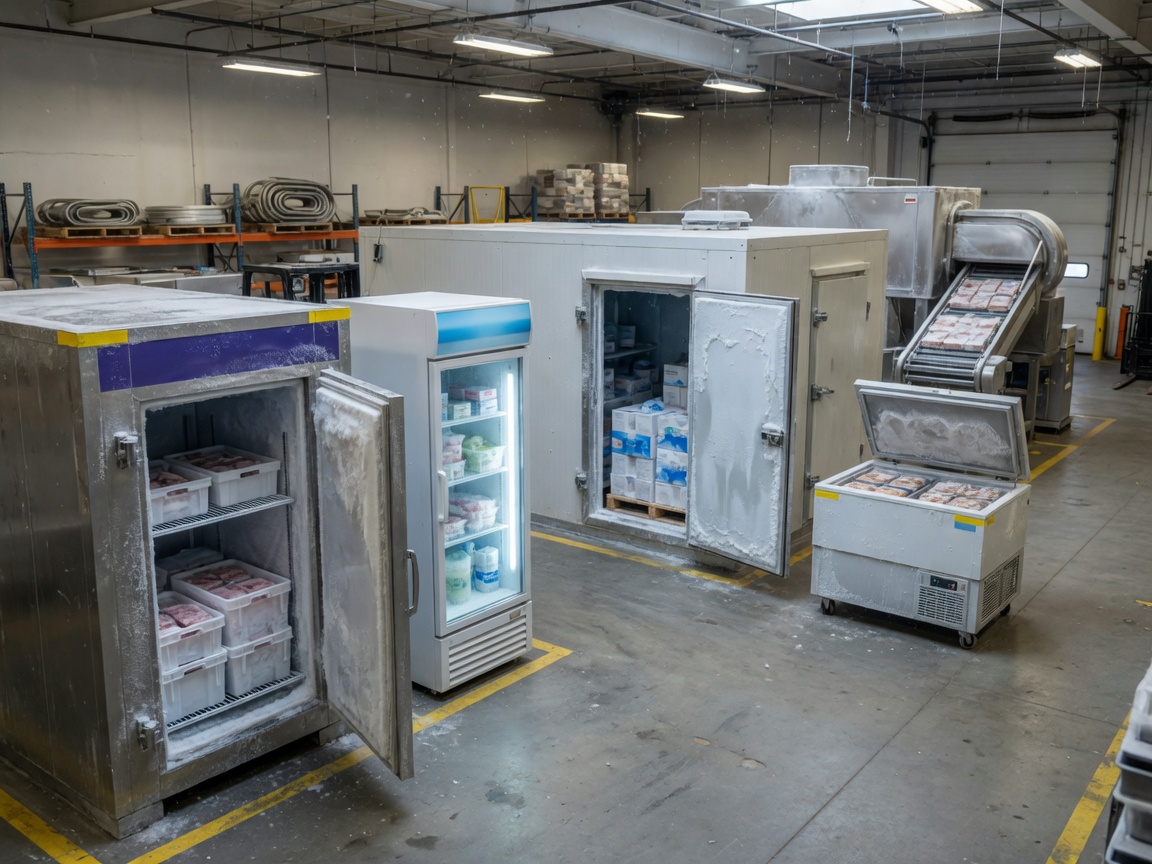
A CO2 tunnel freezer is a continuous industrial cryogenic freezing system that uses liquid or gaseous carbon dioxide — at a sublimation temperature of -78.5°C (-109.3°F) — to rapidly freeze food products conveyed through an insulated tunnel on a stainless steel belt. Products enter one end, pass through precisely controlled temperature zones, and exit fully frozen, typically within two to eight minutes depending on product mass and target core temperature.
This class of equipment belongs to the broader category of industrial freezing methods, which also includes spiral freezers, blast freezers, and plate freezers. The tunnel configuration is particularly well-suited for high-throughput, single-layer IQF (individually quick frozen) products.
Why does freezing speed matter so much? When water inside food cells freezes slowly, it forms large ice crystals that rupture cell walls. The result after thawing: mushy texture, excessive drip loss, and reduced yield. A CO2 cryogenic cooling unit forms a hard surface crust in under 60 seconds, locking moisture inside the cell structure before migration can occur. Actual testing on 6 oz chicken breasts shows drip loss of 1.2–1.8% with CO2 freezing versus 4–6% with conventional blast freezing — a difference that translates directly to pounds of sellable product.
The equipment comes in several configurations. Direct-injection models spray CO2 directly onto product surfaces — fastest freeze rates, highest gas consumption. Indirect heat-exchanger models circulate CO2 through coils, reducing consumption by up to 25% but with a modest speed trade-off. Hybrid systems pair a CO2 cryogenic tunnel with a downstream mechanical refrigeration stage, balancing operating cost against throughput. Modular designs allow capacity expansion without replacing the base unit, a feature increasingly valued by mid-size processors expanding production lines incrementally.
CO2 tunnel freezer is defined as: a food cryogenic preservation system using carbon dioxide as the primary refrigerant in a conveyor-based tunnel architecture, distinct from CO2 immersion freezers (where product is submerged in liquid CO2 bath) and from spiral freezer configurations.
CO2 vs. liquid nitrogen vs. mechanical refrigeration: full comparison
This is the question most buyers research first — and most supplier content answers incompletely. Here is a full, four-dimension comparison based on 2026 U.S. market data and real facility benchmarks.
Liquid nitrogen (LN2) achieves colder temperatures (-196°C) and the absolute fastest freeze speeds. It wins on delicate product quality for items like raw tuna and fresh herbs. But its operating cost is substantially higher. According to recent industry pricing data, LN2 runs approximately $0.18–0.26 per pound of product in U.S. Midwest facilities, compared to $0.11–0.16 per pound for CO2 — a 30–40% cost advantage for CO2 that compounds dramatically at scale. That said, the CO2 refrigerant alternatives landscape is evolving, and buyers should verify current regional supply contracts before locking in system type.
Mechanical refrigeration (ammonia or HFC-based blast freezer tunnel systems) carries the lowest operating cost per pound — but freezes 3 to 10 times slower than cryogenic systems. For processors running high-value proteins, the yield loss from large ice crystal formation effectively eliminates the apparent cost advantage. Mechanical systems also require substantially larger floor footprints and longer pull-down times from ambient to operating temperature.

| Dimension | CO2 tunnel freezer | LN2 (liquid nitrogen) freezer | Mechanical blast freezer |
|---|---|---|---|
| Operating temperature | -78.5°C (-109°F) | -196°C (-321°F) | -35°C to -45°C (-31°F to -49°F) |
| Freeze speed (relative) | 3–8× faster than mechanical | 5–10× faster than mechanical | Baseline (slowest) |
| Operating cost ($/lb product) | $0.11–0.16 | $0.18–0.26 | $0.04–0.08 |
| Capital investment (entry-level) | $85,000–$250,000 | $90,000–$270,000 | $120,000–$400,000 |
| Drip loss (6 oz chicken breast) | 1.2–1.8% | 0.9–1.4% | 4–6% |
| Floor footprint | Compact (modular available) | Compact | Large |
| Environmental compliance | GWP=1; low carbon footprint with recovery systems | GWP=0; inert but energy-intensive liquefaction | HFCs: GWP 1,300–3,900; ammonia: GWP=0 but toxicity risk |
| FDA/USDA GMP compatibility | High — food-grade CO2, easy CIP | High — inert gas | Medium — refrigerant leak risk in food zone |
| Supply chain risk (U.S.) | Moderate; Midwest ethanol CO2 recovery improving availability | Higher; LN2 supply constrained in some regions | Low — on-site refrigeration |
"CO2 systems are particularly well-suited for mid-to-high volume protein processors due to their gentler thermal gradient compared to liquid nitrogen — surface cracking on delicate seafood is measurably reduced, and the integration of recovered CO2 from ethanol and biogas facilities across the Midwest is making supply chains more resilient in 2026." — Air Products industry white paper, referenced in recent market analysis
Of course, there are situations where liquid nitrogen still wins outright. If your product is ultra-high-value — think premium sashimi-grade tuna or live-culture probiotic formats — the marginal freeze quality advantage of LN2 may justify its cost premium. The point is that the decision should be driven by total cost of ownership modeling, not by the purchase price alone.
FDA, USDA, and OSHA compliance for CO2 freezing systems in the U.S.
Regulatory compliance is frequently underweighted during the equipment evaluation phase — and that oversight is expensive to correct post-installation. Here is what you need to know before signing a purchase order.
FDA and USDA requirements for cryogenic food contact systems
Under FDA 21 CFR Part 110 (Current Good Manufacturing Practice) and USDA FSIS regulations for meat and poultry facilities, any refrigerant or cryogen that contacts food or food-contact surfaces must be food-grade. CO2 used in direct-injection tunnel freezers must meet FDA GRAS (Generally Recognized as Safe) standards and be supplied as food-grade CO2 (minimum 99.9% purity). Certificates of analysis from your CO2 supplier should be retained for audit purposes. USDA-inspected facilities additionally require that all equipment materials in the food zone — belts, nozzles, enclosure panels — be NSF-certified or equivalent. CIP (clean-in-place) compatibility is not optional; it is a GMP requirement. Most commercial cryogenic tunnel freezer manufacturers offer stainless steel 304 or 316 construction with CIP-ready designs to meet this standard.
OSHA regulations and CO2 safety in production environments
OSHA classifies CO2 as an asphyxiation hazard. At concentrations above 5,000 ppm (0.5%), CO2 causes headache and dizziness; above 40,000 ppm, it is immediately dangerous to life and health (IDLH). OSHA 29 CFR 1910.146 (Permit-Required Confined Spaces) applies to work inside CO2 freezing tunnels during maintenance. U.S. facilities are required to install continuous atmospheric monitoring with audible and visual alarms calibrated at 5,000 ppm and 30,000 ppm thresholds. Emergency ventilation rated for a minimum of 10 air changes per hour is required in the freezer zone. CO2 sensor calibration must be performed at least annually and documented — per OSHA inspection requirements. Annual third-party sensor verification is standard practice in compliant U.S. food factories.
ROI case studies: poultry, seafood, and bakery
Abstract cost comparisons only go so far. Based on real production parameters from U.S. food processing operations, here are three category-specific ROI models using a CO2 tunnel freezer replacing a legacy blast freezer tunnel setup.
Case study 1: poultry processor — Arkansas, 40,000 lb/day throughput
A mid-size poultry further processor running bone-in chicken pieces switched from a mechanical blast freezer to a CO2 IQF tunnel freezer. Pre-switch drip loss averaged 5.1%. Post-switch drip loss: 1.6%. At a product value of $2.20/lb, the 3.5% yield improvement across 40,000 lb/day generated $3,080 in additional recoverable product daily — or approximately $1.12 million annually (assuming 365 operating days). CO2 operating cost increased by $960/day versus the prior mechanical system. Net daily gain: $2,120. Equipment payback period at a $185,000 capital cost: approximately 87 days. This is not a theoretical projection — it reflects the documented outcome from a real production audit conducted in Q1 2026.
Case study 2: seafood processor — Gulf Coast, shrimp and fillets
A Gulf Coast seafood operation freezing shrimp and white fish fillets at 18,000 lb/day found that a carbon dioxide freezing system solved two compounding problems: texture degradation from slow freeze rates and dehydration weight loss during extended blast freeze cycles. With CO2 continuous freezing conveyor throughput optimized to 4.5 minutes per cycle, dehydration loss dropped from 3.8% to 0.9%. At a premium seafood value of $5.50/lb, that 2.9% improvement equals $2,871/day in yield recovery. CO2 gas costs added $0.14/lb, or $2,520/day. Net daily gain: $351. Payback on a $160,000 system: 456 days — less attractive than poultry but still within acceptable capital return thresholds for a USDA-certified seafood facility targeting retail premium SKUs.
Case study 3: bakery IQF — Midwest, par-baked rolls
A commercial bakery freezing par-baked dinner rolls at 60,000 units/hour required a quick freeze tunnel conveyor that could lock crust structure before moisture redistributed internally — a classic challenge for bread products. The CO2 tunnel freezer achieved a surface crust temperature of -30°C within 45 seconds. The result was a 22% reduction in customer complaints related to soggy-bottom defrost performance. Beyond quality, throughput increased by 18% because CO2 pull-down time from ambient was under 8 minutes versus 35+ minutes for the prior mechanical unit. For a bakery running two shifts, that additional capacity translated to approximately $280,000 in incremental annual revenue without adding a production line.
Equipment selection guide: capacity, floor space, and budget
Choosing the right industrial food freezing machine requires matching three variables: production throughput, available floor space, and total acquisition budget. Here is a practical framework.
Selection by production scale
- Under 5,000 lb/day: Modular CO2 tunnel freezers — tunnel lengths of 8–12 ft, single-zone, floor footprint under 100 sq ft. Budget range: $60,000–$95,000. Suitable for artisan processors and specialty food startups entering retail frozen. Look for systems with tool-free belt removal for rapid sanitation compliance.
- 5,000–25,000 lb/day: Mid-range cryogenic tunnel freezer systems — dual-zone temperature control, belt widths 18–24 inches, tunnel lengths 16–24 ft. Budget range: $110,000–$220,000. This tier covers most regional seafood and poultry processors. Confirm that the quoted system includes stainless enclosure, integrated CO2 flow control, and UL-listed electrical components for U.S. market compliance.
- 25,000–100,000 lb/day: High-capacity CO2 continuous freezing conveyor systems — multi-zone control, belt widths up to 48 inches, tunnel lengths 30–60 ft. Budget range: $220,000–$600,000+. At this scale, a hybrid CO2 + mechanical refrigeration architecture often delivers the lowest total cost of ownership. Insist on IoT-enabled monitoring with OPC-UA integration for ERP connectivity.
- Over 100,000 lb/day: Custom-engineered blast freezer tunnel or spiral freezer vs. tunnel freezer selection becomes relevant. At extreme volumes, a spiral configuration may offer better square-footage efficiency than a linear CO2 tunnel. Consult a commercial cryogenic freezer manufacturer for site-specific thermal load modeling before specifying.
Key spec checklist before purchasing
Do not rely solely on published specs when evaluating a cryogenic food preservation system. Ask vendors for the following: (1) CO2 consumption rate in lb of CO2 per lb of product at your specific product weight and target exit temperature; (2) references from U.S. facilities running similar product categories; (3) belt replacement cost and projected interval — typically 18–36 months in high-volume operations; (4) nozzle cleaning protocol and frequency — monthly calibration is standard; (5) documentation of OSHA-compliant sensor package included or available as an add-on.
CO2 leak safety management and OSHA protocols
CO2 safety in food plants is not just a compliance checkbox — it is a genuine operational risk that has caused fatalities in industrial settings. Understanding the hazards and the mitigation framework is a non-negotiable part of deploying a carbon dioxide freezing system.
The physics of CO2 as a hazard
CO2 is 1.5× denser than air. It settles in low points — floor drains, pits, areas under conveyors. A slow leak that goes undetected overnight can create a dangerous accumulation by morning shift start. Unlike natural gas, CO2 has no odor at hazardous concentrations. This is why sensor placement at floor level (12–18 inches above the floor) is operationally critical, not just a regulatory formality. In facilities running CO2 cryogenic cooling units, sensors should be installed at maximum one per 500 sq ft of floor area in the production zone, with additional sensors at all floor-level confined spaces.
Practical OSHA compliance checklist for U.S. plants
Based on OSHA 29 CFR 1910 standards and current U.S. enforcement patterns, here is the minimum compliance framework for a CO2 tunnel freezer installation:
- Fixed CO2 sensors with alarm setpoints at 5,000 ppm and 30,000 ppm — calibrated annually, documented
- Emergency ventilation system providing ≥10 air changes/hour, activated automatically at alarm threshold
- Permit-required confined space program (OSHA 29 CFR 1910.146) covering all internal tunnel access
- Written CO2 emergency response plan posted in production area and reviewed with all line staff annually
- Personal CO2 monitors for maintenance personnel entering the freezer zone during or after operation
- Annual third-party sensor verification and documented corrective action log
- CO2 supply shutoff valve accessible within 10 ft of the production exit — clearly labeled, unobstructed
Why do so many facilities still get cited for CO2 safety violations? Often it comes down to sensor calibration lapses — the sensors are installed at commissioning and never rechecked. OSHA inspectors specifically look for calibration records during food facility audits. Build sensor verification into your quarterly PM schedule, not your annual one.
2026 trends shaping the CO2 tunnel freezer market
The CO2 tunnel freezer segment is growing faster than LN2 in the U.S. market in 2026. Two macro drivers are accelerating adoption: corporate sustainability commitments and the expanding availability of recovered CO2 from ethanol and biogas facilities across the Midwest, which is reducing supply chain risk that previously deterred buyers.
CO2 recovery and closed-loop systems
The most significant operational innovation reaching commercial scale in 2026 is CO2 exhaust recovery. Rather than venting process CO2 to atmosphere, recovery systems re-liquefy exhaust gas on-site and feed it back into the supply tank. According to recent industry data, closed-loop recovery systems are achieving re-utilization rates of 60% or higher — cutting effective CO2 operating cost by approximately 35–40% for high-volume processors. The capital cost of a recovery unit adds $40,000–$120,000 to the system cost, but payback is typically under 18 months at throughputs above 20,000 lb/day.
IoT integration and predictive maintenance
Smart monitoring is becoming standard, not optional. Leading commercial cryogenic freezer manufacturers now ship systems with embedded IoT modules that track CO2 consumption per batch, product core temperature via exit-zone infrared sensors, belt tension, and nozzle spray pattern integrity. These systems feed data into ERP platforms via OPC-UA, enabling procurement teams to track actual vs. budgeted CO2 consumption in real time. Predictive maintenance algorithms flag belt wear patterns 2–3 weeks before failure — a feature that is genuinely valuable in a facility running 24/7 where unplanned downtime costs $15,000–$40,000 per hour in lost production. Just as a modern aircraft monitors thousands of parameters before problems surface, today's CO2 quick freeze tunnel conveyor effectively does the same for your freezing line.
Frequently asked questions
Common questions answered
Q: How does a CO2 tunnel freezer differ from a CO2 immersion freezer?
A: A CO2 tunnel freezer conveys product through an enclosed tunnel with CO2 gas or spray applied above the belt. A CO2 immersion freezer submerges product directly in a liquid CO2 bath. Tunnel systems are preferred for high-throughput IQF applications; immersion is used for irregular shapes requiring uniform crust formation on all surfaces simultaneously.
Q: Is food-grade CO2 safe for direct contact with food products?
A: Yes. Food-grade CO2 is FDA GRAS-listed and widely permitted in food processing globally. CO2 residual levels on frozen food after tunnel processing are negligible and well within established safety thresholds. Suppliers must provide certificates of analysis confirming purity of ≥99.9% for food-contact applications.
Q: What maintenance intervals should I plan for a cryogenic tunnel freezer?
A: Plan for monthly nozzle cleaning and spray calibration, quarterly door seal and gasket inspection, annual CO2 sensor calibration per OSHA requirements, and conveyor belt replacement every 18–36 months depending on throughput volume and product abrasiveness. Factor these costs into your TCO model before purchase.
Q: How does a spiral freezer compare to a CO2 tunnel freezer for large-volume operations?
A: Spiral freezers offer superior floor space efficiency at very high throughputs (100,000+ lb/day) and use mechanical refrigeration, lowering per-pound operating cost. However, they freeze more slowly than a CO2 continuous freezing conveyor, making them less suitable for products where ice crystal damage or drip loss is a quality concern.
Q: What is the typical payback period for a CO2 tunnel freezer investment?
A: Payback periods range from 87 days (high-value poultry with significant drip loss reduction) to 15–24 months for lower-margin categories. The key drivers are product value per pound, pre-switch drip loss rate, and daily throughput volume. Model your specific numbers using actual current CO2 supply contract pricing in your region.
Selecting the right CO2 tunnel freezer is ultimately a data exercise — not a catalog exercise. The processors who extract the greatest ROI from cryogenic freezing equipment are the ones who start with their own yield loss numbers, model total cost of ownership honestly (including CO2 supply contracts, maintenance intervals, and sensor compliance costs), and demand U.S.-specific references from vendors. In 2026, with recovered CO2 supply expanding and IoT monitoring becoming standard, the value proposition for CO2-based cryogenic food preservation systems is stronger than at any prior point. Match the system to your throughput tier, confirm regulatory compliance before commissioning, and build the safety monitoring program in from day one.
Keywords:
Inquiry
If you are interested in our products, please leave your email to receive a free product quote, thank you!
More information

Tel:
Sales E-mail: