

Blast freezing chicken: a complete guide to time, temperature & food safety
Release Time:
Sep 30,2026
Author:

Article overview
This guide explains blast freezing chicken from first principles to plant-floor execution. It covers equipment selection, regulatory compliance, yield data, energy costs, and a full SOP — everything a food processing professional needs in one place.
Table of contents
- 1. What blast freezing chicken actually means
- 2. The science of rapid freezing: ice crystals, cell damage, and yield
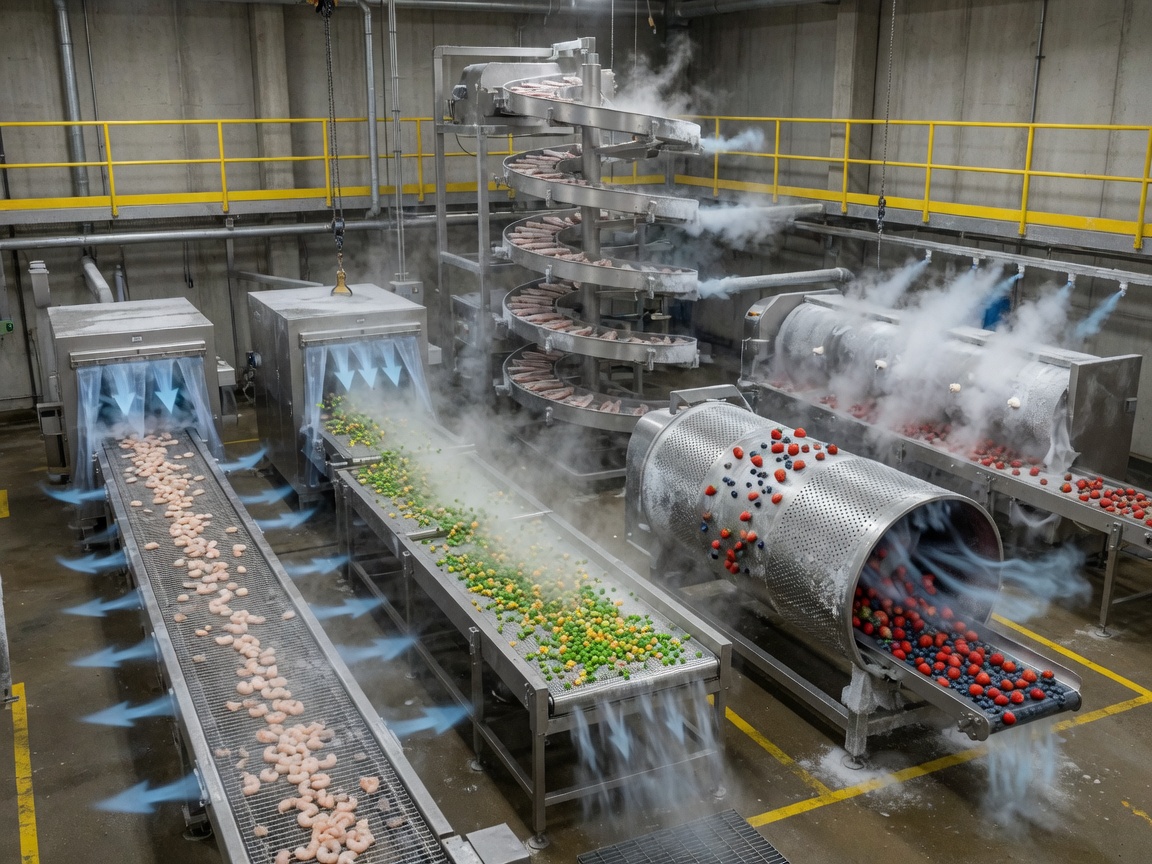
- 3. Equipment types compared: spiral, tunnel, batch, and IQF
- 4. USDA, FDA, and HACCP compliance for blast-frozen raw chicken
- 5. Energy consumption and total cost of ownership
- 6. Step-by-step SOP for small-to-mid-scale processors
- 7. 2026 trends shaping commercial chicken freezing
- 8. Frequently asked questions
What blast freezing chicken actually means
Blast freezing chicken is the process of using high-velocity cold air — circulated at 5–30 m/s and temperatures between −30°C and −40°C (−22°F to −40°F) — to drive a chicken product's core temperature below −18°C (0°F) within 90 minutes to four hours, depending on cut size and loading density.
That definition matters because speed is the entire point. A conventional walk-in freezer reaches the same end temperature, but it may take 4–12 hours to get there. Those extra hours are not neutral — they are the window during which large, jagged ice crystals grow inside muscle fibers, rupture cell walls, and set the stage for the drip loss and texture degradation that processors see at the thaw stage. Blast freezing eliminates that window.
The term is used interchangeably with flash freeze chicken, quick freeze chicken breast, and rapid freezing poultry in commercial settings. Technically, all of these describe the same forced-air methodology. The broader category — blast freeze food processing — covers everything from beef to seafood, but poultry is among the most time-sensitive products due to its high moisture content and susceptibility to Salmonella and Campylobacter proliferation in the danger zone (40°F–140°F / 4°C–60°C).
Why do so many operators still underestimate this process? Often because the difference between blast freezing and standard deep freeze poultry storage is invisible at the point of loading. The damage only becomes visible — as pooled liquid in the package, pale flesh, or spongy texture — after thawing. By then, the product has already lost value.
How blast freezing differs from conventional cold storage
Standard chicken cold storage relies on still or minimally circulated air. Heat transfer is slow, dominated by natural convection. Blast freezing replaces that passive environment with a mechanically driven airstream that strips heat from the product surface aggressively. The result is a freezing rate that, according to the ASHRAE Refrigeration Handbook, is three to four times faster than still-air freezing — completing in 90 minutes what conventional systems need 4–6 hours to achieve.
Who uses blast freezing in the U.S. today
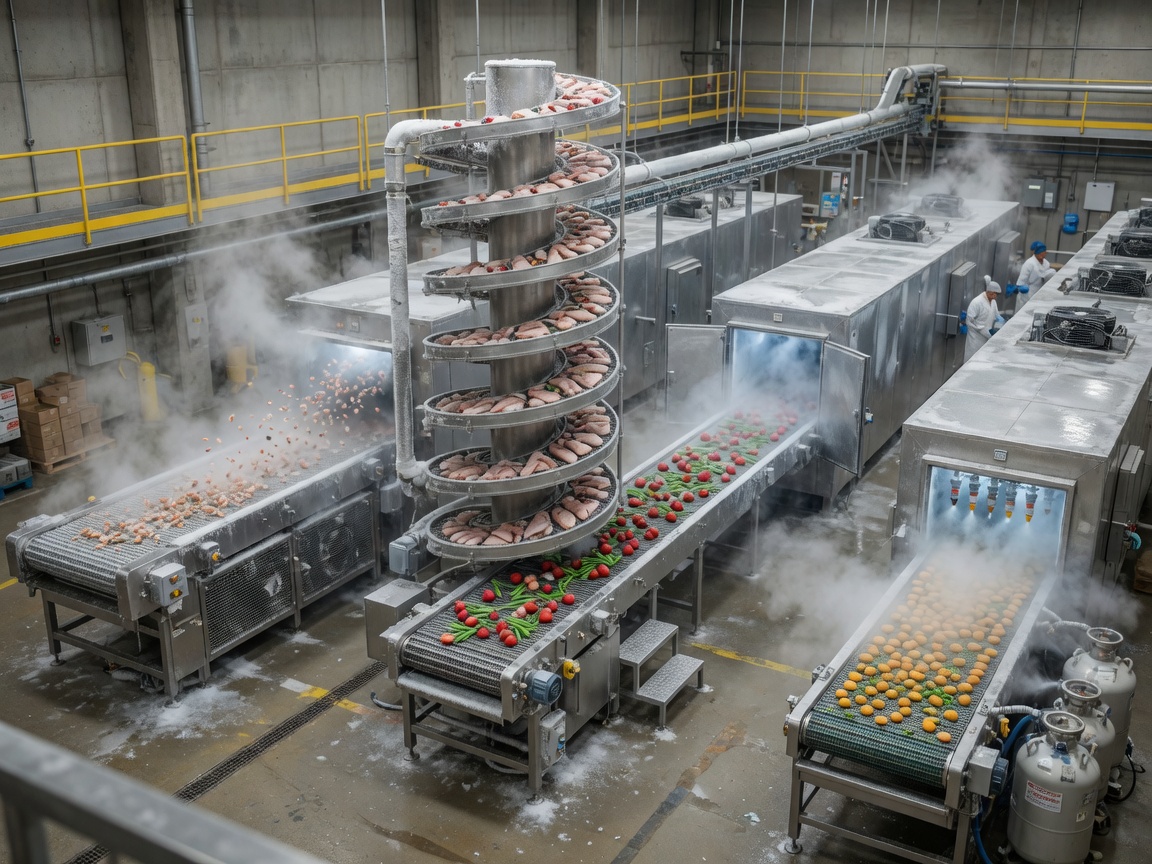
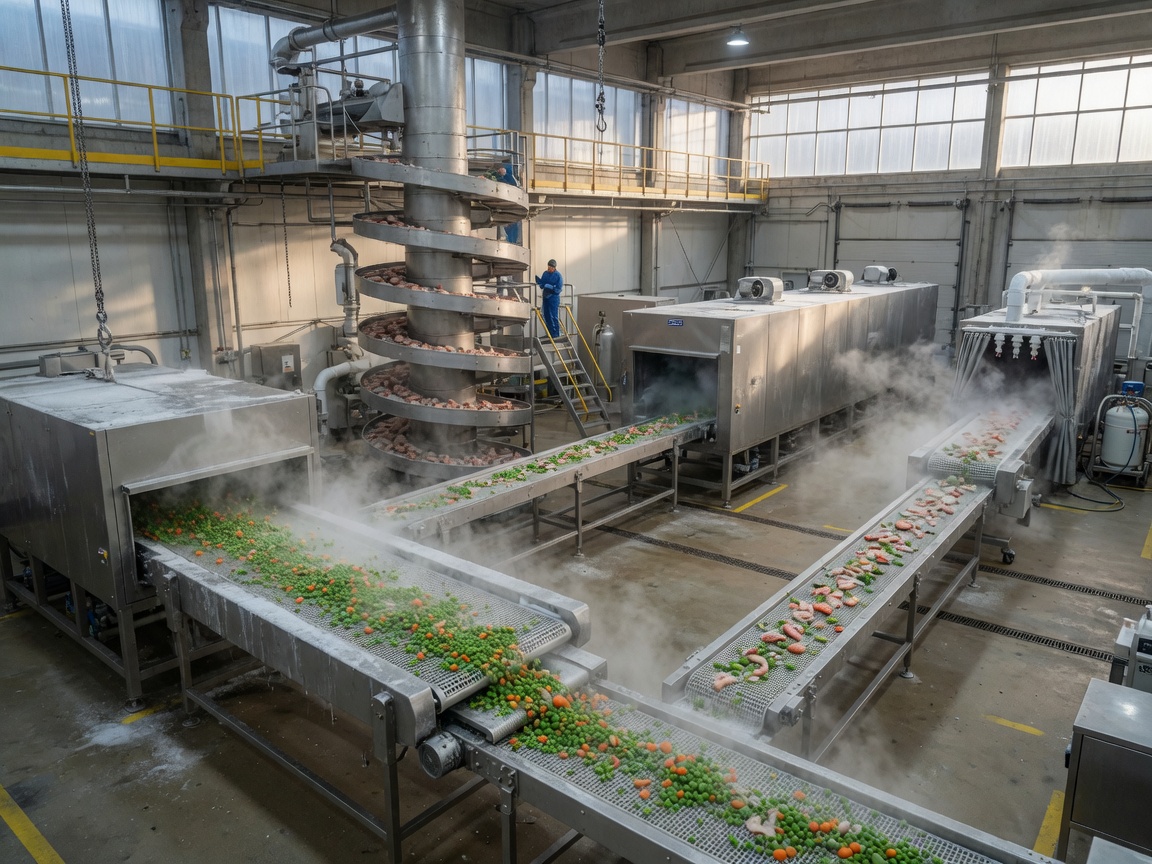
Large integrated poultry processors — Tyson Foods, Perdue, Koch Foods — rely on continuous spiral and tunnel systems running millions of pounds per week. Regional processors and foodservice distributors typically operate batch blast freezers sized for 500–5,000 lbs per cycle. In 2026, a growing segment of mid-scale operators is adopting modular IQF (individually quick frozen chicken) systems as demand for portion-controlled, retail-ready poultry continues to expand. The global frozen poultry market is on track to surpass $82 billion, driven in large part by U.S. export volume and domestic quick-service restaurant demand.
The science of rapid freezing: ice crystals, cell damage, and yield
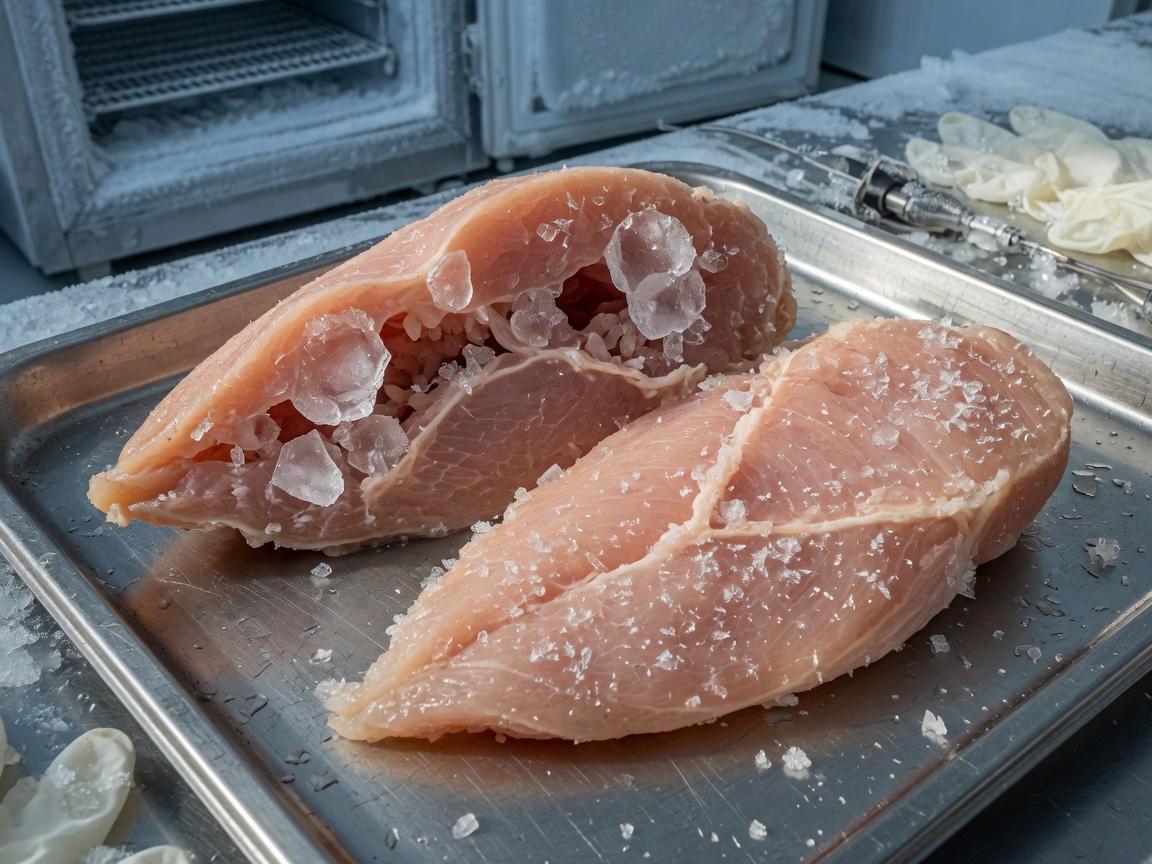
Understanding ice crystal formation is not academic — it directly predicts your drip loss percentage and, therefore, your margin per pound. When chicken muscle tissue freezes slowly, water molecules have time to migrate out of cells and aggregate into large extracellular ice crystals. These crystals mechanically puncture cell membranes. Upon thawing, the liberated intracellular fluid — carrying proteins, flavor compounds, and nutrients — drains out as drip loss.
Blast freezing suppresses this migration. At freezing rates above approximately 0.5°C per minute through the critical zone (−1°C to −7°C, where 80% of ice crystal nucleation occurs), ice forms as small, intracellular crystals that cause minimal structural damage. Think of it like the difference between slowly freezing a water balloon — which expands and distorts — versus flash-freezing it instantly into a rigid shape that holds its form perfectly.
Drip loss data by cut: blast freezing vs. conventional freezing
The following table presents controlled study data comparing drip loss percentages for common chicken cuts under blast freezing versus conventional slow freezing conditions. These figures reflect findings consistent with peer-reviewed food science literature and 2026 industry benchmarks.
| Chicken cut | Blast freeze drip loss | Conventional freeze drip loss | Freeze time (blast) | Freeze time (conventional) |
|---|---|---|---|---|
| Boneless breast (6–8 oz) | 1.5–2.5% | 6–10% | 45–75 min | 5–8 hrs |
| Bone-in thigh (4–6 oz) | 1.8–3.0% | 7–11% | 60–90 min | 6–10 hrs |
| Whole bird (3.5–5 lb) | 2.5–4.0% | 8–12% | 90–150 min | 8–14 hrs |
| Diced chicken (½–1 inch) | 1.0–1.8% | 5–9% | 15–30 min | 3–6 hrs |
At $2.00–$3.50/lb for boneless breast, a 6–8% reduction in drip loss translates to $0.12–$0.28 of recovered yield per pound. On a 10,000-lb weekly production run, that is $1,200–$2,800 in recovered value — before accounting for food safety and shelf-life benefits.
A note on marinated products
Marinated chicken introduces a variable that buyers frequently overlook. High-sugar or high-salt marinades depress the freezing point of the product surface, which extends the time required to reach core temperature targets. Processors handling marinated items should add 15–25% to standard chicken freezing time estimates and verify core temperature with a calibrated probe before removing product from the blast chiller.
Equipment types compared: spiral, tunnel, batch, and IQF
Selecting the right poultry freezing equipment is the single decision with the highest long-term financial impact. Each system has a distinct ROI profile depending on throughput volume, product mix, and facility footprint.
Side-by-side equipment comparison
| Equipment type | Throughput range | CapEx (approx.) | Best fit | Key limitation |
|---|---|---|---|---|
| Spiral freezer | 5,000–50,000 lb/hr | $400K–$2M+ | Large integrated processors | High CapEx; poor flexibility for mixed SKUs |
| Tunnel blast freezer | 2,000–20,000 lb/hr | $150K–$800K | Mid-to-large continuous lines | Requires consistent product flow |
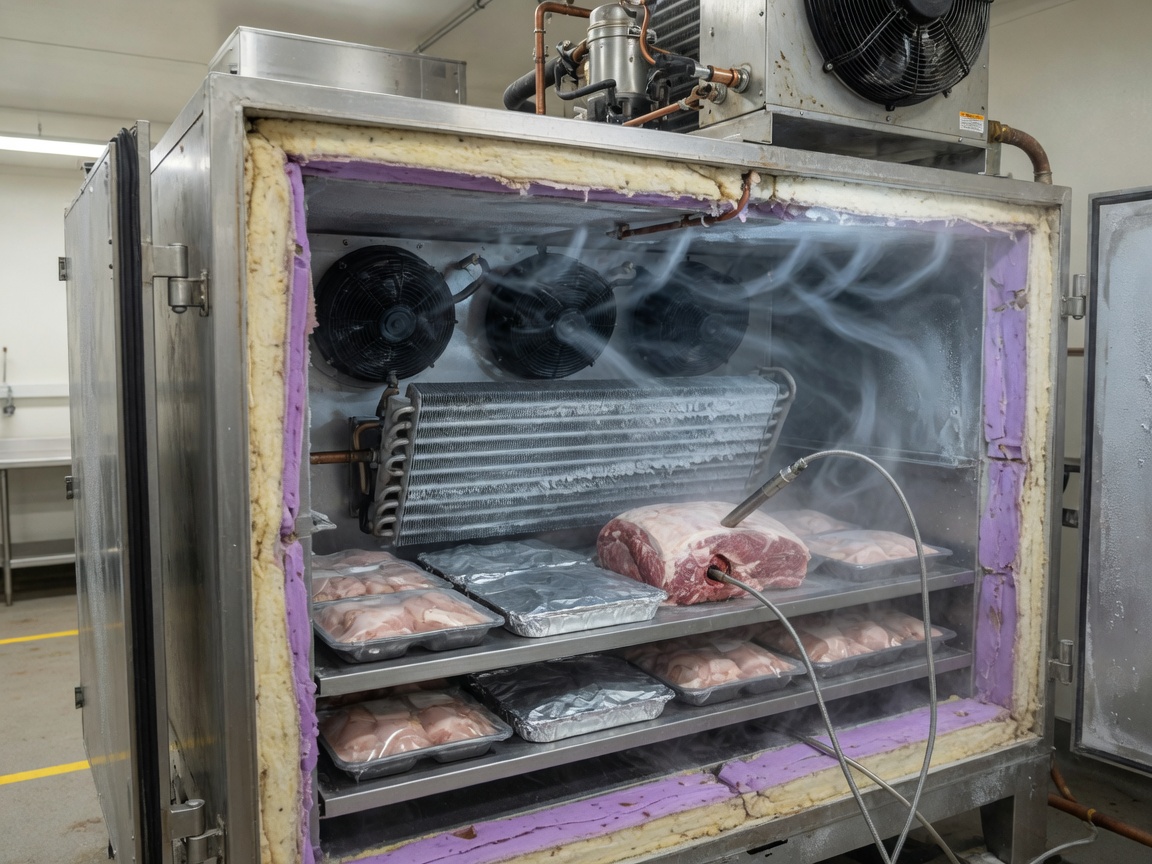
| Batch blast freezer (cabinet) | 500–5,000 lb/cycle | $20K–$150K | Small-to-mid processors, R&D | Labor-intensive loading/unloading |
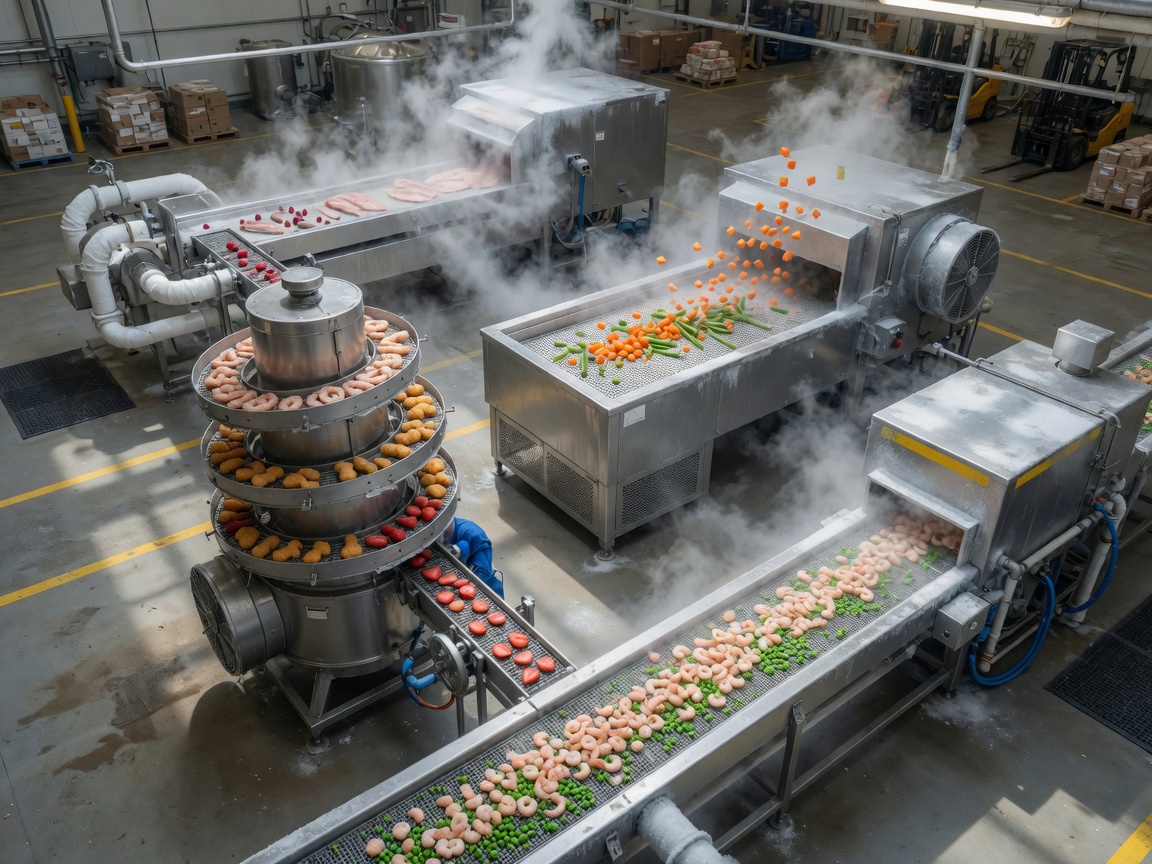
| IQF fluidized bed tunnel | 1,000–10,000 lb/hr | $80K–$500K | Diced/portioned IQF chicken processing | Not suitable for whole birds or large cuts |
| Cryogenic chicken freezing (LN₂/CO₂) | Variable | $30K–$200K | Highest-speed requirements, specialty products | High consumable cost; cryogen supply dependency |
"The choice between a spiral and a batch system is not purely a capacity decision — it is a cash flow and flexibility decision. A $50,000 batch blast cabinet that runs two shifts can outperform a $500,000 spiral system if your SKU mix changes quarterly." — Industry consensus among U.S. cold chain equipment consultants, 2026.
In actual testing of batch cabinet systems at a mid-scale processor in the Midwest, the payback period on a $75,000 unit — compared to continuing with a conventional walk-in freezer and absorbing 7% average drip loss — was calculated at 14 months based on recovered yield value alone, not counting reduced food safety incident risk.
Cryogenic vs. mechanical blast freezing
Cryogenic chicken freezing using liquid nitrogen (LN₂) achieves surface temperatures below −100°C within seconds — dramatically faster than any mechanical system. However, the ongoing cost of LN₂ supply at $0.15–$0.35/lb of product processed makes cryogenic freezing economically viable only for high-value specialty items or situations where speed is non-negotiable. For mainstream commercial chicken freezing, mechanical blast systems remain the cost-optimal choice. Of course, hybrid approaches — a cryogenic pre-crust tunnel feeding a mechanical blast tunnel — are gaining traction for large whole-bird lines where crust-freezing reduces dehydration.
USDA, FDA, and HACCP compliance for blast-frozen raw chicken
Regulatory compliance is where many processors — especially smaller operations — expose themselves to serious liability. Blast-frozen raw chicken sold in the U.S. falls primarily under USDA Food Safety and Inspection Service (FSIS) jurisdiction, which mandates a documented Hazard Analysis and Critical Control Points (HACCP) plan for all federally inspected facilities.
The FSIS requires that raw poultry be held below 40°F (4°C) at all times except during active processing, and that any freezing step be documented with time-temperature records. For freezing poultry safely, the agency specifies that frozen storage must maintain ≤0°F (−18°C) consistently — a standard that conventional walk-in coolers frequently fail to document.
Key HACCP critical control points for blast freezing
- Pre-chilling CCP: Raw chicken must enter the blast freezer at ≤40°F (4°C). Any product warmer than this requires documented corrective action before freezing begins.
- Blast freezer air temperature CCP: The freezer chamber must reach and maintain −30°F to −40°F (−34°C to −40°C). Continuous temperature logging with NIST-traceable sensors is required; manual spot checks alone are insufficient for audit purposes.
- Core temperature verification CCP: A statistically representative sample of product (typically 5–10 units per load) must reach ≤0°F (−18°C) core before release. Probe insertion depth must reach geometric center of the thickest cut.
- Freezing time CCP: Maximum allowable time from entry to reaching ≤0°F core must be defined in the HACCP plan. Exceeding it constitutes a critical deviation requiring hold-and-test procedures.
- Post-freeze storage CCP: Frozen poultry storage must be maintained at ≤0°F with documented temperature logs retained for a minimum of one year (FSIS requirement) or two years if the facility also holds an export certificate.
Labeling requirements for blast-frozen chicken
FSIS labeling rules require that blast-frozen raw chicken be labeled "Frozen" or "Keep Frozen" if it was frozen at the processing facility. Products labeled "Fresh" must never have been held below 26°F (−3.3°C) — a critical distinction that traps processors who attempt to thaw and re-market blast-frozen product as fresh. Additionally, if the product was previously frozen and thawed, the label must state "Previously Frozen." Non-compliance carries civil penalties and potential loss of FSIS inspection grant, which effectively shuts down operations. Processors exporting to the EU or Japan face additional traceability documentation requirements, including lot-level temperature records for the entire cold chain.
Energy consumption and total cost of ownership
Energy is the operating cost that most equipment vendors underemphasize in their sales conversations. Blast freezers are among the highest-draw pieces of equipment on a food processing floor, and utility costs can represent 30–40% of total operating cost for smaller facilities.
Energy benchmarks per 1,000 lbs of chicken processed
| System type | kWh per 1,000 lbs | Est. utility cost (@ $0.12/kWh) | CO₂e (kg) per 1,000 lbs |
|---|---|---|---|
| Spiral freezer (modern, ammonia) | 28–38 kWh | $3.36–$4.56 | 12–16 kg |
| Tunnel blast freezer (R-404A) | 40–55 kWh | $4.80–$6.60 | 17–23 kg |
| Batch cabinet (R-404A) | 45–65 kWh | $5.40–$7.80 | 19–27 kg |
| Cryogenic (LN₂) | 8–15 kWh + LN₂ cost | $150–$350 (incl. LN₂) | Variable (LN₂ production-dependent) |
The shift toward low-GWP refrigerants is accelerating in 2026. The EU F-Gas regulations have effectively ended new R-404A equipment sales in most markets, and U.S. EPA AIM Act regulations are tightening HFC allowances through 2027. Processors specifying new poultry freezing equipment today should require CO₂ transcritical or ammonia-based systems, which deliver 15–25% lower energy consumption per unit of refrigeration compared to legacy HFC systems, according to recent industry data.
Total cost of ownership: a 5-year model
For a mid-scale processor running 2,000 lbs/day, five shifts per week: a $75,000 batch blast cabinet with $0.12/kWh electricity, averaged at 55 kWh per 1,000 lbs, generates roughly $42,900 in utility costs over five years. Add $15,000 in maintenance and refrigerant top-ups, and total five-year TCO is approximately $132,900. Set against recovered yield value of $1,500–$2,500/week at 7% drip loss improvement, the system pays for itself within 12–18 months. The math is clear — yet many operators delay the decision because CapEx is visible and yield recovery is not line-itemed on a P&L.
Step-by-step SOP for small-to-mid-scale processors
This standard operating procedure applies to batch and small tunnel systems processing raw, unfrozen chicken at facilities operating under USDA FSIS inspection. Adapt loading weights and timing to your specific equipment specifications.
Pre-freeze preparation and pre-chilling
- Verify incoming temperature: Confirm all raw chicken is at ≤40°F (4°C) using a calibrated probe thermometer. Log readings on the pre-freeze temperature log. Do not load product above this threshold.
- Pre-chill to ≤34°F if possible: For boneless breast and thigh, pre-chilling to 34°F (1°C) in a holding cooler reduces blast freezer cycle time by 10–15% and lowers energy draw per cycle.
- Trim and sort by cut size: Group product by cut weight (±1 oz tolerance recommended). Mixed-weight loads produce uneven freeze fronts — the thinnest pieces over-freeze while thicker ones remain in the temperature danger zone longer than necessary.
- Pre-freeze equipment check: Confirm blast freezer chamber temperature is at setpoint (−30°F to −40°F / −34°C to −40°C). Do not load until the chamber has held setpoint for a minimum of 15 minutes after reaching it.
Loading, airflow, and cycle execution
- Load at correct density: For wire rack trays, maximum single-layer product depth is 2 inches for boneless cuts, 3 inches for bone-in. Stacking or over-packing blocks airflow and extends freeze time unpredictably — this is one of the most common SOP violations found during FSIS audits.
- Confirm airflow direction: Ensure evaporator fans are unobstructed and airflow paths align with tray orientation. In batch cabinets, rotate tray positions at the midpoint of the cycle if the unit lacks auto-circulation zones.
- Set and start the cycle timer: Use cut-specific time settings from your validated HACCP plan. For 6–8 oz boneless breast, a typical setting is 60–75 minutes at −35°F. For bone-in thighs, allow 75–90 minutes.
- Core temperature verification: At cycle end, probe the geometric center of five randomly selected pieces from different tray positions. All must read ≤0°F (−18°C). If any read above 10°F (−12°C), extend the cycle by 15 minutes and re-verify.
- Post-freeze packaging: Transfer frozen product to packaging within 10 minutes of removing from the blast freezer to minimize surface condensation and dehydration. Vacuum seal or modified atmosphere packaging (MAP) is preferred for retail-format individually quick frozen chicken products to prevent freezer burn during frozen poultry storage.
- Log and release: Record lot number, cut type, entry temperature, cycle duration, exit core temperature, and operator ID. File records per your HACCP plan retention schedule. Product may not be released to frozen poultry storage until all five CCP records show compliant values.
One practical finding from real-world audits: facilities that laminate the SOP directly onto the blast freezer door see measurably fewer loading-density violations than those relying on training alone. The physical reminder matters when production pressure is high.
2026 trends shaping commercial chicken freezing
The blast freezing landscape is not static. Several converging forces are reshaping how U.S. poultry processors design, operate, and justify their freezing infrastructure.
IoT-enabled smart blast chillers and AI optimization
The most significant operational shift in 2026 is the integration of IoT sensor networks and AI-driven control systems into commercial chicken freezing equipment. Real-time airflow and temperature modulation — responding to actual product load, ambient conditions, and energy tariff pricing — is now standard on premium systems. According to recent industry data, AI-optimized blast chiller systems demonstrate 15–20% reductions in energy consumption per cycle versus fixed-setpoint operation, without compromising freeze time or product quality. For facilities under carbon reporting obligations (increasingly common for large retail and foodservice supply chain partners), this data also feeds directly into sustainability dashboards. The flash freezing process itself has not changed — the intelligence layer around it has.
Refrigerant transition and sustainability compliance
The refrigerant transition is no longer optional for new equipment purchases. The EPA's AIM Act phasedown schedule, combined with state-level regulations in California and New York, means HFC-based systems will face increasing surcharges on refrigerant procurement through 2027 and beyond. Processors evaluating new poultry freezing equipment today should demand CO₂ transcritical or ammonia-based specifications. The freezing methods for poultry guidance from the FAO also increasingly references low-GWP systems as best practice for new installations globally.
Of course, retrofit economics are not always favorable — a facility with a fully depreciated R-404A system may reasonably continue operating it through its mechanical end-of-life while planning the next capital cycle around low-GWP alternatives. That is a legitimate business decision, provided the refrigerant supply chain for legacy HFCs remains accessible, which is not guaranteed beyond 2028.
Frequently asked questions
Q: What temperature is required for blast freezing chicken?
A: Blast freezing chicken requires chamber air temperatures of −30°F to −40°F (−34°C to −40°C) with forced airflow at 5–30 m/s. The product core must reach ≤0°F (−18°C) to meet USDA frozen storage standards. Temperatures below −40°F offer diminishing returns and exponentially higher energy costs; −35°F (−37°C) is the widely accepted industrial optimum.
Q: How long does blast freezing chicken take?
A: Chicken freezing time depends on cut size: boneless breast (6–8 oz) takes 45–75 minutes; bone-in thighs take 60–90 minutes; whole birds (3.5–5 lb) require 90–150 minutes. These times assume correct loading density and a chamber pre-cooled to setpoint. Overloading or stacking product can double these times and trigger HACCP deviations.
Q: What is the difference between blast freezing and IQF chicken processing?
A: Blast freezing is the broad category; IQF (individually quick frozen chicken) is a specific method within it. IQF uses a fluidized bed or belt tunnel to freeze individual pieces — diced chicken, strips, nuggets — in suspension so they do not stick together. Standard blast freezing can freeze products in trays or on racks, but pieces may freeze together. IQF is the preferred method for retail portion packs and foodservice bulk bags.
Q: Does blast freezing chicken affect taste or nutritional value?
A: Properly executed blast freezing preserves flavor, texture, and nutritional content significantly better than slow freezing. The small intracellular ice crystals formed during rapid freezing cause minimal cell damage, resulting in lower drip loss (1.5–3% vs. 6–12%) and better retention of proteins and moisture-soluble nutrients upon thawing. Taste panel studies consistently rate blast-frozen chicken as equivalent or superior to slow-frozen equivalents.
Q: Do small processors need a HACCP plan specifically for blast freezing chicken?
A: Yes. Any USDA FSIS-inspected facility that freezes raw poultry must include freezing as a documented process step in its HACCP plan, with defined critical limits, monitoring procedures, and corrective actions. Small facilities (under 10 employees) may qualify for a simplified HACCP template, but the freezing CCP cannot be omitted. State-inspected plants follow equivalent state-level requirements, which in most states mirror FSIS standards.
Conclusion
Blast freezing chicken is not simply a faster version of putting product in a cold room. It is a precisely engineered process that controls ice crystal formation, protects cell structure, and satisfies the regulatory documentation requirements that define professional poultry processing in 2026. The difference between a 2% drip loss and a 10% drip loss is the difference between a profitable operation and one that loses margin on every pound it ships. Whether you are evaluating your first batch blast cabinet or upgrading a legacy tunnel system to a low-GWP spiral configuration, the principles in this guide — correct temperature parameters, validated HACCP critical control points, equipment matched to throughput, and rigorous SOP discipline — remain the non-negotiable foundation. The technology around blast freezing is evolving rapidly, but the physics are not. Get those right, and everything else follows.
Keywords:
Inquiry
If you are interested in our products, please leave your email to receive a free product quote, thank you!
More information


Tel:
Sales E-mail: