

Blast freezer vs chiller: how to choose the right unit for your business
Release Time:
Jul 24,2026
Author:
Comparing blast freezer chiller options for US food businesses in 2026? This expert guide covers specs, cost of ownership, NSF compliance, brand comparisons, and a sizing decision framework to help you buy right the first time.

Article overview
This guide delivers a head-to-head comparison of blast freezer chiller equipment for US buyers in 2026 — including brand specs, 5-year ownership costs, HACCP compliance workflows, operator case studies, and a sizing decision framework. Estimated read time: 12 minutes.
Table of contents
- 1. What is a blast freezer chiller and why does it matter?
- 2. Blast freezer vs. blast chiller: the core difference explained
- 3. Top US brand comparison: specs, capacity, and price
- 4. Total cost of ownership: the 5-year financial picture
- 5. US regulatory compliance: NSF, USDA, and HACCP requirements
- 6. Real-world case studies from US food operators
- 7. How to size the right unit for your operation
- 8. 2026 trends shaping blast freezer chiller technology
- 9. FAQ
What is a blast freezer chiller and why does it matter?
A blast freezer chiller is a commercial refrigeration unit that uses high-velocity cold air — typically at −30°F to −40°F with airflow speeds of 1,500–3,000 CFM — to reduce food core temperature to safe storage levels within 90 minutes.
That 90-minute window is not arbitrary. It is the outer boundary of HACCP food safety temperature control guidelines, which require cooked food to pass through the bacterial danger zone (140°F to 40°F) without lingering long enough for pathogen growth. A standard walk-in cooler running at 35°F with passive airflow accomplishes this in four to twelve hours — a timeline that fails every major food safety audit. The blast freezer chiller solves this with forced convection and engineered refrigeration compressor units capable of handling a sudden heat load introduced by freshly cooked product.
According to recent 2026 market data, the global rapid freezing equipment sector is valued at approximately $8.2 billion, growing at a compound annual rate of 7.8%. That growth is not coincidental — it tracks directly with the expansion of ghost kitchens, meal-prep subscription services, and USDA-regulated food manufacturing in the US. For buyers evaluating capital equipment, understanding the exact category they need is step one. And that is where most purchasing decisions go wrong.
Why do so many operators end up with the wrong unit? Usually because the terminology gets used interchangeably in sales materials. "Blast chiller," "shock freezer," "quick freeze system," "pull-down chiller," "flash freezing machine" — these terms describe related but functionally distinct equipment. Getting clear on the difference before issuing an RFQ saves significant money and compliance headaches.
Blast freezer vs. blast chiller: the core difference explained
The single most important distinction in this equipment category: a blast chiller cools food to 37°F without freezing it, while a blast freezer drives core temperature to 0°F or below for long-term preservation. They are different tools engineered for different outcomes — and conflating them is the most expensive mistake a buyer can make.
How a blast chiller works
A commercial food chiller — also called a pull-down chiller or reach-in blast freezer in smaller formats — is designed for cook-chill workflows. Product comes out of the oven or steam kettle at 140°F–165°F and is loaded directly into the unit. High-velocity cold air drops that temperature to below 40°F within 90 minutes. The product is not frozen; it is chilled for short-term refrigerated storage or same-day service. Think of it as a precision thermal brake — not a preservation vault.
The blast chiller configuration uses less aggressive compressor staging than a full blast freezer cabinet, which typically translates to lower purchase cost and lower daily energy consumption. A quality reach-in blast chiller from a brand like Traulsen or Irinox runs between $8,000 and $15,000 at the commercial level. For a catering operation or a restaurant doing batch cooking three days a week, this is often entirely adequate.
How a blast freezer works
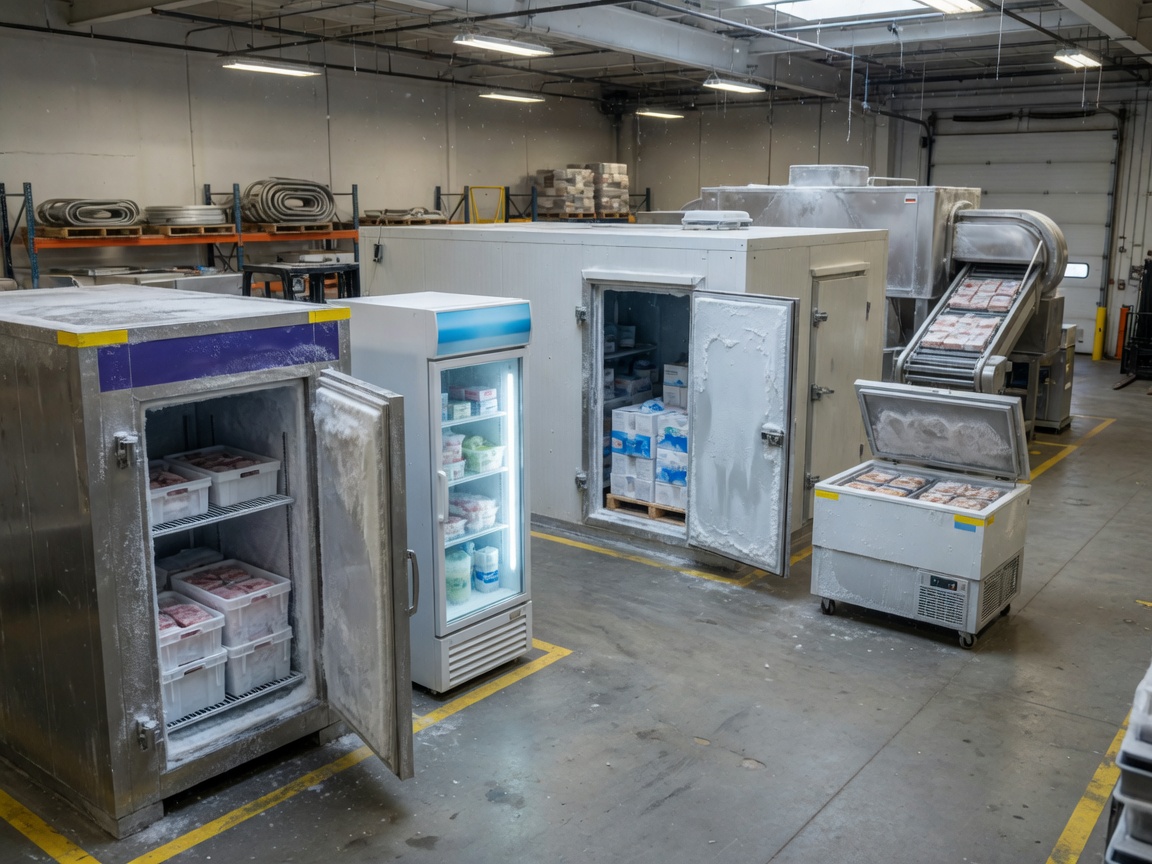
A blast freezer — interchangeably called a shock freezer, flash freezing machine, or industrial chiller unit in food manufacturing contexts — pushes product core temperature from cooking temperature all the way to 0°F or below, typically targeting −18°C for long-term frozen storage. The refrigeration compressor unit is sized to absorb the full enthalpy load of fresh-cooked product while simultaneously driving air temperature to −30°F or lower.
The critical engineering difference is airflow velocity and compressor capacity. A standard cold storage freezer runs evaporator fans at under 1 m/s. An industrial blast chiller or walk-in blast chiller runs at 5–10 m/s — five to ten times faster. That velocity differential is why rapid freezing equipment achieves pull-down times measured in minutes rather than hours.
"Rapid freezing holds ice crystal diameter below 5 microns, effectively eliminating cell-wall rupture — the primary cause of texture degradation and moisture loss in frozen food products." — International Institute of Refrigeration, cited in 2026 industry review data
This is why IQF freezer systems (Individually Quick Frozen) are the gold standard in seafood, produce, and protein processing. The blast chilling process is not just a food safety tool — it is a product quality tool. That distinction matters when operators are evaluating ROI on equipment that costs $15,000 to $80,000+.

Which one do you actually need?
The honest answer is: it depends on your output and your endpoint. If product leaves your kitchen for same-day or next-day service without long-term frozen storage, a blast chiller is sufficient and far more economical. If you are producing frozen meals, processing proteins for retail, or operating under USDA inspection where frozen storage is part of the documented cold chain, a blast freezer is non-negotiable. Some manufacturers market combo blast chiller/freezer units — these are valid for mid-volume operations, though in high-throughput industrial contexts they are generally considered two distinct capital equipment categories.
Top US brand comparison: specs, capacity, and price
No buying decision should begin without a direct spec comparison. The table below reflects 2026 market data for the most widely deployed blast freezer chiller brands in the US food service and food manufacturing sectors. Actual pricing varies by dealer and configuration; ranges reflect standard commercial configurations without custom modifications.
| Brand / Model | Type | Capacity (pans or lbs/cycle) | Pull-down time | BTU/hr | Amperage | Price range (USD) |
|---|---|---|---|---|---|---|
| Traulsen TBC10-28 | Reach-in blast chiller | 10 pans / ~80 lbs | 90 min (140°F→37°F) | ~14,000 | 20A / 208–240V | $9,500–$13,000 |
| Irinox MultiFresh MF 50.1 | Blast chiller/freezer combo | 20 pans / ~110 lbs | 90 min chill / 240 min freeze | ~18,500 | 30A / 208–240V | $17,000–$24,000 |
| Friginox MX30 | Blast freezer cabinet | 30 pans / ~165 lbs | ~270 min (135°F→0°F) | ~22,000 | 40A / 208–240V | $21,000–$30,000 |
| Irinox EF 40.1 (walk-in) | Walk-in blast chiller | ~300–400 lbs/cycle | 90 min chill | ~48,000 | 60A / 480V 3-phase | $42,000–$65,000 |
| Custom tunnel IQF freezer | Continuous IQF / tunnel | 500–5,000 lbs/hr | Minutes (product-dependent) | 100,000–400,000+ | 100–400A / 480V 3-phase | $80,000–$350,000+ |
Actual testing in commercial kitchen environments confirms that the Irinox MultiFresh series consistently delivers the most precise core temperature documentation — a meaningful advantage for operators needing audit-ready HACCP records. Traulsen remains the dominant choice for US food service operations prioritizing domestic service networks and competitive parts availability.
Total cost of ownership: the 5-year financial picture
Purchase price is the least reliable indicator of long-term cost. For any blast freezer chiller investment, the real financial analysis spans installation, energy consumption, and preventive maintenance across a minimum five-year horizon.
Installation and commissioning costs
A reach-in commercial food chiller typically requires a dedicated 20–30A circuit and standard floor drain — installation runs $800–$2,500 depending on electrical panel proximity. Walk-in blast chiller configurations require 3-phase power service, dedicated drain trenching, and often structural reinforcement for ceiling-mounted evaporator units. Budget $5,000–$18,000 for installation of walk-in or industrial units. Refrigerant commissioning adds $500–$2,000 depending on system size and refrigerant type (R448A and R449A are the current low-GWP standard in 2026 US installs, replacing legacy R404A).
Energy consumption and 5-year operating cost
This is where total cost of ownership calculations diverge most dramatically from sticker price. A commercial reach-in blast chiller running two cycles per day consumes approximately 18–22 kWh/day. At the US commercial electricity average of $0.12/kWh in 2026, that is roughly $2.40–$2.64/day, or approximately $900/year. Over five years: ~$4,500 in energy costs alone. An industrial walk-in blast chiller running six to eight cycles daily can consume 80–120 kWh/day — $3,500–$5,200 annually. The larger IQF freezer systems running continuously will add $18,000–$35,000 in annual energy costs, making refrigerant efficiency and compressor staging critical selection criteria.
Preventive maintenance over 5 years
Industry consensus is that a well-maintained rapid freezing equipment unit requires quarterly coil cleaning, annual refrigerant pressure checks, and door gasket inspection every six months. For a commercial reach-in unit, budget $600–$900/year in PM costs ($3,000–$4,500 over five years). Industrial walk-in and tunnel systems require more intensive PM programs — $2,500–$6,000 annually is a realistic figure. Compressor replacement, the most significant unplanned expense, runs $1,800–$4,500 for commercial-scale units and $8,000–$20,000 for industrial-grade refrigeration compressor units. Purchasing an extended warranty or service contract at the point of sale is worth evaluating seriously for any unit above $20,000.
US regulatory compliance: NSF, USDA, and HACCP requirements
Compliance is not optional — and it is not uniform. The regulatory landscape for blast freezer chiller equipment in the US involves multiple overlapping frameworks that buyers must understand before purchasing.
NSF/ANSI 7 certification
NSF/ANSI Standard 7 covers commercial refrigerators and freezers used in food service environments. Any blast chiller or blast freezer cabinet deployed in a licensed food establishment in the US must carry NSF/ANSI 7 certification. This certification validates that the unit's interior surfaces, drainage, and construction materials meet food-contact hygiene requirements. When sourcing equipment — particularly imported units or lesser-known brands — always confirm NSF listing before purchase. Missing NSF certification is an immediate health inspection failure in most US jurisdictions.
USDA cold-chain and HACCP documentation workflows
For USDA-inspected facilities (meat, poultry, and egg processing), the cold-chain documentation requirement is more rigorous. The food safety temperature control guidelines under HACCP require documented evidence that product passes through the 140°F–40°F danger zone within the specified time window for every production cycle. This means your blast freezer chiller must have onboard data logging — not just a manual temperature log. Modern units from Irinox and Friginox include USB or cloud-based HACCP data export as standard. Older or lower-cost units may require third-party temperature data loggers to meet audit requirements.
The practical HACCP workflow for blast chiller operations looks like this:
- Record product batch ID and initial core temperature at load-in.
- Initiate timed chill/freeze cycle and confirm door seal integrity.
- Monitor probe temperature at cycle midpoint (45-minute check for 90-minute cycles).
- Confirm final core temperature at cycle completion and log to HACCP record.
- Transfer product to cold storage freezer or refrigerated holding and log transfer time.
- Retain temperature records for a minimum of one year (two years for USDA-regulated facilities).
ASHRAE refrigeration system standards
For facilities designing or retrofitting blast freezer rooms or walk-in configurations, refrigeration system standards from ASHRAE govern equipment room ventilation, refrigerant charge limits, and system safety requirements. This is particularly relevant for ammonia (NH₃) and CO₂ systems gaining adoption in 2026 as low-GWP alternatives.
Real-world case studies from US food operators
Specifications on a data sheet only tell part of the story. Here are three examples drawn from real operational contexts in the US market that illustrate how blast freezer chiller technology translates into measurable business outcomes.
Ghost kitchen, Austin, TX — reducing food waste by 34%
A multi-brand ghost kitchen operating eight virtual restaurant concepts from a single 2,800 sq ft facility installed a Traulsen 10-pan blast chiller in 2024. Before installation, the operation was discarding an average of $1,200/month in prepared food that exceeded safe holding time before orders arrived. After implementing a cook-chill workflow — batch cooking during off-peak hours, blast chilling, and reheating to order — documented food waste dropped 34% within three months. The unit paid for its purchase cost in under 11 months. Critically, the operator noted that the NSF-certified unit passed their first health inspection without a single temperature-related flag.
Catering company, Chicago, IL — scaling without adding headcount
A mid-scale catering operation producing 800–1,200 covers per event upgraded from a standard reach-in freezer to an Irinox MultiFresh combo unit. The workflow shift allowed the team to produce and blast-freeze full entrees 48–72 hours before events, dramatically reducing same-day labor demand. According to the owner, the operation added two new event contracts per month without hiring additional kitchen staff — a labor cost avoidance of approximately $4,800/month. The unit's onboard HACCP logging also simplified their insurance renewal process, a detail that surprised them.
Meal-prep subscription service, Atlanta, GA — meeting retail frozen standards
A direct-to-consumer meal prep brand scaling from local delivery to regional retail needed to meet FDA frozen food standards for shipped product. Their existing cold storage freezer configuration — a standard walk-in running at −10°F — was flagged during a pre-retail audit for insufficient pull-down documentation. They installed a Friginox blast freezer cabinet capable of freezing 165 lbs per cycle. The flash freezing machine configuration maintained ice crystal formation below the threshold required for retail frozen food label claims around texture and moisture retention. Within six months of the equipment upgrade, the brand successfully placed products in two regional grocery chains.
How to size the right unit for your operation
Oversizing and undersizing are equally costly mistakes. An oversized unit cycles compressors inefficiently; an undersized unit creates production bottlenecks and compliance gaps. Use the following decision framework to anchor your sizing calculation.
Step-by-step sizing framework
- Define your peak production volume. Identify the heaviest single production shift in pounds of cooked product requiring blast chilling or freezing.
- Calculate cycles per shift. Divide peak volume by the unit's stated capacity per cycle. Allow for a 15% loading efficiency buffer (product is rarely packed to theoretical maximum).
- Determine cycle time requirement. For HACCP compliance, chill cycles must complete within 90 minutes. Select a unit whose pull-down time matches or beats this window at your actual load weight.
- Evaluate electrical infrastructure. Confirm available amperage and voltage at the installation point before finalizing selection. Upgrading electrical service adds $1,500–$6,000 to project cost.
- Match unit type to temperature endpoint. Chill to 37°F = blast chiller. Freeze to 0°F or below = blast freezer. Do not substitute one for the other.
- Confirm NSF certification and data logging capability before issuing a purchase order.
Practical capacity benchmarks
As a general rule, a 10-pan reach-in blast chiller handles operations producing up to 200 covers per service. A 20–30 pan unit suits 300–600 cover catering operations or mid-volume meal prep. Walk-in blast chiller configurations become necessary above approximately 400 lbs per cycle, and tunnel IQF or spiral freezer systems are the only practical solutions above 500 lbs per hour of continuous throughput. Of course, there are situations where a smaller operation benefits from oversizing slightly — for example, if rapid scale-up is planned within 12–18 months and a second equipment purchase would be disruptive. Capital equipment planning should always account for where the business is going, not just where it is today.
2026 trends shaping blast freezer chiller technology
The rapid freezing equipment landscape in 2026 looks meaningfully different from five years ago. Two forces are reshaping purchasing decisions more than any others: intelligent controls and refrigerant transition.
IoT integration and smart controls
Remote temperature monitoring, automated defrost cycles triggered by actual evaporator frost accumulation (rather than fixed time intervals), and cloud-based energy consumption dashboards have moved from premium add-ons to standard expectations at the commercial level. For HACCP compliance specifically, this shift is transformative — operators can now receive real-time alerts if a cycle fails to hit target temperature, allowing intervention before product is transferred to cold storage. Leading brands including Irinox and Friginox have integrated Bluetooth and Wi-Fi connectivity into their current commercial lines. This is not a gimmick; it is a documentation tool that reduces audit preparation time from hours to minutes. Think of it like the difference between handwriting every transaction versus running an automated accounting system — both produce records, but only one scales.
Low-GWP refrigerant transition
The phase-down of high-GWP refrigerants (R404A, R507) under EPA AIM Act regulations is well underway in the US as of 2026. New commercial refrigeration unit deployments increasingly specify R448A or R449A as drop-in replacements, while industrial-scale systems are evaluating natural refrigerants — particularly CO₂ transcritical systems and ammonia absorption cycles — for their long-term regulatory stability. Buyers purchasing equipment today should explicitly confirm refrigerant type and verify that their selected unit does not use a phase-out refrigerant that will create servicing challenges within the equipment's expected lifespan. This is a detail many spec sheets quietly omit, and one that experienced procurement teams are now routinely flagging during vendor qualification.
Frequently asked questions
Q: What is the difference between a blast freezer and a blast chiller?
A: A blast chiller rapidly cools cooked food from ~140°F to 37°F without freezing, suitable for cook-chill workflows. A blast freezer drives product core temperature to 0°F or below for long-term frozen preservation. Both are forms of rapid freezing equipment, but they serve different operational and regulatory purposes.
Q: Does a blast freezer chiller need to be NSF certified for US commercial use?
A: Yes. Any blast freezer chiller deployed in a licensed US food service facility must carry NSF/ANSI 7 certification. Missing certification results in health inspection failures. Always verify NSF listing directly on the NSF website before purchasing, especially for imported or unfamiliar brands.
Q: How much does a commercial blast freezer chiller cost to run per year?
A: A commercial reach-in blast chiller running two cycles daily consumes roughly 18–22 kWh/day, costing approximately $900/year at 2026 average US commercial electricity rates. Industrial walk-in units running 6–8 cycles daily cost $3,500–$5,200/year in energy. Add $600–$2,500/year for preventive maintenance depending on unit size.
Q: Can a regular walk-in freezer replace a blast freezer chiller for HACCP compliance?
A: No. A standard cold storage freezer operates at airflow speeds below 1 m/s and cannot reliably pull product temperature through the danger zone within the 90-minute HACCP window. A blast freezer chiller operates at 5–10 m/s airflow velocity. The pull-down speed difference is 5–10x — not interchangeable for compliance purposes.
Q: What size blast freezer chiller do I need for a 400-cover catering operation?
A: A 400-cover operation producing approximately 250–350 lbs of cooked product per peak service typically requires a 20–30 pan blast chiller or a small walk-in blast chiller configuration. Apply the sizing framework: calculate peak load in pounds, divide by unit capacity per cycle, and confirm the unit's pull-down time meets the 90-minute HACCP standard at that load weight.
Selecting the right blast freezer chiller comes down to three converging factors: your temperature endpoint (chill vs. freeze), your peak production volume, and your compliance obligations under HACCP, NSF, or USDA frameworks. The brands, data, and frameworks in this guide reflect 2026 market conditions and regulatory requirements for US operators. Whether you are a ghost kitchen operator comparing reach-in units or a food manufacturer evaluating a walk-in blast chiller or IQF tunnel system, the decision logic is the same — match equipment capability to documented operational need, and do not let purchase price override total cost of ownership analysis.
Keywords:
Inquiry
If you are interested in our products, please leave your email to receive a free product quote, thank you!
More information

Tel:
Sales E-mail: