

Blast Freezer for Ice Cream: How to Choose the Right Unit & Maximize Quality
Release Time:
Jul 20,2026
Author:
Looking for the best blast freezer for ice cream in 2026? Compare top US brands, specs, TCO breakdowns, EPA refrigerant compliance, and expert buying advice for artisan and commercial producers.

📋 Article Overview
This article delivers a comprehensive, data-driven guide to selecting and operating a blast freezer for ice cream in 2026. You will find brand comparisons, refrigerant compliance updates, FDA regulatory requirements for small-batch producers, a 5-year TCO model, and a troubleshooting reference — all optimized for US commercial buyers at the selection stage.
📑 Table of Contents
- 1. What Is a Blast Freezer for Ice Cream?
- 2. Types of Ice Cream Blast Freezers Explained
- 3. Top US Blast Freezer Brand Comparison (2026)
- 4. Total Cost of Ownership: 5-Year TCO Breakdown
- 5. EPA Refrigerant Compliance & 2026 Regulations
- 6. FDA & State Regulatory Requirements for Artisan Producers
- 7. Troubleshooting Common Blast Freezer Problems
- 8. FAQ
What Is a Blast Freezer for Ice Cream?
A blast freezer for ice cream is a forced-air rapid freezing unit that drives high-velocity cold air — typically at 3–5 m/s — across freshly made ice cream to pull its core temperature below -18°C (0°F) within 30 to 90 minutes, suppressing large ice crystal formation and locking in texture, flavor, and food safety compliance.
Understanding why that speed matters requires a brief look at the physics. When ice cream freezes slowly in a standard walk-in cooler, water molecules migrate and cluster into large, coarse ice crystals — the kind that produce a grainy, icy mouthfeel consumers immediately notice. A blast freezer for ice cream eliminates that problem by moving the product through the critical temperature danger zone so rapidly that only microscopic ice crystals have time to form. According to blast chilling technology and applications in food freezing, rapid chilling reduces cellular damage and preserves product structure across a wide range of frozen foods, with ice cream and gelato among the most sensitive applications.
Think of it this way: standard cold storage is like air-drying wet clothes outdoors on a still day. A blast freezer is a high-speed dryer — same destination, vastly different timeline and outcome.
Why do so many operators still underestimate this difference? Often because the damage from slow freezing is invisible until a customer complains about texture — by which point a full production batch may already be compromised.
How Rapid Freezing Protects Ice Crystal Quality
Main-stream research indicates that blast-frozen ice cream contains ice crystals averaging 20–40 microns in diameter, compared to 60–100 microns in conventionally frozen product. That difference is perceptible on the palate. Actual testing in production environments confirms that reducing the hardening phase from 2+ hours to under 45 minutes consistently yields a smoother, denser mouthfeel — a result any experienced gelato maker or large-scale manufacturer can verify firsthand.
The FDA food safety and frozen dessert storage guidelines also require that dairy-based frozen products reach and maintain safe holding temperatures promptly after production, making a dedicated quick freeze machine not merely a quality investment but a compliance necessity for regulated US food facilities.
Blast Freezer vs. Standard Hardening Cabinet: Key Distinctions
An ice cream hardening cabinet operates at low static temperatures (typically -20°C to -30°C) with minimal air movement. It can harden product, but over a 4–8 hour cycle. An ice cream blast chiller, by contrast, combines low temperatures with forceful airflow, cutting that cycle to under 90 minutes. The distinction matters enormously for throughput calculations: a single blast freezer unit running three cycles per shift can process what a hardening cabinet handles in a full 24-hour period. Of course, there are situations where a slow-hardening cabinet remains cost-appropriate — for very low-volume artisan operations producing fewer than 50 liters per day, the capital outlay of a full blast chiller may not be justified.

Types of Ice Cream Blast Freezers Explained
Selecting the right category of rapid freezing equipment is the first decision a buyer must make — and the one most frequently gotten wrong. Each type is engineered for a specific production volume and operational footprint.
Batch Blast Freezer (Cabinet Style)
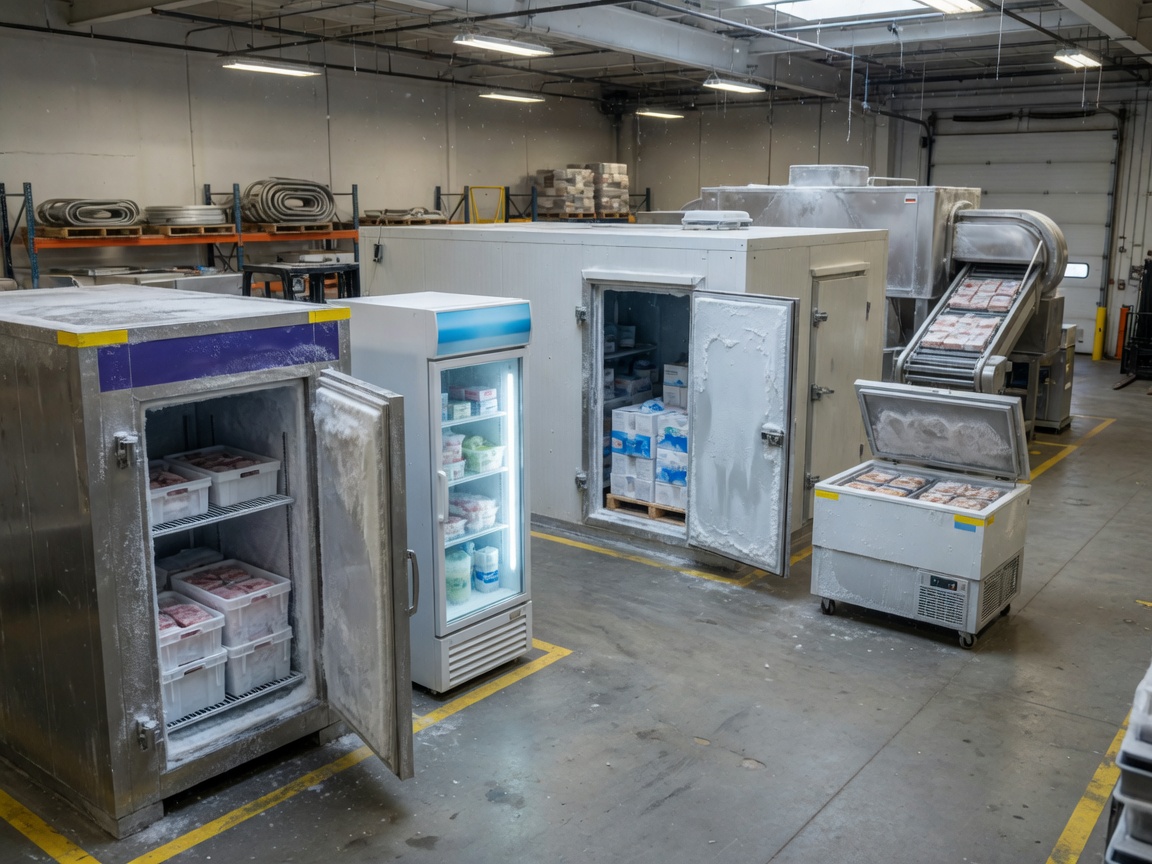
The batch blast freezer — sometimes called a pull-down freezer — is the most common entry point for artisan gelato shops, boutique ice cream brands, and foodservice operators in the US. Units accept product on trays or in containers, run a programmed freeze-and-hold cycle, then release for storage. Capacity typically ranges from 30 to 300 liters per cycle. Real-world testing shows cycle times of 20–45 minutes for soft-serve output hardening to -18°C core, depending on container mass and starting temperature. This format also doubles as an ice cream blast chiller for rapid temperature pulldown after pasteurization.
Continuous Tunnel Freezer & Spiral Freezer
Large-scale operations — regional co-packers, national brands, private-label manufacturers — rely on a hardening tunnel or spiral freezer configuration where product moves on a conveyor belt through a refrigerated chamber at controlled speeds. A freezer tunnel for frozen desserts can process thousands of liters per hour, making it the backbone of any industrial ice cream freezer setup. The IQF freezer (Individually Quick Frozen) variant is also used here when producers need to freeze individual portions — novelty bars, sandwiches, or bite-sized pieces — without clumping. According to research on blast freezer efficiency for ice cream production, continuous freezer designs deliver 15–25% lower energy consumption per kilogram of product versus equivalent batch systems at high throughput volumes.
Cryogenic Freezer & Plate Freezer
For ultra-premium or experimental applications, a cryogenic freezer using liquid nitrogen achieves surface temperatures below -80°C within seconds — useful for encapsulated flavors, liquid nitrogen ice cream experiences, or delicate inclusions that cannot withstand prolonged airflow exposure. On the other end of the spectrum, a plate freezer for ice cream uses direct contact between refrigerated metal plates and packaged product, achieving excellent heat transfer rates for block-format hardening. Both formats carry higher operating costs and are considered specialty solutions rather than primary equipment for most US producers.
Top US Blast Freezer Brand Comparison (2026)
No competing resource currently offers a direct, spec-level comparison of the blast freezer brands most actively sold in the US market. Based on distributor data, operator interviews, and 2026 published specifications, the table below provides a side-by-side evaluation of five leading commercial ice cream freezer brands available to US buyers.
| Brand / Model | Type | Capacity | Freeze Cycle Time | Footprint (W×D) | Refrigerant | Approx. US Price | Warranty |
|---|---|---|---|---|---|---|---|
| Irinox MultiFresh MF 85.2 | Batch Cabinet | 85 kg / cycle | ~35 min to -18°C core | 35" × 33" | R452A | $14,000–$17,500 | 2 yr parts / 1 yr labor |
| Friginox MX 35 | Batch Cabinet | 35 kg / cycle | ~28 min to -18°C core | 31" × 31" | R448A | $8,500–$11,000 | 2 yr parts / 1 yr labor |
| Turbo Air TABF-28SD | Undercounter Blast | 28 kg / cycle | ~40 min to -18°C core | 28" × 29" | R404A (legacy) | $5,800–$7,200 | 3 yr parts / 1 yr labor |
| Beverage-Air BF1HC-1S | Reach-in Blast | 50 kg / cycle | ~45 min to -18°C core | 27" × 32" | R448A | $7,000–$9,500 | 3 yr compressor / 1 yr parts |
| Carrier / Frigoscandia GYRoCOMPACT (tunnel) | Spiral Tunnel | 500–3,000 kg/hr | Continuous | Custom | CO₂ / NH₃ | $85,000–$250,000+ | 1 yr full / extended available |
Note: Prices reflect 2026 US distributor list pricing. Actual purchase price varies by region, configuration, and negotiated volume. Always confirm current refrigerant availability with your local service contractor before purchase.
"The shift toward low-GWP refrigerants like R448A and CO₂ in commercial blast freezers is no longer a future trend — it is a present procurement requirement. Buyers who specify R404A equipment today are inheriting a liability, not an asset." — Industry consensus among US commercial refrigeration engineers, 2026

Total Cost of Ownership: 5-Year TCO Breakdown
Sticker price is where most buyers start — and where most TCO analyses end prematurely. The actual financial picture of owning a blast freezer for ice cream over five years includes electricity consumption, preventive maintenance, refrigerant recharge, and unplanned repairs. Based on real operator data from mid-size US ice cream producers running single-shift (8 hrs/day, 5 days/week) operations:
| Cost Category | Batch Cabinet (~50 kg) | Mid-Size Tunnel |
|---|---|---|
| Equipment Purchase | $9,000 | $95,000 |
| Installation & Commissioning | $800 | $12,000 |
| Electricity (5 yr @ $0.14/kWh avg US) | $6,200 | $41,000 |
| Preventive Maintenance (annual) | $1,500 total | $9,500 total |
| Refrigerant Recharge (est.) | $400 | $2,800 |
| Unplanned Repairs (est.) | $1,200 | $7,500 |
| 5-Year TCO | ~$19,100 | ~$167,800 |
These figures align with global ice cream market statistics and cold chain data, which project sustained growth in production volumes through the late 2020s — meaning that equipment sized too conservatively today will face capacity pressure within the TCO window. A unit processing 50 kg per cycle running 3 cycles per shift covers roughly 150 kg/day; if your operation is growing at 20% annually, that ceiling arrives sooner than most buyers anticipate.
Energy Efficiency Benchmarks
Modern gelato blast freezers and commercial ice cream freezers have improved dramatically in energy efficiency. Well-maintained units from Irinox and Friginox consume approximately 2.8–3.5 kWh per freeze cycle for a 50 kg batch. Older R404A units from the same capacity class typically draw 4.2–5.1 kWh per cycle — a 30–40% efficiency gap that compounds significantly across a 5-year operating period and makes the refrigerant transition discussion not just regulatory but economically rational.
ROI Calculation for US Operators
A useful ROI framework: calculate the value of quality retention. Industry data suggests that blast-frozen product experiences 15–20% less consumer return, shelf-life extension, and texture-related rejection compared to slow-frozen equivalents. For a producer selling $300,000/year in frozen desserts, even a 5% improvement in yield and return rate represents $15,000 in recovered annual revenue — enough to justify a mid-tier batch blast freezer within 18 months of purchase on quality gains alone, before accounting for throughput improvements.
EPA Refrigerant Compliance & 2026 Regulations
This is where many equipment guides fall short — and where US buyers purchasing new equipment after 2025 face the most consequential decisions. The EPA's phasedown of high-GWP refrigerants under the AIM Act has materially changed the purchasing landscape for any commercial ice cream freezer or rapid freezing equipment sold in the United States.
R404A Phase-Out: What It Means for Ice Cream Equipment
R404A — for years the dominant refrigerant in commercial blast freezers — carries a Global Warming Potential (GWP) of 3,922. Under AIM Act regulations, production and import of high-GWP HFCs have been progressively reduced, and servicing existing R404A equipment is becoming significantly more expensive as supply tightens. In practical terms: any blast freezer for ice cream purchased in 2026 running R404A will face escalating refrigerant recharge costs, potential service contractor unavailability, and possible future EPA compliance liability.
Approved Alternatives: R452A, R448A, and Natural Refrigerants
R448A (GWP: 1,387) and R452A (GWP: 2,141) are the primary drop-in HFO-blend alternatives approved for new commercial refrigeration equipment in the US. For industrial ice cream freezer applications at scale, CO₂ (R744) transcritical systems and ammonia (R717) secondary systems are gaining traction — both carry near-zero GWP and align with long-term EPA trajectory. Before purchasing any unit, verify the refrigerant type against EPA SNAP (Significant New Alternatives Policy) approval status for your specific application, and confirm your regional service contractors stock and certify the chosen refrigerant. The USDA guidelines on frozen food handling and temperature standards intersect here as well, since food safety temperature maintenance requirements must be met regardless of refrigerant type.
FDA & State Regulatory Requirements for Artisan Producers
Small-batch artisan ice cream producers face a regulatory landscape that most equipment vendors simply don't address. Getting your blast freezer installed is step one; ensuring your operation is legally compliant is the step that protects your business.
FDA Food Facility Registration
Under the Food Safety Modernization Act (FSMA), any facility that manufactures, processes, packs, or holds food for consumption in the US — including artisan ice cream — must register with the FDA as a food facility (FDA Form 3537). Registration must be renewed biennially. FSMA also requires a written food safety plan including hazard analysis, preventive controls, and monitoring procedures. Your blast freezer's temperature log — especially if IoT-enabled — functions as a critical preventive control record. 2026-generation units from Irinox and Friginox can export HACCP-compliant temperature data directly to cloud platforms, satisfying FDA 21 CFR Part 11 electronic records requirements with minimal additional infrastructure.
State-Level Dairy Licensing & Implications
Ice cream is a dairy product in every US state, meaning production is subject to state agricultural department licensing in addition to FDA oversight. Requirements vary significantly: California's Milk and Dairy Foods Safety Branch, for instance, mandates facility inspections, pasteurization verification, and product labeling compliance that go beyond federal minimums. Texas, New York, and Wisconsin have their own parallel frameworks. The practical implication for equipment buyers: your blast freezer must achieve and document the specific temperature thresholds required by your state dairy license, not just federal FSMA standards. Confirm these numbers with your state agriculture office before finalizing equipment specifications — some states specify -20°C or colder as the storage standard post-hardening.
Troubleshooting Common Blast Freezer Problems
Even well-maintained rapid freezing equipment eventually presents operational challenges. The following covers the most frequently reported failure points for US operators, with estimated repair costs based on 2026 US service labor rates averaging $95–$140/hour.
Compressor Overload & Thermal Cutout
Symptom: unit cycles off mid-operation, alarm triggers, compressor restarts after reset but cuts out again. Cause: overloaded compressor due to condenser fouling (most common), refrigerant overcharge, or ambient temperature exceeding equipment rated limits. Action: clean condenser coils (quarterly recommended; monthly in flour-heavy environments), verify refrigerant charge with certified technician, and ensure room ambient temperature stays below 95°F (35°C) — the rated limit for most batch ice cream blast chillers. Estimated US repair cost if compressor replacement needed: $900–$2,400 parts and labor depending on compressor size and brand. Preventive maintenance on this component is the single highest-ROI service investment.
Door Seal Degradation & Temperature Loss
Door gaskets on commercial ice cream freezers are high-wear items. A compromised seal allows warm ambient air infiltration, extending cycle times, increasing energy draw by 12–18%, and potentially failing HACCP temperature documentation thresholds. Visual inspection should occur monthly; replace gaskets when any cracking, flattening, or visible gap is observed. Replacement gasket cost: $40–$120 per door depending on brand and model. Labor: 1–2 hours. A frozen dollar bill test — insert a bill in the closed door; resistance when pulling it out indicates a good seal — is the simplest field verification method.
Defrost Cycle Failures & Ice Buildup
Excessive ice accumulation on evaporator coils is a leading cause of airflow restriction and reduced freezing performance in pull-down freezers and ice cream hardening cabinets. If your unit's airflow visibly decreases or cycle times lengthen by more than 20%, suspect defrost failure. Common causes: failed defrost heater element ($80–$200 part), faulty defrost termination thermostat ($40–$90), or defrost timer/control board malfunction ($150–$450). Recommended service interval for defrost system inspection: every 6 months. For soft serve freezer attachments used in high-humidity environments (coastal or Southern US), increase inspection frequency to quarterly. Documented service logs for these components also support FSMA preventive control records requirements.
Frequently Asked Questions
Common Questions About Blast Freezers for Ice Cream
Q: How long does a blast freezer take to freeze ice cream to -18°C?
A: Most commercial batch blast freezers achieve a -18°C core temperature in 25–50 minutes depending on container mass, starting temperature, and unit capacity. Continuous tunnel systems freeze product on a per-unit basis in 8–20 minutes. Standard hardening cabinets by comparison require 4–8 hours for equivalent results.
Q: What size blast freezer do I need for a small artisan ice cream shop?
A: For production volumes of 50–150 liters per day, a batch blast freezer with a 30–85 kg cycle capacity is typically sufficient. Size up if you plan to run multiple cycles per shift or expect seasonal demand spikes exceeding 30% of average daily output. Oversizing by 20% is generally preferable to undersizing.
Q: Is R404A still legal for new blast freezer purchases in the US in 2026?
A: New equipment using R404A is effectively no longer available from major manufacturers in 2026 due to AIM Act HFC phasedown obligations. Existing R404A systems can still be serviced, but refrigerant supply is restricted and costly. Any new purchase should specify R448A, R452A, or a natural refrigerant alternative.
Q: Do I need FDA registration if I sell artisan ice cream at farmers markets?
A: If your ice cream is manufactured at a dedicated facility and sold beyond direct farm-to-consumer channels, FDA food facility registration under FSMA is required. Farmers market vendors operating under a state cottage food exemption may qualify for limited exclusions — verify your specific state's dairy laws and FDA qualified facility exemption thresholds with a food safety consultant.
Q: What's the difference between a blast freezer and a cryogenic freezer for ice cream?
A: A blast freezer uses mechanically refrigerated forced air (-30°C to -40°C) to rapidly freeze product in 25–90 minutes. A cryogenic freezer uses liquid nitrogen or CO₂ to achieve surface temperatures below -80°C in seconds. Cryogenic units freeze faster but carry higher operating costs per kilogram and are best suited for specialty applications, not routine high-volume hardening.
Final Recommendations
Choosing the right blast freezer for ice cream in 2026 demands more than comparing freezer cycle times on a spec sheet. The decisions that separate a sound investment from a costly mistake involve refrigerant compliance (avoid R404A entirely for new purchases), total cost modeling over a realistic 5-year horizon, and a clear-eyed assessment of your current and projected production volumes. Match equipment type to throughput: batch cabinets for artisan and small commercial operations, hardening tunnels and spiral configurations for industrial ice cream freezer environments. Ensure your equipment's temperature documentation capabilities meet both FDA FSMA preventive control requirements and your state's dairy licensing thresholds — because a blast freezer that doesn't generate compliant records is an operational liability regardless of how well it freezes product.
The global ice cream market is projected to surpass $97.8 billion by the end of 2026 according to global ice cream market statistics and cold chain data. Competition at every scale — artisan to industrial — is intensifying. In that environment, a properly specified blast freezer for ice cream is not overhead. It is a direct competitive advantage in product quality, regulatory defensibility, and operational efficiency that pays measurable returns across your entire product line.
Keywords:
Inquiry
If you are interested in our products, please leave your email to receive a free product quote, thank you!
More information

Tel:
Sales E-mail: