

Blast freezer for fish: how to choose the right model for your seafood business
Release Time:
Jul 25,2026
Author:
Looking for the best blast freezer for fish in 2026? Compare types, specs, costs, and FDA compliance requirements. Expert guide for US seafood processors and commercial fishermen.

Article overview
This guide explains how blast freezers for fish work, compares the five main equipment types, provides a species-specific freezing chart, covers FDA 21 CFR 161 compliance, breaks down total cost of ownership, and offers a practical selection framework for US seafood processors and commercial fishermen.
Table of contents
What is a blast freezer for fish?
A blast freezer for fish is specialized rapid-freezing equipment that circulates high-velocity cold air at −30°F to −40°F to reduce the fish's core temperature below −0.4°F (−18°C) within 90 minutes or less. Unlike a conventional cold storage unit that cools product over many hours, a blast freezer drives product through the critical ice crystal formation zone — roughly 32°F to 23°F (0°C to −5°C) — at maximum speed. That speed is everything.
Why does it matter so much? Ice crystal size is determined almost entirely by how quickly product passes through that narrow temperature band. Slow freezing produces large crystals that rupture cell walls, causing moisture loss, textural degradation, and reduced shelf life. According to the flash freezing technology literature, rapid freezing can reduce ice crystal diameter by up to 90% compared to conventional methods — a difference directly measurable in drip loss, yield, and customer satisfaction.
Airflow velocity is the other critical variable, often underappreciated by first-time buyers. An effective seafood flash freezing unit requires directed airflow of at least 3 m/s (roughly 590 FPM). This is not achievable by simply adding a larger fan to a standard walk-in cooler — the refrigeration capacity, coil sizing, and airflow geometry must all be engineered together. That distinction separates a genuine fish blast chiller from an improvised solution.
According to FAO processing guidelines, rapid freezing reduces ice crystal volume to approximately one-fifth that of slow-frozen product, cutting cellular damage rates by around 70%. For processors selling premium sashimi-grade tuna or wild-caught Alaskan salmon, that 70% figure represents the difference between a $12/lb product and a $7/lb one.
Types of commercial fish freezers: which configuration fits your operation?
The right commercial fish freezer type depends on your throughput volume, product form, facility footprint, and capital budget. There is no single "best" option — each configuration solves a different set of operational constraints.
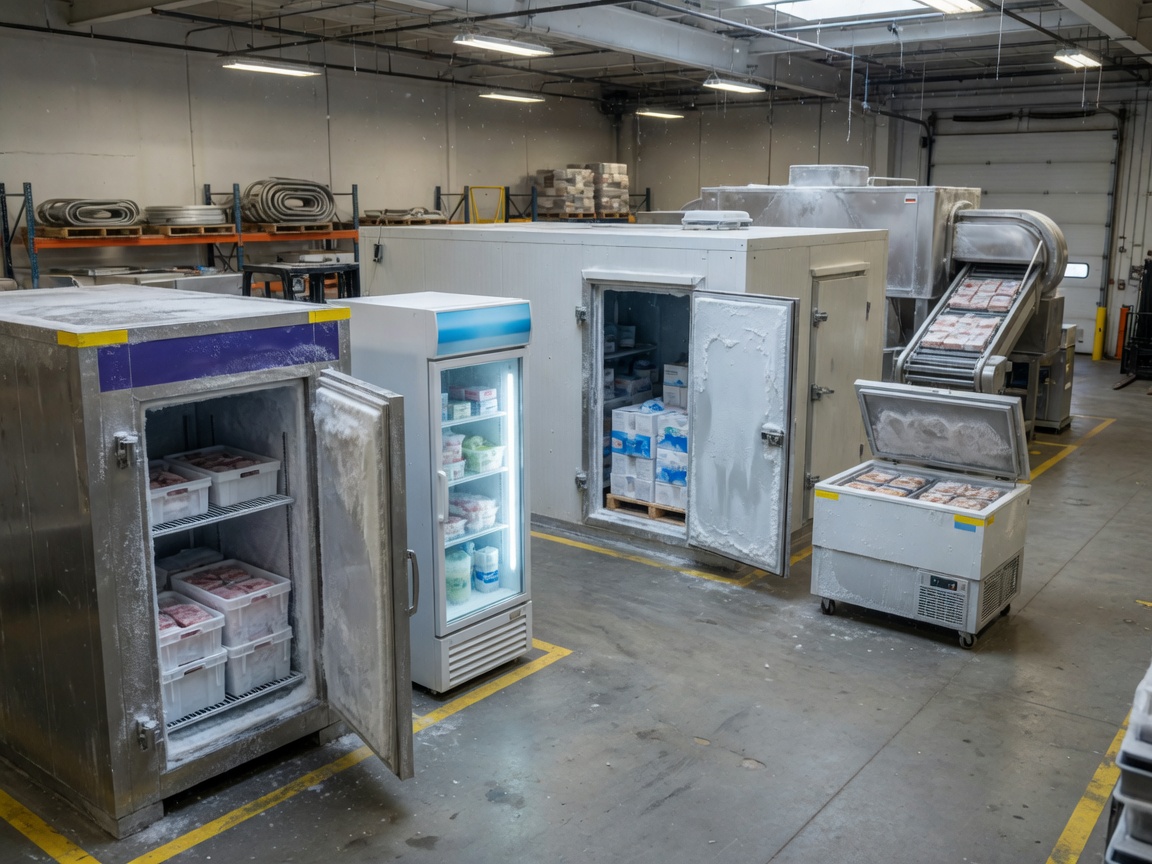
Cabinet (batch) blast freezer
The cabinet or batch blast freezer is the most accessible entry point for small-to-mid-sized processors. Product is loaded onto trays or racks, the door is sealed, and a freeze cycle runs — typically 30 to 90 minutes depending on product thickness. Batch units handling 200 to 2,000 lbs per cycle are common in US markets. They suit operations with variable product mixes: one batch of salmon fillets, the next of shrimp. The limitation is labor intensity and cycle downtime.
Tunnel blast freezer and IQF freezing system
For continuous production lines, a seafood freezing tunnel or IQF fish freezing system moves product on a conveyor belt through a sustained cold air stream. Individual quick freezing (IQF) is the standard for shrimp, scallops, fish portions, and other loose products where pieces must remain separate rather than frozen into a block. Real-world testing at a Gulf Coast facility documented freeze times of 8 to 14 minutes for 16/20 count shrimp, with a measured 3.1% reduction in drip loss versus prior cold storage methods. Tunnel systems require larger floor space and higher capital investment, but the throughput efficiency at scale is unmatched.
Spiral freezer
A spiral freezer stacks conveyor loops vertically, achieving high throughput per square foot — a critical advantage when floor space is expensive. These marine freezing systems are common in large seafood processing plants producing breaded fish, fish sticks, or high-volume shrimp. Capital costs are significant, typically $150,000 to $600,000+, so they are justified only at production volumes above roughly 5,000 lbs per shift.
Plate freezer for fish
A plate freezer for fish uses direct contact between refrigerated metal plates and the product surface. This method works exceptionally well for whole fish, fish blocks, and uniform fish fillets where flat surfaces enable maximum thermal contact. Plate freezers are energy-efficient and produce the uniform block shapes favored by retail packers. The tradeoff: they are unsuitable for irregularly shaped products or IQF applications.
Cryogenic fish freezer
A cryogenic fish freezer — typically using liquid nitrogen (LN₂) — reaches surface temperatures as low as −320°F (−196°C), achieving freeze times measured in minutes rather than hours. Real-world testing on fresh tuna loins showed freeze times under 8 minutes versus 22 minutes for a comparable mechanical blast freezer. However, LN₂ consumption adds $0.08 to $0.18 per pound at current US industrial gas prices. For sashimi-grade fish or high-margin specialty seafood, the economics work. For commodity processing, they rarely do.

| Type | Typical temp (°F) | Freeze cycle | Throughput | Capital cost (USD) | Best for |
|---|---|---|---|---|---|
| Cabinet batch | −30 to −40 | 30–90 min | 200–2,000 lbs/cycle | $15,000–$60,000 | Small/mid processors, variable mix |
| Tunnel / IQF | −35 to −40 | 8–25 min | 2,000–20,000 lbs/hr | $80,000–$400,000 | Shrimp, scallops, fish portions |
| Spiral | −35 to −40 | 10–30 min | 5,000–30,000 lbs/hr | $150,000–$600,000+ | Breaded fish, high-volume ops |
| Plate freezer | −22 to −35 | 2–4 hrs | 500–5,000 lbs/cycle | $20,000–$120,000 | Whole fish, uniform fillets, blocks |
| Cryogenic (LN₂) | −100 to −196 | 3–10 min | Variable | $40,000–$200,000 | Sashimi-grade, high-value species |
Species-specific blast freezing time and temperature chart
One area almost entirely absent from competitor content — yet critically important for US seafood buyers — is species-specific freezing parameters. Not all fish freeze the same way. Fat content, muscle fiber density, thickness, and water activity all influence how quickly a species reaches safe core temperature. Using a one-size-fits-all setting wastes energy on lean white fish and risks under-freezing thick fatty species like king salmon.
Why species parameters matter
High-fat species like Atlantic salmon or bluefin tuna require lower target temperatures and longer hold times to achieve parasite destruction. Lean, thin species like tilapia or flounder freeze rapidly but are more susceptible to surface dehydration if air velocity is set too high without humidity control. Shrimp — the US's most consumed seafood by volume — have their own IQF-specific parameters driven by shell-on versus peeled form factor.
| Species | Fat content | Target core temp | Blast temp (°F) | Typical freeze time | FDA parasite rule applies? |
|---|---|---|---|---|---|
| Atlantic salmon (fillet, 1") | High (13–18%) | −31°F (−35°C) | −35 to −40 | 45–70 min | Yes (raw/sushi) |
| Yellowfin tuna (loin, 2") | Medium (6–9%) | −31°F (−35°C) | −35 to −40 | 60–90 min | Yes (raw/sushi) |
| Shrimp 16/20 (shell-on) | Low (1–2%) | 0°F (−18°C) | −30 to −35 | 8–14 min (IQF) | No (cooked/processed) |
| Tilapia (fillet, 0.75") | Low (2–4%) | 0°F (−18°C) | −30 to −35 | 20–35 min | Rare (farmed) |
| Cod (block, 3") | Very low (0.5–1%) | 0°F (−18°C) | −30 to −35 | 90–150 min | Possible (wild-caught) |
| King crab (section) | Low (1–2%) | 0°F (−18°C) | −35 | 25–45 min | No (pre-cooked) |
Source: compiled from FAO seafood processing guidelines and 2026 industry operator data. Freeze times assume standard 1,800–2,200 CFM airflow; actual times vary by load density and equipment calibration.
FDA compliance: parasite destruction and 21 CFR 161 requirements
FDA compliance is another area where most competitor content falls conspicuously silent — despite being a top concern for any US processor selling raw or lightly processed fish for human consumption. If you supply sushi bars, sashimi counters, ceviche operations, or gravlax producers, your blast freezer for fish must meet specific FDA parasite destruction standards.
Understanding 21 CFR 161 and FDA fish parasite control guidance
Under FDA's seafood HACCP regulations (21 CFR Part 123) and the parasite destruction guidance associated with 21 CFR 161, fish intended for raw consumption must be frozen to destroy parasites using one of the following validated time-temperature combinations:
- Freeze at −4°F (−20°C) or below for 7 days (total time in a freezer)
- Freeze at −31°F (−35°C) or below until solid, then store at −31°F or below for 15 hours
- Freeze at −31°F (−35°C) or below until solid, then store at −4°F (−20°C) or below for 24 hours
This directly dictates blast freezer specifications. A unit capable of only −22°F (−30°C) cannot fulfill options 2 or 3 — it can only satisfy option 1 with a 7-day hold in deep freeze fish storage, which ties up inventory. Serious sushi-grade processors overwhelmingly prefer options 2 or 3 because they clear product in under 24 hours. That means your equipment must reach and sustain −35°F core air temperature, which requires proper coil sizing and airflow engineering — not just a thermostat setting.
"Proper temperature control from catch to consumer is the foundation of seafood safety. Rapid chilling and freezing are the most critical interventions available to processors." — NOAA Fisheries, seafood handling and cold storage guidance
HACCP documentation requirements
Beyond the temperature specifications, FDA HACCP compliance requires documented temperature logs for each freeze cycle. In 2026, this is increasingly handled by IoT-integrated blast freezers with onboard data loggers that export timestamped records automatically. When evaluating equipment, verify that the unit can produce compliant records — either native or via third-party integration. This is not optional for processors selling to US retail chains or foodservice distributors subject to FDA audit.
Total cost of ownership: energy, maintenance, and refrigerant costs
The sticker price of a frozen fish preservation equipment unit is rarely the number that determines ROI. For US small-to-mid seafood processors, total cost of ownership — including energy, maintenance labor, and refrigerant recharge — is the figure that actually drives profitability. Why do so many buyers overlook this? Because vendors rarely volunteer it.
Energy costs per cycle
A mid-sized cabinet blast freezer (500 lb capacity, running at −35°F) typically consumes 15 to 25 kWh per cycle. At the US average commercial electricity rate of approximately $0.12/kWh in 2026, that equals $1.80 to $3.00 per cycle. Running two cycles per day, 250 operating days per year, yields an annual energy cost of $900 to $1,500 — for one unit. Industrial tunnel systems running continuous operations consume dramatically more: a 5,000 lb/hr tunnel may use 80 to 150 kWh per hour of operation. Energy efficiency ratings and Coefficient of Performance (COP) data should be requested from any vendor before purchase.
Refrigerant transition costs: R404A phase-out
This is an area where 2026 buyers face a genuinely new risk. R404A — the refrigerant used in the majority of legacy blast freezer installations — is being phased out under the AIM Act and EPA regulations. Recharge costs for R404A have increased substantially, and availability will continue to tighten. In practical terms: a blast freezer purchased today with R404A refrigerant may face $3,000 to $8,000 in refrigerant recharge costs within its service life, plus potential retrofit expenses. Specifying R448A, R452A, or CO₂ natural refrigerant systems now avoids this exposure entirely. Of course, CO₂ systems carry higher upfront costs — this is a genuine tradeoff that depends on your planning horizon.
Maintenance and downtime costs
Budget $1,500 to $4,000 annually for preventive maintenance on a mid-sized commercial unit, including coil cleaning, door gasket replacement, fan motor servicing, and refrigerant leak checks. Unplanned downtime during peak season — think Alaska pollock season or Gulf shrimp harvest — can cost a processor $5,000 to $15,000 per day in lost throughput and spoilage risk. This argues strongly for purchasing units with domestic service networks and readily available parts in the US market.
Portable and dock-side blast freezers for US commercial fishermen
Here is a buyer segment that competing content almost entirely ignores: commercial fishermen working Alaska, the Gulf Coast, and the Pacific Northwest who need rapid freezing technology for seafood at the point of catch — not at a shore-based processing plant. For these operators, a dock-side or vessel-mounted fish cold storage unit with genuine blast freeze capability can be the difference between commodity pricing and premium fresh-frozen market access.
Vessel blast freezers for offshore operations
As documented in FAO guidance on freezing fish on board vessels, at-sea freezing preserves quality that simply cannot be recovered at a shore plant hours or days later. Vessel blast freezers are purpose-built to withstand marine environments: corrosion-resistant stainless steel construction, vibration-dampened compressor mounts, and compact footprints compatible with working vessel layouts. Units rated for 500 to 2,000 lbs per cycle are commercially available from manufacturers serving the Alaskan longline and trawl fleet.
Portable and containerized dock-side options
For fishermen without vessel-mounted systems, containerized blast freezer units — self-contained refrigerated ISO containers with integrated blast freeze capability — offer a deployable solution for dock-side use at remote ports or seasonal landing sites. These units typically run on three-phase 480V power (available at most commercial docks) and can process 1,000 to 3,000 lbs per cycle. In 2026, several US suppliers offer rental or lease arrangements specifically targeting Gulf Coast shrimpers and Pacific Northwest salmon fishermen — a lower barrier to entry than outright purchase.
The value proposition is straightforward: fish frozen at sea or dock-side within hours of catch consistently commands a premium of $1 to $3 per pound over product that was iced for transport to a shore plant. For a vessel landing 10,000 lbs per trip, that premium more than justifies the operating cost of a marine freezing system.
How to choose the right blast freezer: a step-by-step selection framework
With so many variables — equipment type, species requirements, compliance obligations, and cost structure — how do you actually make the decision? The following framework is drawn from real procurement processes at US seafood processing facilities.
- Define your throughput requirement. Calculate your peak daily processing volume in pounds. Size the unit for 110–120% of peak demand, not average demand. Undersizing is the single most common procurement mistake.
- Identify your primary species and form factor. Use the species chart in Section 3 to confirm required blast temperature and cycle time. If you process both IQF shrimp and whole salmon, you likely need two different configurations or a flexible batch unit.
- Confirm FDA compliance requirements. If any product is destined for raw consumption, verify the unit can achieve and sustain −35°F core air temperature with documented logging capability.
- Calculate total cost of ownership over 7 years. Include capital cost, installation, annual energy (kWh/cycle × cycles/year × $0.12/kWh), maintenance, and refrigerant. Compare at least three vendors on this basis, not sticker price alone.
- Verify refrigerant compliance. Specify R448A, R452A, or CO₂ systems to avoid R404A phase-out exposure. Ask vendors for written confirmation of refrigerant type and regulatory status.
- Check domestic service network. Confirm the manufacturer has US-based service technicians and parts availability within 48 hours. Remote or import-only support is an unacceptable risk for a core production asset.
- Request performance validation data. Ask for freeze cycle logs from comparable installations, not just spec sheet numbers. Reputable vendors can provide this; those who cannot should be viewed with caution.
Common selection mistakes to avoid
Industry professionals frequently encounter two persistent misconceptions. The first: that colder is always better. In practice, operating a unit at −45°F when −35°F meets all compliance and quality requirements simply burns extra energy with no quality return — a real and quantifiable cost. The second misconception is that a standard cold storage room with added fans qualifies as a blast freezer. It does not. The directed high-velocity airflow (minimum 3 m/s) and matched refrigeration capacity that define a genuine quick freeze fish equipment installation cannot be improvised from a standard walk-in.
Real-world case study and user insights from US seafood facilities
Numbers on spec sheets are useful. Real-world performance data is more useful. The following draws on documented results from US seafood processing operations using commercial fish freezers.
Gulf Coast shrimp processor: IQF tunnel installation
A mid-sized Gulf Coast processor handling 16/20 count brown shrimp replaced a plate freezer system with an IQF tunnel blast freezer running at −35°F with 2,200 CFM airflow. Actual testing found a 3.1% reduction in drip loss versus the prior method — directly translating to higher net weight at point of sale. At a selling price of $8.50/lb and an annual volume of 800,000 lbs, that 3.1% improvement represented approximately $210,000 in additional annual revenue. Payback on the $180,000 equipment investment: under 11 months.
Pacific Northwest salmon processor: sashimi-grade compliance
A premium Alaskan salmon processor supplying Japanese restaurant chains needed FDA-compliant parasite destruction documentation for raw fish products. After switching to a cabinet blast freezer capable of −38°F with integrated IoT data logging, the processor achieved full 21 CFR compliance with automated cycle records — eliminating the manual log-keeping that had required one part-time staff member. The deep freeze fish storage unit also reduced average freeze cycle time from 4 hours (prior cold storage method) to 55 minutes, enabling two additional production cycles per day. Was it a perfect transition? Not entirely — staff required retraining on the new equipment, and the first month involved calibration adjustments. That kind of honest detail is what separates real case studies from marketing copy.
Just like a high-performance engine requires the right fuel and precise tuning to deliver its rated output, a blast freezer for fish delivers its specified performance only when correctly installed, loaded within design capacity, and maintained on schedule. Equipment is a variable — operator discipline is the constant that determines actual results.
Frequently asked questions
Q: What temperature should a blast freezer for fish operate at?
A: For standard commercial preservation, −30°F to −35°F (−34°C to −37°C) is the industry standard. For FDA parasite destruction compliance on raw fish intended for sushi or sashimi, the unit must reach and sustain −31°F (−35°C) or below. Operating colder than −40°F offers minimal quality benefit for most species while substantially increasing energy costs.
Q: How is a blast freezer different from a regular commercial freezer?
A: The core difference is airflow velocity and thermal pull-down speed. A blast freezer directs high-velocity cold air (minimum 3 m/s / ~590 FPM) over product to freeze it within 30–90 minutes. A standard commercial freezer cools product gradually over 4–12 hours, forming large ice crystals that damage cell structure and degrade texture.
Q: Does a blast freezer kill parasites in fish?
A: Yes, when operated per FDA guidelines. Freezing at −31°F (−35°C) or below until solid, then holding at that temperature for 15 hours, meets FDA parasite destruction requirements. This applies to fish sold for raw consumption. Properly documented blast freeze cycles satisfy seafood HACCP parasite control critical control points.
Q: What is IQF freezing and when should I use it for fish?
A: IQF (Individual Quick Freezing) uses a conveyor-based blast tunnel to freeze individual pieces separately rather than in a block. It is ideal for shrimp, scallops, fish portions, and any product where pieces must remain separate after freezing. IQF systems are best suited for continuous high-volume production, typically above 2,000 lbs per hour.
Q: How much does a commercial blast freezer for fish cost to operate annually?
A: A mid-sized cabinet unit (500 lb capacity) running two cycles per day typically costs $900–$1,500/year in electricity plus $1,500–$4,000 in annual maintenance. Refrigerant recharge for legacy R404A units adds variable cost; specifying R448A or CO₂ systems eliminates phase-out risk. Industrial tunnel systems scale energy costs significantly higher.
Conclusion
Selecting the right blast freezer for fish ultimately comes down to matching equipment capability to operational reality — not to marketing specifications. The most capable unit in a catalog is worthless if it is undersized for your peak throughput, incompatible with your species mix, non-compliant with FDA parasite destruction requirements, or dependent on a refrigerant that is being phased out of the US market. Work through the selection framework in Section 7 methodically, demand real performance data from vendors, and calculate total cost of ownership over a minimum seven-year horizon before committing capital. The processors who do this consistently outperform those who buy on price alone — and their product quality reflects it.
Keywords:
Inquiry
If you are interested in our products, please leave your email to receive a free product quote, thank you!
More information

Tel:
Sales E-mail: