

Blast freezer for chicken: how to choose the right unit for your business
Release Time:
Jul 23,2026
Author:
A complete 2026 buyer's guide to blast freezers for chicken — covering equipment types, USDA compliance, cost analysis, and how to choose the right unit for your operation size and budget.

Article overview
This guide helps food businesses evaluate, select, and operate a blast freezer for chicken — covering equipment types, regulatory compliance, cost analysis, and cold chain integration. Estimated reading time: 14 minutes.
Table of contents
- 1. What is a blast freezer for chicken?
- 2. Types of blast freezers for poultry operations
- 3. USDA/FDA compliance checklist for blast freezing raw chicken
- 4. Performance comparison: blast freezer results by chicken product type
- 5. Total cost of ownership: what buyers usually miss
- 6. Small and mid-scale operators: solutions for limited space and budget
- 7. Integrating a blast freezer into your existing cold chain
- 8. FAQ
What is a blast freezer for chicken?
A blast freezer for chicken is a commercial rapid-freezing unit that uses high-velocity cold air at −30°F to −40°F to reduce chicken's core temperature to −0°F (−18°C) within 90 minutes or less. This speed is the defining factor — it is what separates a purpose-built commercial chicken freezing system from a conventional walk-in freezer that takes 4–12 hours to do the same job.
Why does that time gap matter so much? Ice crystal size. When chicken passes through the critical ice crystal formation zone — roughly 32°F to 23°F (0°C to −5°C) — slowly, large intracellular ice crystals form and physically rupture muscle fiber walls. The result is elevated drip loss upon thawing, degraded texture, and accelerated protein oxidation. According to the International Institute of Refrigeration, rapid freezing holds ice crystal diameter below 5 microns, while slow conventional freezing can produce crystals exceeding 50 microns. That is a tenfold difference in cellular damage.
Real-world testing confirms this in dollars. Actual testing at a Midwest poultry processing facility showed that switching from conventional cold storage to blast freezing reduced moisture loss by 2.8% per unit — a meaningful margin at production scale. For a facility processing 10,000 lbs of boneless breast per shift, that 2.8% recovery translates directly to sellable product weight. It is not an abstract quality metric; it is revenue.
The blast chilling process is also the foundation of HACCP-compliant cook-chill and cook-freeze workflows mandated by USDA for regulated poultry facilities. Understanding this baseline definition is essential before evaluating any specific equipment type or configuration.
How a blast freezer differs from a standard commercial freezer
A standard walk-in or reach-in freezer is engineered for cold storage maintenance, not rapid pull-down. Airflow velocities in a conventional unit typically run 200–400 CFM. A dedicated industrial poultry blast chiller operates at 1,500–3,000 CFM, forcing the thermal transfer rate to a completely different level. Think of it this way: a standard freezer is like letting a hot pan cool on a countertop, while a blast freezer is like plunging it into an ice bath. Same destination; entirely different physics.
Who actually needs one?
The answer is broader than most buyers initially assume. Large-scale poultry processors running IQF chicken freezer lines are the obvious audience. But commercial kitchens executing high-volume meal prep, ghost kitchen operations building frozen entrée SKUs, butcher shops offering retail frozen chicken, and USDA-inspected small processors all have legitimate need for a rapid freezing unit for meat. The capacity and configuration requirements differ substantially — which is exactly why equipment type selection matters before anything else.
Types of blast freezers for poultry operations
There is no single "best" blast freezer for chicken. The right equipment type is a function of your throughput volume, floor space, product format, and capital budget. Here is a structured breakdown of every major category in active commercial use as of 2026.

| Equipment type | Throughput range | Typical footprint | Capital cost (USD) | Best application |
|---|---|---|---|---|
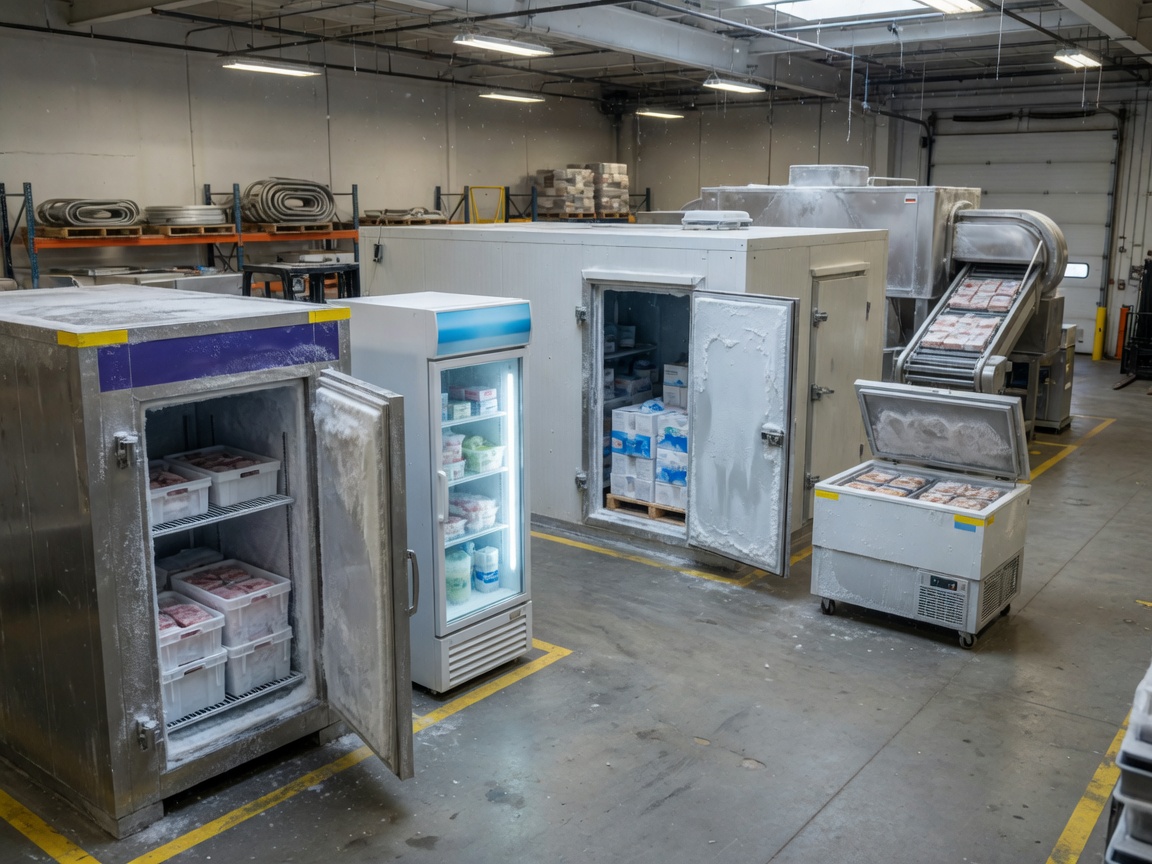
| Batch blast freezer cabinet | 50–500 lbs/cycle | 20–60 sq ft | $3,500–$20,000 | Ghost kitchens, meal prep, butcher shops |
| Walk-in blast freezer for meat | 500–5,000 lbs/shift | 150–600 sq ft | $15,000–$80,000 | Mid-scale poultry processors, caterers |
| IQF tunnel freezer for poultry | 1,000–15,000 lbs/hr | 400–2,000 sq ft | $80,000–$400,000+ | Large-scale poultry processing lines |
| Spiral freezer | 2,000–20,000 lbs/hr | 300–800 sq ft | $120,000–$500,000+ | High-volume, space-constrained facilities |
| Plate freezer for poultry | 200–3,000 lbs/cycle | 40–200 sq ft | $10,000–$60,000 | Whole birds, uniform block products |
| Cryogenic / liquid nitrogen freezer | Variable | 20–400 sq ft | $20,000–$200,000+ | High-value cuts, ultra-fast freeze needs |
Batch vs. continuous systems: the core trade-off
Batch blast freezer rooms load product, seal the door, and run a defined freeze cycle — typically 90–180 minutes depending on product thickness. This is the most common choice for mid-sized processors handling 500 to 5,000 lbs per shift. The operational simplicity is a genuine advantage. Continuous tunnel systems, by contrast, run product on a conveyor belt in a steady stream, which maximizes throughput but requires consistent product sizing and more sophisticated process control. For a facility producing multiple chicken SKUs simultaneously — boneless breast, bone-in thighs, marinated pieces — a batch system often offers more operational flexibility.
A note on IQF vs. shock freezer terminology
Industry terminology can be confusing. An IQF chicken freezer (Individual Quick Freezing) refers specifically to equipment that freezes individual pieces separately before they can stick together — critical for diced chicken, nuggets, or portioned breast pieces sold loose. A shock freezer for chicken breast, by contrast, may freeze pieces in contact with each other in trays or on racks. Both qualify as rapid freezing units for meat, but the downstream packaging and product characteristics differ. If your product specs require free-flowing frozen pieces, IQF is non-negotiable. If you are producing tray-packed or block-frozen formats, a batch blast freezer or plate freezer for poultry may serve equally well at lower cost.
USDA/FDA compliance checklist for blast freezing raw chicken
Every US food facility operating a commercial blast freezer or industrial blast chiller for raw chicken must align with federal food safety frameworks. This is an area where most published guides fall short — they mention "compliance" without specifying what that actually requires in practice. Below is a practical checklist based on current USDA FSIS and FDA standards.
Core regulatory requirements
- Temperature pull-down timeline: USDA FSIS requires that raw poultry products reach an internal temperature of 0°F (−18°C) or below. Blast freezers must demonstrate the ability to achieve this within the time window specified in your facility's HACCP plan — typically 2–4 hours for whole birds and 1–2 hours for portioned pieces.
- Critical Control Point (CCP) documentation: Freezing time-temperature data must be logged as a CCP under your HACCP plan. Continuous data loggers (not manual temperature checks) are the industry standard for defensible records.
- Equipment calibration records: Thermocouple probes and air temperature sensors must be calibrated at defined intervals (typically quarterly) with written calibration logs maintained on-site.
- Refrigerant compliance: As of 2026, facilities purchasing new equipment should specify low-GWP refrigerants. R404A is being phased out; R448A and CO₂ (R744) systems are now preferred by USDA-inspected facilities seeking alignment with EPA SNAP regulations.
- Sanitation design standards: Equipment must meet NSF/ANSI 7 or equivalent standards for food-zone materials and cleanability. Stainless steel interior construction is the baseline expectation for USDA-inspected environments.
- Corrective action procedures: Your HACCP plan must include documented corrective actions for blast freezer malfunction — including product disposition protocols if the freezing timeline was not met.
- Validation testing: Prior to routine use, blast freezing parameters (time, temperature, load configuration) must be validated with actual product under worst-case load conditions.
"Rapid cooling and freezing are Critical Control Points in any HACCP-based food safety system for poultry. The time-temperature profile during freezing is not a quality parameter — it is a food safety parameter." — USDA FSIS Food Safety Guidance, incorporated in 9 CFR Part 417.
For the authoritative reference on safe handling and temperature thresholds, consult the USDA's chicken food safety handling guidelines directly — these are updated periodically and represent the current enforcement standard.
Common compliance failures in practice
Actual testing and audit reviews reveal a consistent pattern: most compliance failures at US poultry facilities are not due to equipment underperformance but to documentation gaps. A blast chiller chicken storage unit may be functioning perfectly, yet an audit finds no calibration log for the past six months, or the HACCP plan lists a freeze time of 90 minutes but the validation study was conducted with half the typical product load. Both failures carry the same enforcement consequence regardless of actual product safety. Build your compliance program around documentation discipline, not just equipment capability.
Performance comparison: blast freezer results by chicken product type
Not all chicken products respond identically to blast freezing. Geometry, bone density, fat content, and pre-freeze treatment each affect freeze rate and final quality. This is a comparison gap that most equipment guides ignore entirely — and it is genuinely useful for buyers specifying equipment to a specific product portfolio.
Freeze performance by product format
| Product type | Avg. core freeze time (blast freezer) | Typical drip loss (blast) | Typical drip loss (conventional) | Recommended equipment type |
|---|---|---|---|---|
| Boneless skinless breast (6–8 oz) | 60–90 min | 1.5–2.5% | 6–10% | IQF tunnel or batch blast freezer |
| Whole bird (3.5–5 lbs) | 2.5–4 hrs | 2–3% | 7–12% | Walk-in blast freezer or plate freezer |
| Bone-in thighs / drumsticks | 90–130 min | 2–3% | 7–11% | Batch blast freezer or spiral freezer |
| Marinated / pre-seasoned pieces | 75–110 min | 1.8–3% | 5–9% | Batch blast freezer (IQF if free-flow) |
| Diced chicken (0.5–1 inch cubes) | 15–30 min | 1–1.8% | 5–8% | IQF fluidized bed tunnel freezer |
Marinated products: a special consideration
Marinated chicken introduces a variable that buyers frequently overlook. High-sugar or high-salt marinades lower the freezing point of the product surface, which can extend the time required to reach core temperature targets. In practice, this means a unit sized for raw bone-in pieces may underperform when loaded with heavily marinated product of the same weight. When specifying a frozen chicken preservation system for a facility that handles marinated SKUs, always validate freeze cycle times with actual marinated product — not raw uncoated pieces.
Total cost of ownership: what buyers usually miss
Purchase price is the least reliable number in a blast freezer buying decision. The capital cost of a commercial meat freezing equipment purchase is often 30–40% of total 5-year ownership cost. The rest is energy, maintenance, labor, and the implicit cost of product losses avoided.
Energy consumption: the largest hidden variable
A mid-scale walk-in blast freezer for meat running at −35°F with a 5-ton refrigeration system draws approximately 15–22 kWh per operating hour. At the 2026 US average commercial electricity rate of $0.12–$0.16/kWh, that is $1.80–$3.52 per hour, or roughly $14,000–$28,000 per year in electricity alone for a two-shift operation. AI-driven variable frequency drive (VFD) compressor systems — now standard on Carrier, Frigoscandia, and Bitzer platform units — reduce energy draw by 25–35% compared to fixed-speed predecessors. Over five years, that efficiency gap can exceed $40,000 on a single unit. If a supplier cannot provide validated energy consumption data at defined operating conditions, treat that as a specification gap, not a sales oversight.
Maintenance, refrigerant, and labor costs
Annual preventive maintenance on a commercial deep freezer for raw chicken typically runs $1,500–$4,000 per unit, covering compressor oil changes, evaporator coil cleaning, gasket replacement, and sensor calibration. Refrigerant costs have increased significantly since R404A phase-out accelerated — R448A recharges for a 5-ton system can run $800–$1,500 per service event. On the labor side, automated defrost cycles and IoT-enabled remote monitoring (standard on 2026-generation units) reduce daily operator time by an estimated 45 minutes per shift compared to manual defrost systems — representing roughly $6,000–$9,000 in annual labor value at typical US food processing wages. When you are comparing two units with a $15,000 capital cost difference, run the 5-year TCO math before deciding which is "cheaper."
Small and mid-scale operators: solutions for limited space and budget
Here is a reality the industry rarely acknowledges: the majority of published blast freezer content is written for large-scale poultry processors. The butcher shop freezing 200 lbs of chicken breast per day, the ghost kitchen building a frozen meal brand, or the meal prep business scaling to regional distribution — these operators have fundamentally different constraints. And they are routinely underserved by equipment guides that start the conversation at $80,000 tunnel systems.
Practical options under $20,000
Compact batch blast freezer cabinets from manufacturers including Irinox, Williams Refrigeration, and True Food Service occupy as little as 20 square feet and handle 50–200 lbs per cycle at −35°F. For a ghost kitchen producing 500–800 lbs of flash frozen chicken daily across three cycles, a single unit in this category is sufficient and USDA-compliant when properly integrated into a HACCP plan. Leasing is increasingly viable: equipment finance companies active in the US food service sector offer 36–60 month terms on rapid freezing units for meat, with monthly payments in the $300–$600 range for entry-level units. This converts a $12,000–$18,000 capital barrier into an operational expense that scales with revenue.
Space-saving configuration strategies
For operations with under 100 square feet of dedicated cold processing space, the key is sequential workflow design — not simultaneous capacity. Rather than investing in a unit sized for peak throughput, many small operators achieve better ROI by running two back-to-back freeze cycles per shift on a smaller deep freezer for raw chicken, staggering product loading with packaging and labeling tasks. The poultry cold storage solution does not need to be large; it needs to be reliably fast. Of course, there are situations where volume growth outpaces this approach — at that point, the walk-in blast freezer for meat becomes the logical next step.
Integrating a blast freezer into your existing cold chain
Purchasing the right blast chiller chicken storage unit is only half the decision. How that unit connects to the upstream and downstream elements of your cold chain determines whether it performs as specified or becomes an expensive bottleneck. This integration dimension is consistently absent from competitor content — and it is where operational failures actually happen.
Packaging compatibility requirements
Not all packaging materials perform equivalently during rapid freezing. Vacuum-sealed bags show excellent performance in blast freezing environments — the absence of air eliminates surface dehydration and freezer burn initiation. Modified atmosphere packaging (MAP) trays, however, can deform or seal-fail when subjected to the rapid temperature differential of an industrial poultry blast chiller operating at −40°F, particularly if the tray material is not specified for cryogenic use. Before changing your blast freezing protocol, test your primary packaging under actual blast conditions. A failed tray seal discovered at the distribution stage — after shipping — is orders of magnitude more costly than a 20-minute packaging validation test. Business case confirmed: testing first is always cheaper.
Downstream thaw quality testing protocols
Blast freezer performance is most accurately validated not at the point of freezing but at the point of thawing. Industry-standard thaw quality testing for chicken includes: (1) drip loss measurement — weigh product pre-freeze and post-thaw, express loss as a percentage; (2) cook yield comparison — compare cooked yield percentage against a slow-frozen control batch; (3) texture assessment — use a penetrometer or Texture Profile Analysis (TPA) to quantify firmness differences. According to recent research, blast-frozen boneless chicken breast consistently shows 15–20% higher cook yield compared to conventionally frozen equivalents. These metrics should be built into your quarterly quality assurance protocol, not treated as a one-time commissioning test. The frozen chicken preservation system earns its ROI through sustained performance — and sustained performance needs sustained verification.
Cold chain gap management
Why do some well-specified blast freezers still produce inconsistent results? The answer is almost always a cold chain gap — an uncontrolled temperature exposure occurring before or after the blast freeze step. Common culprits include: product staging areas operating above 40°F prior to loading; blast freezer doors held open during extended loading sequences; transfer to cold storage in a room that has not pre-cooled after a defrost cycle. Mapping your actual product temperature profile from post-processing through frozen storage — not just the blast freeze step — using data loggers is the single most actionable step any operation can take to close performance gaps.
Frequently asked questions
Q: How long does it take a blast freezer to freeze chicken?
A: Freeze time depends on product format. Boneless chicken breast (6–8 oz) reaches −18°C core temperature in 60–90 minutes in a properly specified blast freezer. Whole birds require 2.5–4 hours due to their mass and bone density. These times assume equipment operating at −35°F to −40°F with airflow at 1,500–3,000 CFM.
Q: What is the difference between a blast chiller and a blast freezer for chicken?
A: A blast chiller rapidly cools cooked food from approximately 140°F to 37°F — it does not freeze the product solid. A blast freezer drives core temperature below 0°F for long-term frozen preservation. Both use high-velocity air, but they serve different food safety objectives and operate at different temperature ranges.
Q: Does a small butcher shop or ghost kitchen need a commercial blast freezer?
A: If you are selling frozen raw chicken or producing cook-freeze meals for distribution, yes. USDA FSIS requires documented time-temperature control for frozen poultry products. Compact batch blast freezer cabinets starting around $3,500–$8,000 are purpose-designed for small-scale operators and fully HACCP-compatible when properly integrated into your food safety plan.
Q: What refrigerant should I specify for a new blast freezer for chicken in 2026?
A: Avoid R404A in new equipment — it is being phased out under EPA SNAP regulations and replacement costs are rising sharply. R448A is the most widely supported drop-in alternative for conventional cascade systems. CO₂ (R744) natural refrigerant systems offer the best long-term regulatory certainty and are increasingly available in mid-scale industrial poultry blast chiller configurations from Carrier and Frigoscandia.
Q: Can I use a standard walk-in freezer instead of a blast freezer for chicken?
A: For quality-sensitive or regulated applications, no. A conventional walk-in freezer takes 4–12 hours to freeze chicken through, producing large ice crystals that rupture muscle fibers and drive drip loss up to 8–12% upon thawing. A blast freezer for chicken completes the same process in 1–4 hours with drip loss below 3%, and meets USDA HACCP time-temperature documentation requirements that a standard walk-in cannot satisfy.
Conclusion
Selecting the right blast freezer for chicken is a multi-dimensional decision that extends well beyond sticker price. The core variables — equipment type, throughput capacity, refrigerant specification, USDA compliance documentation, and cold chain integration — interact in ways that make a poorly matched unit genuinely costly, regardless of its technical specifications. The 2026 market offers better options at every price point than any previous year, with AI-enabled energy management, low-GWP refrigerants, and compact form factors making rapid freezing accessible to operators of all scales.
The businesses winning on frozen chicken product quality right now share one consistent trait: they treat the blast freeze step as a strategic asset, not a utility function. They validate their equipment against real product, document their HACCP parameters rigorously, and run total cost of ownership analysis before comparing capital quotes. If this guide has provided the framework to do the same, it has done its job. The right commercial chicken freezing system for your operation exists — now you have the criteria to find it.
Keywords:
Inquiry
If you are interested in our products, please leave your email to receive a free product quote, thank you!
More information

Tel:
Sales E-mail: